Boswellia vs Turmeric
Boswellia blocks 5-LOX. Turmeric targets COX-2. They hit different inflammatory pathways — here's when each wins and when you need both.
Ingredients in this letter

TL;DR
- Boswellia and turmeric (curcumin) are not competitors - they target different inflammatory pathways. Boswellia inhibits 5-LOX (leukotrienes). Curcumin modulates COX-2 (prostaglandins).
- Choosing one over the other leaves an entire inflammatory cascade unaddressed. That is why people often feel partial relief from either ingredient alone.
- Both have absorption challenges. Curcumin is notoriously poorly absorbed without piperine. Boswellia requires standardized extraction to deliver meaningful AKBA levels.
- Clinical research supports using them together for broader inflammatory pathway coverage than either provides alone.
- Bottom line: The question is not boswellia or turmeric - it is boswellia and turmeric, dosed correctly and formulated for absorption.
If you are comparing boswellia vs turmeric, the answer is not either/or. These two ingredients target fundamentally different inflammatory enzymes - boswellia inhibits 5-lipoxygenase (5-LOX), while curcumin modulates cyclooxygenase-2 (COX-2). They reduce different inflammatory mediators through separate biological mechanisms. Choosing one means the other pathway continues unchecked. The research-supported approach is using both, which is why LanFam Health's Complete Inflammation Support includes curcumin with piperine and boswellia serrata together in the same formula - not as redundant ingredients, but as complementary pathway coverage.
This comparison will walk through what each ingredient actually does, where the science diverges, and why the "which is better" framing misses the point entirely.
Quick Comparison: Boswellia vs Curcumin
Boswellia SerrataTurmeric (Curcumin)
Active compound
Boswellic acids (AKBA)
Curcuminoids
Primary pathway
5-LOX inhibition
COX-2 modulation
Inflammatory mediator reduced
Leukotrienes
Prostaglandins
Absorption challenge
Requires standardized extract with high AKBA content
Extremely poor without piperine (~1-2% absorption alone)
Timeline to results
4-8 weeks in clinical trials
4-8 weeks in clinical trials
Best for
Joint comfort, 5-LOX-driven inflammation, gut integrity
Broad inflammatory response, COX-2-driven inflammation, antioxidant support
Complementary?
Yes — does not address COX-2
Yes — does not address 5-LOX
The overlap in timeline is notable. Both require consistent daily use over weeks, not days. But they are working on different biochemical targets during that period - which is why combining them produces broader coverage than doubling down on either one.
What Is Boswellia?
Boswellia serrata is a tree native to India, North Africa, and the Middle East. Its resin - Indian frankincense - has been used in Ayurvedic medicine for over 3,000 years. The active compounds are boswellic acids, with acetyl-11-keto-beta-boswellic acid (AKBA) being the most potent.
What makes boswellia distinctive is its mechanism. AKBA directly inhibits the 5-lipoxygenase enzyme, which converts arachidonic acid into leukotrienes. Leukotrienes are inflammatory mediators that amplify tissue swelling, joint sensitivity, and prolonged inflammatory cascades. This is a targeted, measurable enzyme inhibition - not a vague "antioxidant" claim.
Clinical trials have demonstrated that standardized boswellia extract supports joint comfort and physical function, with measurable improvements appearing around week 4 and continuing to build through week 8. The evidence base is substantial enough that boswellia has moved well beyond traditional-use status into serious clinical research.
What Is Curcumin?
Curcumin is the primary bioactive compound in turmeric root. It is one of the most studied natural anti-inflammatory compounds in the world, with thousands of published papers examining its effects.
Curcumin's primary mechanism involves modulating the COX-2 enzyme - the same target that ibuprofen and other NSAIDs address. COX-2 produces prostaglandins, a major class of inflammatory mediators responsible for tissue inflammation, discomfort signaling, and swelling. Curcumin also influences the NF-kB signaling pathway, which plays a role in regulating broader inflammatory gene expression.
The research behind curcumin is strong. But curcumin has a well-documented limitation that affects every turmeric supplement on the market: bioavailability.
The 5-LOX vs COX-2 Difference
This is the core of the boswellia vs curcumin comparison, and it is the reason the "which is better" question is the wrong question.
Your body produces inflammation through multiple parallel pathways. Two of the most significant enzyme-mediated pathways are:
COX-2 pathway: Converts arachidonic acid into prostaglandins. These mediators drive tissue inflammation, discomfort, and swelling. This is the pathway that NSAIDs block and that curcumin modulates.
5-LOX pathway: Converts arachidonic acid into leukotrienes. These mediators amplify the inflammatory signal, contribute to joint sensitivity, and sustain prolonged inflammatory responses. This is the pathway that boswellia inhibits - and that most supplements and NSAIDs do not address.
Here is the practical implication: if you take only curcumin, you are modulating prostaglandin production while leukotrienes continue unchecked. If you take only boswellia, you are reducing leukotrienes while prostaglandins continue. Either way, one major inflammatory cascade keeps running.
This is why many people report that turmeric "helps but does not fully resolve" their joint discomfort. It is not that turmeric is ineffective - it is that COX-2 modulation alone is an incomplete strategy when 5-LOX is simultaneously producing leukotrienes in the same tissue.
The inverse is also true. Boswellia alone leaves the COX-2 pathway unaddressed. Neither ingredient is a complete solution. Together, they cover both major enzyme-mediated inflammatory pathways.
The Absorption Problem
Both boswellia and curcumin face absorption challenges - but they are different challenges with different solutions.
Curcumin's Bioavailability Problem
Curcumin is one of the most poorly absorbed compounds in the supplement industry. Studies have shown that without enhancement, roughly 1-2% of ingested curcumin reaches the bloodstream. The rest is metabolized in the gut and liver before it can exert systemic effects. This means that a 500mg curcumin capsule without an absorption enhancer may deliver as little as 5-10mg of usable curcumin.
The most well-established solution is piperine - a compound from black pepper extract. Research has shown that co-administration of piperine with curcumin increases absorption by approximately 2,000%. Piperine works by temporarily inhibiting certain metabolic enzymes in the gut and liver that would otherwise break down curcumin before it reaches the bloodstream.
This is not optional. Any curcumin supplement without piperine (or another verified absorption enhancer) is fundamentally compromised regardless of the curcumin dose listed on the label.
Boswellia's Quality Problem
Boswellia does not face the same dramatic bioavailability issue as curcumin. However, it has a quality and standardization problem. Raw boswellia resin powder contains boswellic acids at variable and often low concentrations. The difference between a standardized extract (65%+ boswellic acids with verified AKBA content) and a generic boswellia powder is the difference between a clinical dose and a label decoration.
Most clinical trials showing benefit used standardized boswellia extract in the range of 100-250mg per day. Products listing boswellia in a proprietary blend without disclosing the exact dose - or using raw herb powder instead of standardized extract - may not deliver meaningful 5-LOX inhibition.
Why the Answer Is "Both"
The case for combining boswellia and curcumin is not marketing. It is biochemistry.
Inflammation is not one pathway. It is a network of parallel cascades, each producing different mediators that contribute to discomfort, stiffness, and tissue sensitivity through different mechanisms. Addressing only one pathway - whether through a single supplement ingredient or even through NSAIDs - leaves the others running.
Boswellia and curcumin address the two most significant enzyme-mediated inflammatory pathways:
- Curcumin + piperine modulates COX-2, reducing prostaglandin production with verified absorption enhancement
- Boswellia serrata inhibits 5-LOX, reducing leukotriene production through a pathway curcumin cannot reach
This is biochemical complementarity. Neither ingredient replaces the other. Neither makes the other redundant. They work on parallel targets that both contribute to the inflammatory response you experience as joint discomfort, stiffness, or reduced mobility.
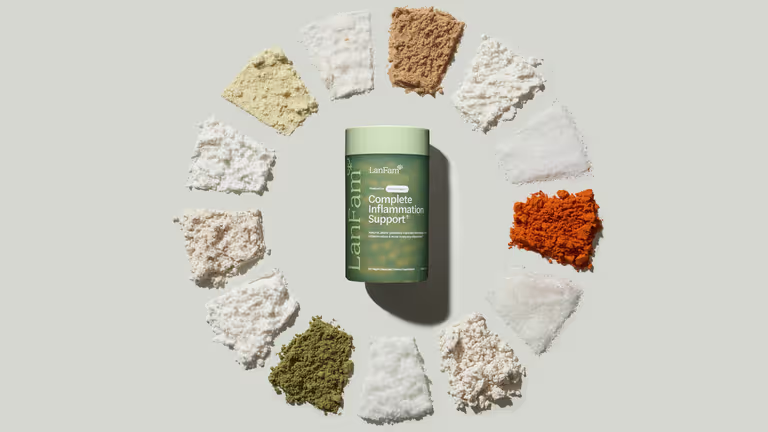
LanFam Health's Complete Inflammation Support was formulated by Fabio Lanzieri - drawing on 40 years of pharmaceutical experience - to address exactly this kind of pathway gap. The formula includes both curcumin with piperine and boswellia serrata, alongside 11 additional standardized ingredients targeting inflammatory pathways beyond just COX-2 and 5-LOX: NF-kB signaling, oxidative stress, gut barrier integrity, and neuroinflammation.
The piperine in Complete Inflammation Support is dosed at 6mg - sufficient to enhance curcumin absorption while remaining well below the 20mg+ threshold where significant drug interactions have been documented. Every ingredient dose is disclosed on the label. No proprietary blends. No guessing.
The Right Question
The research is clear: boswellia vs turmeric is the wrong comparison. These ingredients are not competitors for the same job. They are partners addressing different dimensions of the same biological problem.
If you have been taking curcumin alone and noticing partial but incomplete results, the 5-LOX pathway may be the gap. If you have been taking boswellia alone, COX-2-mediated inflammation may be the unaddressed factor. The most evidence-supported approach is using both - properly dosed, properly extracted, and properly formulated for absorption.
LanFam Health's Complete Inflammation Support combines curcumin with piperine, boswellia serrata, and 11 additional standardized ingredients across six inflammatory pathways. It was built by Fabio Lanzieri after 40 years in pharmaceuticals - not to stack ingredients for label appeal, but to cover the pathways that single-ingredient supplements leave open.
Explore the full ingredient list and see the research behind each one →LanFam Health offers a 90-day money-back guarantee - because results from natural compounds build gradually, and you deserve the time to evaluate them honestly.

References
- 2.Ammon HPT. Boswellic acids and their role in chronic inflammatory diseases. Adv Exp Med Biol. 2016. https://doi.org/10.1007/978-3-319-41334-1_13
- 3.Kimmatkar N, Thawani V, Hingorani L, Khiyani R. Efficacy and tolerability of Boswellia serrata extract in treatment of osteoarthritis of knee — a randomized double blind placebo controlled trial. Phytomedicine. 2003. https://doi.org/10.1078/094471103321648593
- 4.Anand P, Kunnumakkara AB, Newman RA, Aggarwal BB. Bioavailability of curcumin: problems and promises. Mol Pharm. 2007. https://doi.org/10.1021/mp700113r
- 5.Shoba G, Joy D, Joseph T, Majeed M, Rajendran R, Srinivas PSSR. Influence of piperine on the pharmacokinetics of curcumin in animals and human volunteers. Planta Med. 1998. https://doi.org/10.1055/s-2006-957450
- 6.Gupta SC, Patchva S, Aggarwal BB. Therapeutic roles of curcumin: lessons learned from clinical trials. AAPS J. 2013. https://doi.org/10.1208/s12248-012-9432-8
- 7.Daily JW, Yang M, Park S. Efficacy of turmeric extracts and curcumin for alleviating the symptoms of joint arthritis: a systematic review and meta-analysis of randomized clinical trials. J Med Food. 2016. https://doi.org/10.1089/jmf.2016.3705
- 8.Haroyan A, Mukuchyan V, Mkrtchyan N, et al. Efficacy and safety of curcumin and its combination with boswellic acid in osteoarthritis: a comparative, randomized, double-blind, placebo-controlled study. BMC Complement Altern Med. 2018. https://doi.org/10.1186/s12906-017-2062-z
Frequently asked questions
There's a seat at our table
Letters from our family to yours — the science, the recipes, the things that actually helped real families. Leave your email and we'll send the next one.