Magnesium and Inflammation: What the Research Shows
How magnesium status relates to CRP and chronic inflammation, what the research documents, and food sources. Honest, science-backed guide.
Ingredients in this letter
You eat well. You move when you can. Yet the stiffness lingers, and your last blood panel flagged a high CRP. One mineral keeps surfacing in that conversation: magnesium. It sits behind hundreds of reactions in your body, and most American adults fall short of it. Here is what the research documents about magnesium status, inflammation, and the markers your doctor watches.
Research on magnesium and inflammation documents a consistent inverse link: people with higher magnesium intake tend to show lower levels of C-reactive protein (CRP), a key blood marker of inflammation. Magnesium is a cofactor in hundreds of enzymatic reactions, and low magnesium status has been associated with chronic low-grade inflammation in observational studies and several randomized trials. Adequate magnesium will not "cure" inflammation, but the evidence suggests it supports a healthy inflammatory response when your intake meets your needs.
Why Magnesium Matters for Inflammation
Magnesium does quiet, structural work. It acts as a cofactor for more than 300 enzyme systems, helps regulate calcium movement in and out of cells, and supports the production of glutathione, the body's main intracellular antioxidant. When magnesium runs low, several of these systems drift in an inflammatory direction.
The mechanism is studied at the cell level. Low magnesium allows more calcium to flow into cells through L-type calcium channels and the NMDA receptor. That shift raises oxidative stress, and oxidative stress activates NF-κB, a master switch that turns on pro-inflammatory genes. Researchers have observed that magnesium helps restrain NF-κB activation by maintaining levels of IκBα, a natural brake on that pathway. A 2018 review in the Journal of Inflammation Research [1] describes how magnesium deficiency associates with higher TNF-α, IL-1, IL-6, and CRP — the same cytokines and acute-phase reactants clinicians track in chronic inflammation.
The plain-language version: magnesium helps keep the cellular "off switch" for inflammation working. Run short, and the off switch gets sticky.
What the Research Documents on Magnesium and CRP
CRP is the marker most studies use, because it is cheap to measure and rises with systemic inflammation. The pattern across the magnesium literature is consistent.
Observational evidence
In the Women's Health Initiative Observational Study [2], researchers followed 3,713 postmenopausal women aged 50 to 79. Higher dietary magnesium intake was inversely associated with hs-CRP, IL-6, and TNF-α receptor 2 — even after adjusting for body weight, fiber, fruit, vegetable intake, and other factors. Across rising quintiles of magnesium intake, average hs-CRP fell from 3.08 to 2.16 mg/L. This is the population closest to many readers here: women navigating midlife and beyond.
A broader meta-analysis and systematic review [3] of dietary magnesium reached the same conclusion: dietary magnesium intake is significantly and inversely associated with serum CRP levels. The authors suggested that part of magnesium's relationship with chronic disease may run through its effect on inflammation.
Trial evidence
Observational data show association, not cause. For cause, we look at randomized controlled trials.
- A 2018 meta-analysis in the Archives of Medical Science [4] pooled eight randomized trials (349 participants) and found magnesium supplementation lowered serum CRP, with a weighted mean difference of −1.33 mg/L. The authors noted substantial variation between studies.
- A 2022 meta-analysis in Nutrients [5] (17 trials, 889 participants, mostly women) reported that magnesium supplementation significantly decreased serum CRP and raised nitric oxide levels.
Here is the most useful nuance from this body of work. The benefit concentrates in people who start deficient. As the 2018 review [1] put it, when intake or blood levels suggest a deficiency, magnesium tends to associate with low-grade inflammation — but when status is already adequate, adding more magnesium does not meaningfully move inflammatory markers. Magnesium corrects a shortfall. It is not a lever you keep pulling for more effect.
Most People Fall Short — Quietly
You can run low on magnesium without a dramatic deficiency on a standard blood test. Two facts explain why this matters.
First, intake is low across the board. Data from the National Health and Nutrition Examination Survey (NHANES) indicate that close to half of U.S. adults take in less magnesium than the Estimated Average Requirement, according to the NIH Office of Dietary Supplements [6]. The Recommended Dietary Allowance is roughly 320 mg/day for adult women and 420 mg/day for adult men.
Second, the standard serum test can miss it. Only about 1% of body magnesium sits in the blood, so a "normal" serum reading can mask a body-wide shortfall. Researchers studying subclinical magnesium deficiency argue that many people in the lower end of the reference range are functionally short. That is the population where the inflammation link is most relevant.
Recommended Dietary Allowance for adults
| Group | RDA (mg/day) |
|-------|--------------|
| Women 31–50 | 320 |
| Women 51+ | 320 |
| Men 31–50 | 420 |
| Men 51+ | 420 |
Source: NIH Office of Dietary Supplements [6].
Food First: Where Magnesium Lives
Food is the most reliable way to raise magnesium status, and your body regulates food-sourced magnesium better than large supplemental doses. As a rule, foods high in fiber are high in magnesium.
Strong sources, per the NIH Office of Dietary Supplements [6]:
- Pumpkin seeds and chia seeds — among the most concentrated sources by serving.
- Almonds, cashews, and peanuts — a small handful contributes meaningfully.
- Spinach and Swiss chard — cooked greens concentrate the mineral.
- Black beans, edamame, and other legumes — fiber and magnesium together.
- Whole grains — brown rice, oats, and whole-wheat bread.
- Dark chocolate (high cocoa) — a genuine source, in moderation.
Your body absorbs roughly 30% to 40% of the magnesium you eat. A diet built on the foods above — close to a Mediterranean or DASH pattern — tends to lift magnesium and lower inflammatory markers at the same time, because the whole pattern works together.
If you consider a supplement, forms that dissolve well in liquid (citrate, lactate, chloride) tend to absorb better than magnesium oxide. Talk with your clinician first, especially if you take other medications or have kidney concerns.
What Magnesium Won't Do
Honesty serves you better than hype, so here are the limits.
- It will not erase chronic inflammation. Magnesium addresses one input. Sleep, body weight, activity, and overall diet carry significant weight.
- More is not better past adequacy. Once your status is sufficient, the trials show little added effect on CRP. Extra magnesium mostly leaves the body — and high supplemental doses can cause digestive upset.
- It treats no disease. Magnesium supports normal physiology. It does not diagnose, treat, cure, or prevent any condition.
- Blood tests can mislead. A normal serum magnesium does not rule out a functional shortfall, so do not read one number as the whole story.
A note on ProleevaMax and magnesium
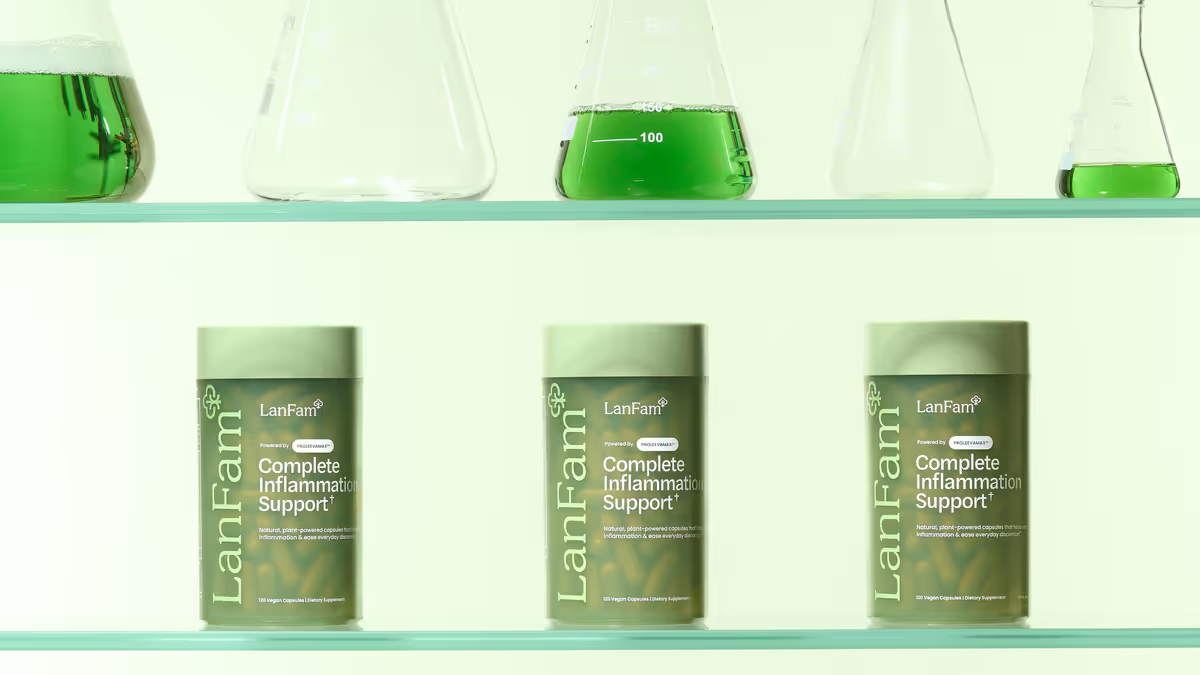
To be transparent: Complete Inflammation Support (Powered by ProleevaMax®) does not contain magnesium. We cover magnesium here because the question comes up often and the science deserves a clear answer. If your magnesium intake is low, food and a clinician-guided supplement are the right place to start.
ProleevaMax takes a different route. Instead of a single mineral, it pairs standardized botanicals with targeted amino acids to support a healthy inflammatory response across more than one pathway. Boswellia (Indian Frankincense), standardized to 65% boswellic acids, anchors the botanical side. Whole-root turmeric, matcha (a source of EGCG and L-theanine), Asian ginseng, and resveratrol round out the plant component, while a unique L-glutamine and L-serine pairing, GABA, and 5-HTP support nervous-system resilience. Magnesium and ProleevaMax are not competitors; they address different parts of the picture.
How Magnesium and ProleevaMax's Approach Differ
| | Magnesium | ProleevaMax design |
|---|---|---|
| Type | Single essential mineral | Multi-ingredient botanical + amino acid formula |
| Main role | Cofactor for 300+ enzymes; corrects a shortfall | Multi-pathway support for a healthy inflammatory response |
| Best when | Your intake is below the RDA | You want broad daily inflammatory-response support |
| In ProleevaMax? | No | — |
These statements have not been evaluated by the Food and Drug Administration. This product is not intended to diagnose, treat, cure, or prevent any disease.
Support a Healthy Inflammatory Response, Across More Than One Pathway
Magnesium is one input. A balanced inflammatory response draws on many. If you want daily, multi-pathway support that goes beyond a single mineral, explore Complete Inflammation Support (Powered by ProleevaMax®) — built on standardized ingredients with the science behind each one and a clear look at how it works.
ProleevaMax is designed around the 90-Day Protocol: many people notice a response by Week 2, clearer changes in comfort and mobility around Week 4, and more meaningful improvement in daily function by Week 8, through Day 90. It comes with a 90-day money-back guarantee — the full length of the protocol — so you can follow the timeline with confidence.
Keep learning: see our guides on the best vitamins for inflammation, vitamin D and inflammation, and how to lower CRP naturally.

References
- 2.Nielsen FH. Magnesium deficiency and increased inflammation: current perspectives. Journal of Inflammation Research. 2018. https://doi.org/10.2147/JIR.S136742
- 3.Chacko SA, Song Y, Nathan L, et al. Relations of dietary magnesium intake to biomarkers of inflammation and endothelial dysfunction in an ethnically diverse cohort of postmenopausal women. Diabetes Care. 2010. https://doi.org/10.2337/dc09-1402
- 4.Dibaba DT, Xun P, He K. Dietary magnesium intake is inversely associated with serum C-reactive protein levels: meta-analysis and systematic review. European Journal of Clinical Nutrition. 2014. https://doi.org/10.1038/ejcn.2014.7
- 5.Mazidi M, Rezaie P, Banach M. Effect of magnesium supplements on serum C-reactive protein: a systematic review and meta-analysis. Archives of Medical Science. 2018. https://doi.org/10.5114/aoms.2018.75719
- 6.Veronese N, Pizzol D, Smith L, Dominguez LJ, Barbagallo M. Effect of magnesium supplementation on inflammatory parameters: a meta-analysis of randomized controlled trials. Nutrients. 2022. https://doi.org/10.3390/nu14030679
- 7.National Institutes of Health, Office of Dietary Supplements. Magnesium: fact sheet for health professionals. NIH Office of Dietary Supplements. 2026. https://ods.od.nih.gov/factsheets/Magnesium-HealthProfessional/
Frequently asked questions

There's a seat at our table
Letters from our family to yours — the science, the recipes, the things that actually helped real families. Leave your email and we'll send the next one.