GABA
The primary inhibitory neurotransmitter — and the "quieting" ingredient in ProleevaMax. How GABA supports nervous system resilience, what the science says, and where it sits in the formula.
A note from Maria Lanzieri.
There's a kind of day I've come to recognize — the ones where the noise doesn't stop. Not noise from outside, but the low-level hum your nervous system carries after months of pain, disrupted sleep, and an immune system that's been on high alert for too long. On those days, the question isn't whether I did everything right. It's whether my body can settle. GABA is the ingredient in ProleevaMax that speaks most directly to that question. This is what I know about it.
What it is
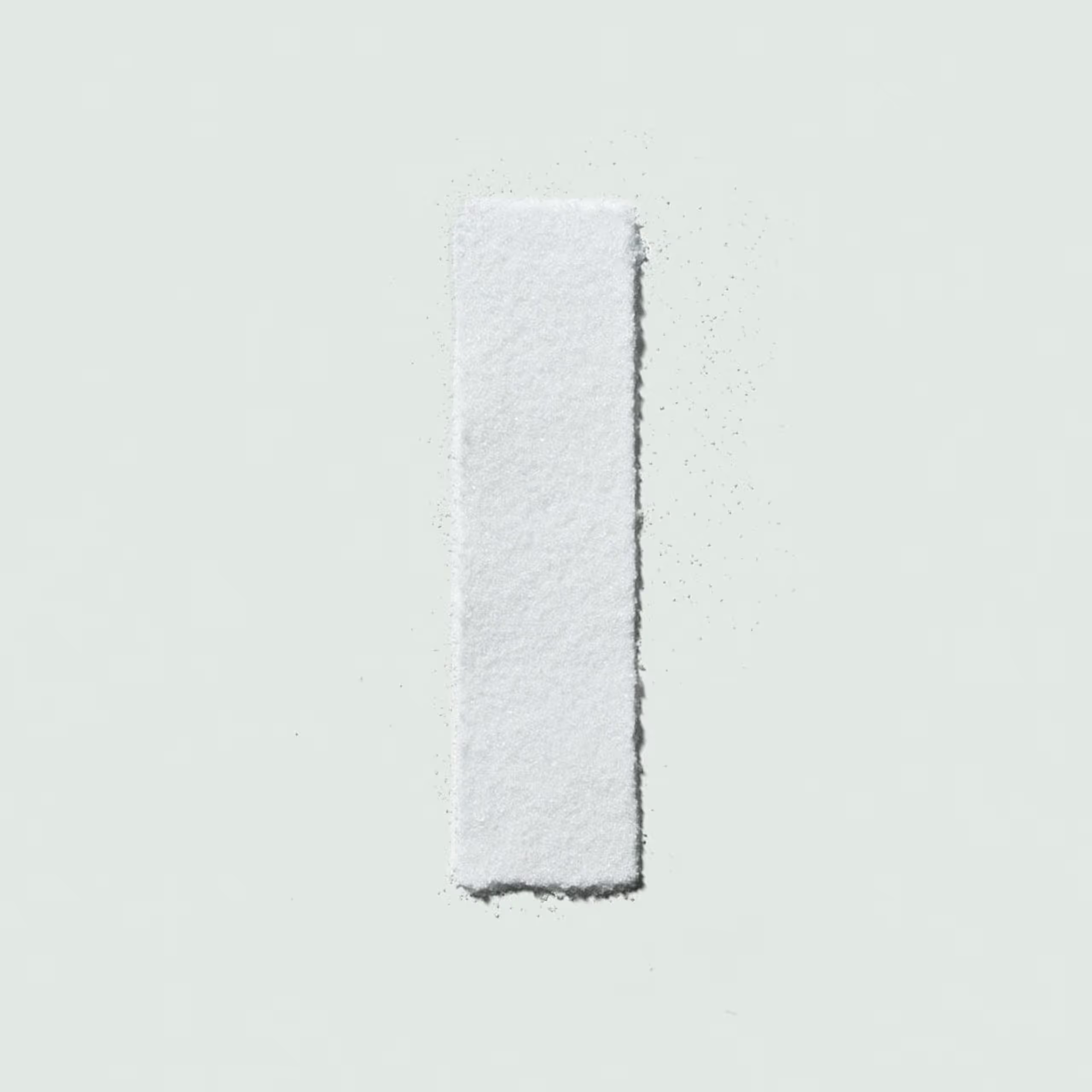
GABA — Gamma-Aminobutyric Acid — is an amino acid that functions as the central nervous system's primary inhibitory neurotransmitter. Where most signaling molecules in the brain are excitatory (telling neurons to fire), GABA does the opposite: it binds to receptor sites and tells neurons to quiet down. It's made naturally in the body from glutamate, another amino acid, via a single enzymatic conversion. GABA is present in virtually every region of the brain and spinal cord. As a supplement, it's typically derived from bacterial fermentation processes and comes in a standardized form identical to the body's own compound1.
How it works
GABA acts primarily on two receptor families: GABAA and GABAB. GABAA receptors are ion channels — when GABA binds, chloride ions flow into the neuron, lowering its electrical charge and making it less likely to fire. GABAB receptors operate more slowly, using a messenger system to reduce the release of other signaling molecules. Together, these two pathways make GABA the main brake on neuronal excitability throughout the central nervous system.
Here's where the honest part matters: the question of whether oral GABA supplements cross the blood-brain barrier is genuinely debated in the scientific literature. The blood-brain barrier is selective by design — it's supposed to keep most compounds out of the brain unless they have specific transport mechanisms. For a long time, researchers assumed oral GABA stayed in the periphery and couldn't meaningfully affect central nervous system function. That assumption has held up less cleanly than it once seemed.
More recent work points to several contributing pathways. GABA acts on receptors in the enteric nervous system — the gut's own neural network — which communicates bidirectionally with the brain via the vagus nerve. There's also evidence that the blood-brain barrier becomes more permeable under conditions of chronic inflammation and physiological stress, which is relevant for people who've been managing pain long-term. And some research suggests limited but real direct transport. What doctors and researchers have found, across multiple models, is that people report genuine calming effects after oral GABA supplementation — the mechanism isn't fully mapped, but the observed response is consistent enough that the research community takes it seriously1,2.
For chronic pain specifically, the nervous-system piece matters because pain doesn't just live in the joint or the tissue where it started. Over time, chronic inflammatory pain alters the way the nervous system processes signals — a phenomenon called central sensitization, where the system becomes more reactive, not less. GABA's inhibitory function speaks directly to this: supporting nervous system resilience when the body's pain-signaling has been running loud for too long3.
The evidence
Research on GABA's relationship to inflammation has grown meaningfully in recent years. A 2023 review in Frontiers in Nutrition examined GABA's anti-inflammatory activity and found that GABA supplementation was associated with reductions in pro-inflammatory markers in multiple model systems4. A separate 2023 paper in Biomedicines confirmed that GABA's inhibitory signaling intersects with inflammatory pathway regulation — the nervous system and immune system talk to each other, and GABA sits at one of the exchange points2. Earlier mechanistic work published in the Journal of Neuroinflammation described GABA's regulatory role in neuroinflammation in detail, establishing the molecular basis for why nervous system resilience and inflammatory load are connected3.
A comprehensive pharmaceutical review of GABA published in Molecules in 2019 — one of the most thorough summaries of the literature — assessed GABA's safety, absorption, and biological effects across both human and animal studies, concluding that the evidence supports its use as a supplement for nervous-system support, while noting that the precise central mechanism needs more human-trial clarification1.
An Updated Review on Pharmaceutical Properties of Gamma-Aminobutyric Acid
Ngo DH, Vo TS — Molecules · 2019
GABA and the GABAergic System: The Principal Mediator of Neuroinflammation
Tian J, Bhupinder S — Biomedicines · 2023
Neuroinflammation increases GABAergic tone and impairs cognitive and motor function in hyperammonemia by a PPARγ-dependent mechanism
Hernandez-Rabaza V, Cabrera-Pastor A, Taoro-Gonzalez L, et al — J Neuroinflammation · 2016
The Anti-inflammatory Activity of GABA and Its Active Mechanisms in Lipopolysaccharide-Stimulated Macrophages
Zheng Y, Zhang X, Wu X, et al — Front Nutr · 2023
United States Pharmacopeia (USP) Safety Review of Gamma-Aminobutyric Acid (GABA)
Oketch-Rabah HA, Madden EF, Roe AL, Betz JM — Nutrients · 2021
Dosage
Clinical and observational studies typically use oral GABA in the range of 100–500 mg per day. Effects associated with relaxation and sleep quality are often reported within 1–4 weeks of consistent daily dosing. This is not a fast-acting sedative and should not be expected to function like one. Consult your physician before starting any new supplement, particularly if you are on prescription sleep aids, anxiety medications, or antidepressants.
Safety & interactions
Oral GABA at supplement doses is well-tolerated for most adults. Mild drowsiness is the most commonly reported side effect and is generally manageable by taking GABA in the evening. A formal safety review commissioned by the U.S. Pharmacopeia in 2021 examined the existing evidence and found no serious adverse events associated with standard supplemental doses5.
Two categories of medications warrant a direct conversation with your physician before combining with GABA supplementation:
- Sedatives, benzodiazepines, and prescription sleep medications — GABA is the same inhibitory neurotransmitter these drugs modulate. Combining oral GABA with pharmaceutical GABA-receptor agonists (benzodiazepines, zolpidem, gabapentin, and related compounds) can produce additive sedation that is stronger than either alone. Do not combine without physician guidance.
- SSRIs, SNRIs, and MAOIs — While GABA's interaction profile with antidepressants is less documented than 5-HTP's, the nervous-system overlap warrants caution. The cross-talk between GABAergic and serotonergic signaling is real. If you are on antidepressant medication, confirm with your prescribing physician before adding GABA.
GABA is not recommended during pregnancy or lactation unless specifically cleared by your physician.
In ProleevaMax
GABA sits in Pathway 4 — Nervous System Resilience — alongside L-Serine, Choline, 5-HTP, and Vitamin B6. Fabio chose these five together because chronic inflammatory pain has a nervous-system amplification component that the anti-inflammatory actives in Pathways 1 and 2 don't reach on their own. GABA's role is the quieting piece: supporting the inhibitory side of a nervous system that's been running on heightened alert. At 99% purity in ProleevaMax, it's the same standardized form used in the clinical literature.*
Frequently asked questions
The days when the noise turns down — when sleep comes a little easier and the body isn't still bracing at midnight — those didn't happen for me all at once. They happened gradually, over weeks, as the whole formula started working together. GABA is one reason why. Not a magic switch. Just the quieting ingredient doing what the quieting ingredient is supposed to do.
— Maria
* These statements have not been evaluated by the Food and Drug Administration. This product is not intended to diagnose, treat, cure, or prevent any disease.
— Maria Lanzieri, Co-founder & CFO

Co-founder & CFO
Maria Lanzieri is the reason LanFam Health exists. After surviving breast cancer, she was put on estrogen-blocking medication that left her with chronic pain. The only daily option her doctors offered was NSAIDs — unsafe for ten-plus years of continuous use. Her husband Fabio, with 40 years in pharmaceuticals, searched every option and found nothing that addressed root cause. So he started building one at their kitchen table.
That formulation became ProleevaMax. Maria was the first person to take it. She still is.
Maria writes about life on the other side of a hard recovery — what works, what doesn't, the recipes she's actually making, the routines that fit around a real day. Her health history is the foundation of the brand, but her content is lifestyle, not illness. She writes the way she'd write to a friend: warm, practical, specific.
What Maria writes about
- Anti-inflammatory recipes and food routines
- Daily living through chronic pain and recovery
- Practical lifestyle adjustments — sleep, movement, breath, food, supplementation rhythm
- The Active Ager perspective — staying mobile and engaged after 50
- The personal angle on the LanFam origin story

There's a seat at our table
Letters from our family to yours — the science, the recipes, the things that actually helped real families. Leave your email and we'll send the next one.