Boswellia Serrata
Indian frankincense resin with 40 years of clinical research behind it. Mechanism, standardization, RCT evidence, and why it pairs with curcumin in ProleevaMax.
A note from Fabio Lanzieri.
When I'm building a formula, every ingredient earns its place by doing something no other ingredient on the list already does. Boswellia serrata is in ProleevaMax for one precise reason: it covers the inflammatory arm that curcumin doesn't. That's not a vague claim — it's a specific mechanism, a specific enzyme, and forty years of research behind it. This page is the explanation I'd give a colleague who asked me why we didn't just put more curcumin in.
What it is
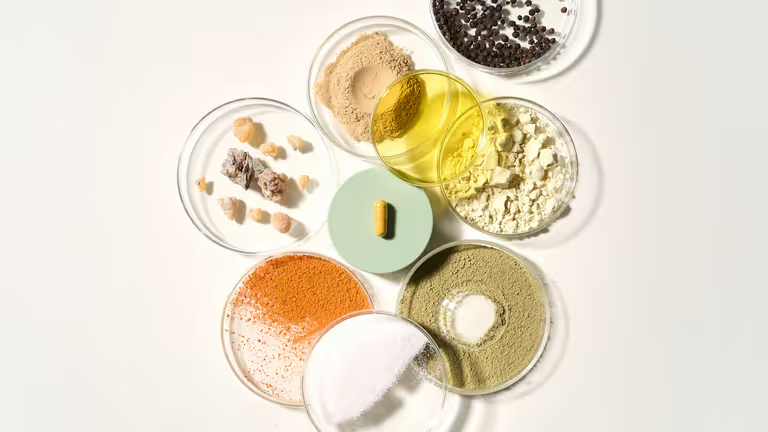
Boswellia serrata is an Indian tree — also called Indian frankincense or salai guggul — that produces a resin used in Ayurvedic medicine for centuries. The active compounds in that resin are a family of pentacyclic triterpene acids collectively called boswellic acids. The most pharmacologically significant of these is AKBA: acetyl-11-keto-β-boswellic acid. A standardized boswellia extract concentrates boswellic acids to a defined percentage; the form used in well-controlled clinical trials — and the form we use in ProleevaMax — is standardized to 65% boswellic acid1. Unstandardized "boswellia" capsules in the supplement aisle are the same problem as unstandardized turmeric: you're buying the bark, not the chemistry.
How it works
The arachidonic acid cascade is the body's principal inflammatory signaling pathway. You can think of it as a branching river: arachidonic acid is the upstream source, and two separate enzyme systems — COX and LOX — are the two forks downstream. COX-2 (cyclooxygenase-2) produces prostaglandins, the inflammatory mediators that NSAIDs were designed to block. The other fork, 5-LOX (5-lipoxygenase), produces leukotrienes — a separate class of inflammatory mediators that NSAIDs leave almost entirely untouched.
This is where boswellia matters. Boswellic acids — specifically AKBA — are potent, selective inhibitors of 5-lipoxygenase2. They bind to 5-LOX and suppress leukotriene synthesis upstream of the inflammatory cascade. This is a meaningfully different intervention from what curcumin does: curcumin modulates NF-κB activation and reduces COX-2 transcription; boswellia reaches the 5-LOX arm that curcumin does not. Together they cover both forks of the arachidonic acid pathway — which is the formulation logic, not a marketing story.
Beyond 5-LOX inhibition, boswellic acids have been shown to interfere with complement activation and leukocyte migration — mechanisms relevant to joint-tissue inflammation specifically3. The Ammon papers (2006, 2010, 2016) trace the full mechanistic picture across chronic inflammatory disease models, from cytokine suppression to cartilage-degradation enzyme modulation4. What this adds up to is a compound with a clear primary mechanism (5-LOX) and meaningful secondary effects — not a scattered "multi-target" ingredient that touches twelve pathways loosely.
The evidence
Two recent randomized controlled trials define the clinical case for boswellia in joint pain. Perez-Pinero and colleagues (Nutrients, 2023) enrolled knee osteoarthritis patients in a double-blind RCT comparing a standardized boswellia extract against placebo — significant improvements in pain scores and physical function at 90 days5.† Mohsenzadeh and colleagues (BMC Research Notes, 2023) ran a parallel knee OA trial with similar findings: boswellia-group participants showed clinically meaningful reductions in pain and stiffness compared to control over the treatment period6.† Yu and colleagues published a meta-analysis in BMC Complementary Medicine and Therapies (2020) pooling seven randomized trials in osteoarthritis patients — boswellia extracts consistently outperformed placebo on pain and function across the pooled sample, with an effect size that held across standardization levels and formulations7. The evidence base here is not thin: this is recent, controlled, replicated data in the specific patient population ProleevaMax serves.
Boswellia serrata, a potential antiinflammatory agent: an overview
Siddiqui MZ — Indian J Pharm Sci · 2011
Boswellic acids and their role in chronic inflammatory diseases
Ammon HPT — Adv Exp Med Biol · 2016
Modulation of the immune system by Boswellia serrata extracts and boswellic acids
Ammon HPT — Phytomedicine · 2010
Boswellic acids in chronic inflammatory diseases
Ammon HPT — Planta Med · 2006
Boswellia serrata extract supplementation and knee osteoarthritis: a randomized, double-blind, placebo-controlled trial
Perez-Pinero S, et al — Nutrients · 2023
Effect of frankincense supplementation on knee osteoarthritis: a randomized controlled trial
Mohsenzadeh MS, et al — BMC Res Notes · 2023
Effectiveness of Boswellia and Boswellia extract for osteoarthritis patients: a systematic review and meta-analysis
Yu G, et al — BMC Complement Med Ther · 2020
Dosage
Clinical trials typically use 100-400 mg/day of standardized boswellia extract (65% boswellic acids), taken with a meal. Benefit accumulates over 4-12 weeks of consistent daily use. This is not an acute-pain intervention. Consult your physician before starting a daily boswellia regimen, particularly if you are on prescription medication.
Safety & interactions
Boswellia serrata has a notably clean safety profile — in some head-to-head comparisons with NSAIDs for knee osteoarthritis, the boswellia arm showed better gastrointestinal tolerability than the NSAID arm5. For most adults at trial-range doses, boswellia is well-tolerated. The primary caution worth flagging:
- Anticoagulants — while no major drug interaction is established, out-of-caution monitoring is reasonable in people on warfarin or direct oral anticoagulants, given the general overlap between botanicals and coagulation pathways.
No significant interactions with common medications are documented in the peer-reviewed literature at the doses used in clinical trials. Pregnancy and lactation use has not been adequately studied at supplemental doses — cleared food-level use as spice is distinct from a standardized extract, and supplemental use should be cleared by a physician.
In ProleevaMax
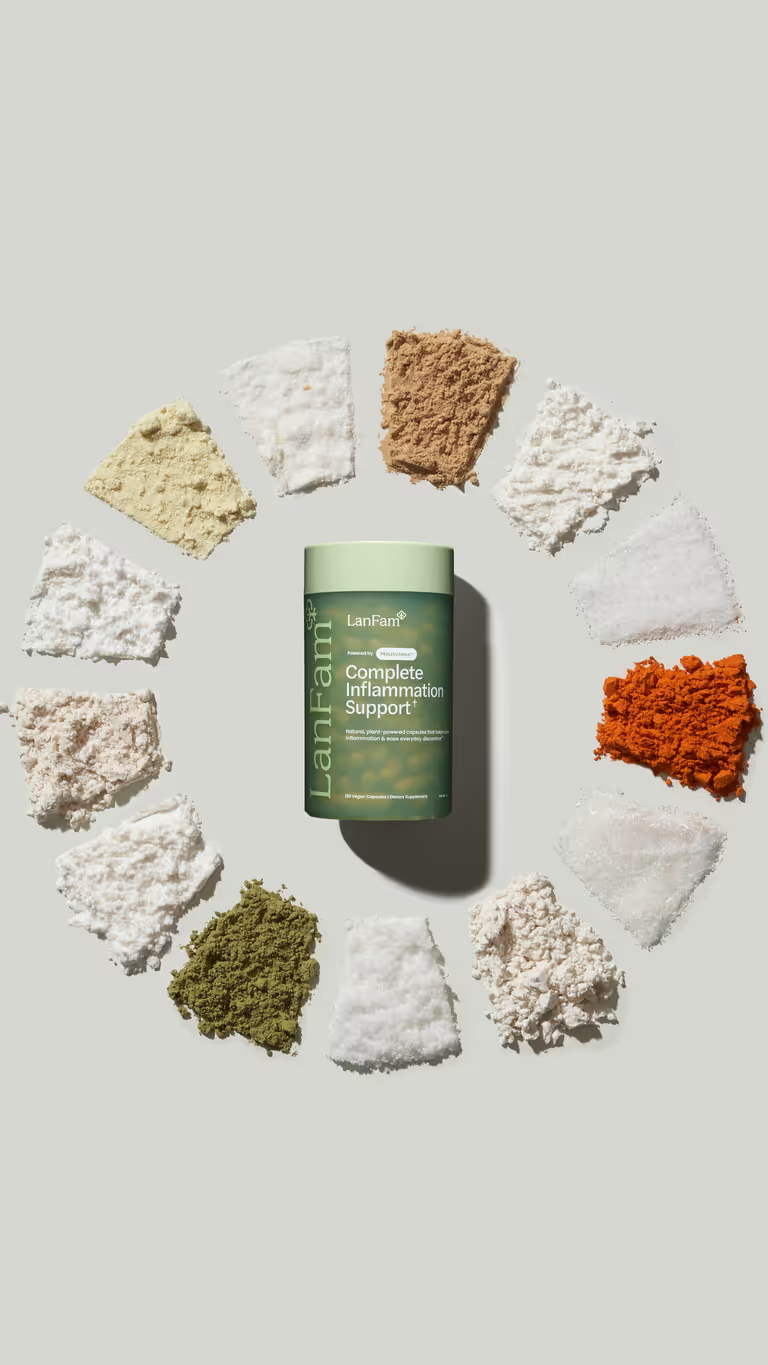
Boswellia serrata sits in Pathway 1 — Inflammatory Signaling, alongside curcumin. We use the 65% boswellic acid standardized extract at a trial-validated dose. The pairing is deliberate: curcumin takes the COX-2 arm of the arachidonic acid cascade; boswellia takes the 5-LOX arm. Two complementary mechanisms, one pathway, zero redundancy.* That's the formulation logic — and it's the reason we don't need more curcumin to do boswellia's job.
Frequently asked questions
The question I get about boswellia isn't "does it work?" — the trial data settles that. The question I get is "why isn't everyone using it?" The answer is standardization. Boswellic acid at 65% is a pharmaceutical-grade extraction decision. Without it, you have resin. With it, you have a mechanism. That distinction is what forty years in this industry taught me to care about.*
— Fabio
* These statements have not been evaluated by the Food and Drug Administration. This product is not intended to diagnose, treat, cure, or prevent any disease.
† Specific clinical-study outcome — see referenced trial for full methodology and population.
— Fabio Lanzieri, Co-founder & CEO

Co-founder & CEO
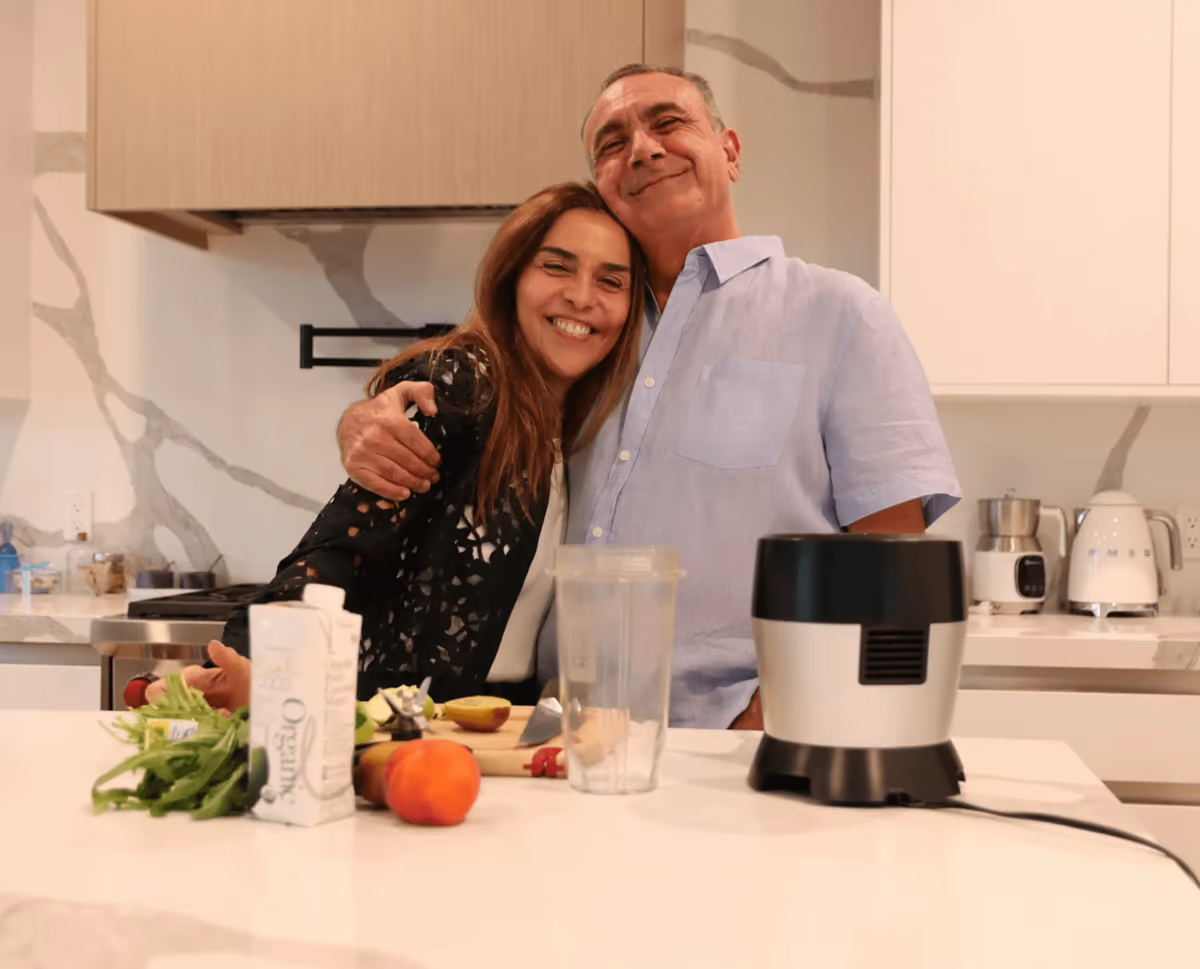
Fabio Lanzieri spent 40 years inside the pharmaceutical industry before founding LanFam Health with his wife Maria and daughter Cristina. When Maria's breast-cancer recovery left her dependent on estrogen-blocking medication and chronic pain that doctors could only address with daily NSAIDs, Fabio went looking for an alternative. Pharma didn't have one. Non-pharma didn't address root cause.
So he built one — at their kitchen table. The result became ProleevaMax, a synergistic formulation targeting six inflammatory pathways with 13 standardized ingredients. Every formulation decision still passes Fabio's family standard: if we wouldn't give it to our own, we won't make it.
Fabio's writing covers the mechanism science behind chronic inflammation — NF-κB, COX-2, NLRP3, the gut-brain axis, and how individual compounds modulate them. He writes the way he explains things at the dinner table: warmth first, then the science.
What Fabio writes about
- Chronic inflammation as a root cause across joint pain, neuroinflammation, metabolic dysfunction, and aging
- The 6-pathway framework — how inflammation goes from acute and protective to chronic and corrosive
- Individual compounds (curcumin, boswellia, resveratrol, panax ginseng, L-glutamine) and how they modulate inflammatory pathways
- NSAID alternatives — what 40 years of pharmaceutical research has and hasn't proven about long-term use
There's a seat at our table
Letters from our family to yours — the science, the recipes, the things that actually helped real families. Leave your email and we'll send the next one.