Resveratrol
A stilbene polyphenol that activates SIRT1 and scavenges free radicals directly — and the reason careful formulation matters more than the molecule alone.
A note from Fabio Lanzieri.
Resveratrol is one of those compounds where the popular story and the chemistry story are almost completely disconnected. The popular story is about red wine and longevity — which is interesting dinner conversation and not remotely how we think about this ingredient. The chemistry story is about a stilbene polyphenol that activates a specific cellular signaling protein, scavenges free radicals through a second mechanism entirely, and then fails to do any of that reliably if it isn't formulated as the right isomer at the right dose. That's the story worth telling, and it's why resveratrol is in Pathway 2 of ProleevaMax.
What it is
Resveratrol is a stilbene — a class of polyphenolic compounds produced by plants in response to infection, injury, or UV stress. The biologically active form is trans-resveratrol (the cis isomer is less stable and absorbs poorly). Natural sources include red grapes, peanuts, mulberries, and the skin of red wine grapes — but commercial extract for supplementation comes almost exclusively from the root of Japanese knotweed (Fallopia japonica), which produces the compound at higher concentrations than any food source and can be standardized reliably. The 98% standardization refers to trans-resveratrol content; this is the assayed form in every serious clinical trial1.
How it works
Resveratrol operates through two distinct antioxidant mechanisms that do not overlap, which is part of why it's genuinely complementary to matcha (EGCG) rather than redundant with it.
The first mechanism is direct: resveratrol donates hydrogen atoms to neutralize reactive oxygen species — free radicals that would otherwise damage cell membranes, proteins, and DNA. This is classical radical scavenging, and trans-resveratrol is structurally efficient at it because of the hydroxyl groups on its phenolic rings1.
The second mechanism is indirect and more interesting: resveratrol activates SIRT1, one of the sirtuin family of NAD+-dependent deacetylase enzymes. SIRT1 is not itself an antioxidant — it's a cellular stress-response regulator. When activated, SIRT1 deacetylates a range of transcription factors and co-regulators that govern the body's endogenous antioxidant enzyme systems, including catalase and MnSOD. It also modulates NF-κB activity — the same upstream inflammatory switchboard that curcumin targets in Pathway 1, though through a different molecular route. The net effect is upregulation of the cell's own defenses against oxidative stress rather than just adding exogenous scavenging capacity2.
A third layer involves direct transcriptional modulation: resveratrol suppresses COX-2 gene expression in inflamed tissue, reducing prostaglandin synthesis through a pathway that is separate from both SIRT1 activation and direct scavenging3. The convergence of these three mechanisms — direct scavenging, SIRT1-mediated endogenous upregulation, and COX-2 transcriptional suppression — is why resveratrol's mechanistic profile is broader than a simple radical-neutralizer picture suggests.
The evidence
The strongest controlled-trial evidence in chronic inflammatory conditions comes from a 2018 randomized double-blind trial in patients with rheumatoid arthritis — 1,000 mg/day of trans-resveratrol supplementation over three months produced significant reductions in disease activity scores and inflammatory markers (CRP, TNF-α, IL-6) compared to placebo4. A 2021 meta-analysis of resveratrol across inflammatory and oxidative stress outcomes confirmed the pattern: resveratrol supplementation consistently and significantly reduced CRP, TNF-α, and malondialdehyde (a marker of lipid peroxidation) across multiple trial designs5. Effect sizes are modest but reproducible, particularly at 150-500 mg/day — the range where bioavailability losses are manageable with a standardized 98% trans-resveratrol extract.
Therapeutic potential of resveratrol: the in vivo evidence
Baur JA, Sinclair DA — Nat Rev Drug Discov · 2006
SIRT1: a promising therapeutic target for chronic inflammatory diseases
Yu W, Sun S, Zhao Y, et al — Front Immunol · 2024
Synergistic chondroprotective effects of curcumin and resveratrol in human articular chondrocytes: inhibition of IL-1β-induced NF-κB-mediated inflammation and apoptosis
Csaki C, Mobasheri A, Shakibaei M — Arthritis Res Ther · 2009
Resveratrol as an effective adjuvant therapy in the management of rheumatoid arthritis: a clinical study
Khojah HM, Ahmed S, Abdel-Rahman MS, Elhakeim EH — Medicine (Baltimore) · 2018
The effect of resveratrol supplementation on inflammatory and oxidative stress markers in adults: a systematic review and meta-analysis of randomized controlled trials
Foshati S, Ghavami A, Moarabi F, Heidari B, Askari G — Int J Clin Pract · 2021
Dosage
Clinical trials typically use 150-500 mg/day of standardized 98% trans-resveratrol extract. Some studies extend to 1,000-2,000 mg/day without additional benefit on chronic-inflammation outcomes — the dose-response flattens above 500 mg for most endpoints in the existing literature. Consistent daily use over 4-8 weeks matters more than any individual dose. Consult your physician before starting a daily resveratrol regimen, particularly if you are on prescription medication.
Safety & interactions
Resveratrol at trial-range doses is well-tolerated for most adults. Two categories warrant a conversation with your physician before daily use:
- Anticoagulants and antiplatelet drugs — resveratrol has mild antiplatelet activity at higher doses. If you are on warfarin, apixaban, rivaroxaban, dabigatran, or daily aspirin, discuss with your physician before adding resveratrol to your regimen, as additive effects on platelet function are possible.
- Hormone-sensitive conditions — resveratrol has weak estrogen-receptor binding activity at very high doses in laboratory studies. The clinical significance of this at standard supplemental doses is not established, but if you have a personal history of hormone-sensitive cancer, discuss with your oncologist before use.
Pregnancy and lactation: resveratrol at supplemental doses has not been adequately studied in pregnant or nursing women. Food-level exposure through grapes and red wine — set aside alcohol — is not meaningfully comparable to standardized supplementation. Avoid supplemental resveratrol unless cleared by your physician.
In ProleevaMax
Resveratrol is the headline ingredient in ProleevaMax for Pathway 2 — Antioxidant Defense, paired with matcha (EGCG). The pairing is deliberate: matcha drives endogenous antioxidant enzyme upregulation through the Nrf2 pathway; resveratrol covers the same upstream territory via SIRT1 while simultaneously providing direct radical scavenging capacity that EGCG doesn't fully replicate. The chemistry rewards careful formulation — and the 98% standardized trans-resveratrol standardization is the specification that makes the trial data reachable at supplement doses.*
Frequently asked questions
The point about resveratrol isn't that red wine is medicine. It's that the molecule inside the grape skin is structurally interesting, its two-mechanism antioxidant story holds up under scrutiny, and the formulation decisions around isomer purity and dose determine whether any of that matters in practice. Those decisions are what we made.*
— Fabio
* These statements have not been evaluated by the Food and Drug Administration. This product is not intended to diagnose, treat, cure, or prevent any disease.
— Fabio Lanzieri, Co-founder & CEO

Co-founder & CEO
Fabio Lanzieri spent 40 years inside the pharmaceutical industry before founding LanFam Health with his wife Maria and daughter Cristina. When Maria's breast-cancer recovery left her dependent on estrogen-blocking medication and chronic pain that doctors could only address with daily NSAIDs, Fabio went looking for an alternative. Pharma didn't have one. Non-pharma didn't address root cause.
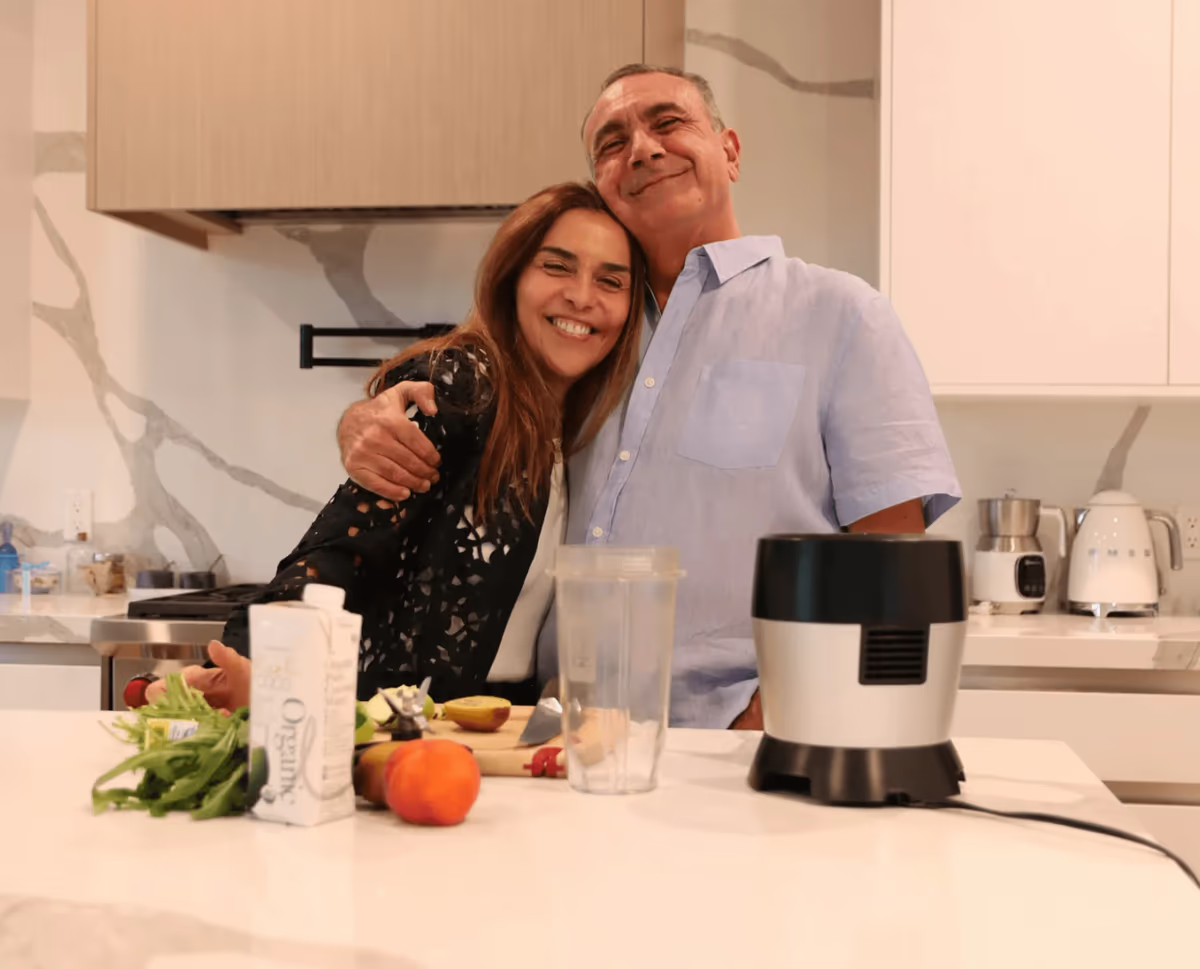
So he built one — at their kitchen table. The result became ProleevaMax, a synergistic formulation targeting six inflammatory pathways with 13 standardized ingredients. Every formulation decision still passes Fabio's family standard: if we wouldn't give it to our own, we won't make it.
Fabio's writing covers the mechanism science behind chronic inflammation — NF-κB, COX-2, NLRP3, the gut-brain axis, and how individual compounds modulate them. He writes the way he explains things at the dinner table: warmth first, then the science.
What Fabio writes about
- Chronic inflammation as a root cause across joint pain, neuroinflammation, metabolic dysfunction, and aging
- The 6-pathway framework — how inflammation goes from acute and protective to chronic and corrosive
- Individual compounds (curcumin, boswellia, resveratrol, panax ginseng, L-glutamine) and how they modulate inflammatory pathways
- NSAID alternatives — what 40 years of pharmaceutical research has and hasn't proven about long-term use
There's a seat at our table
Letters from our family to yours — the science, the recipes, the things that actually helped real families. Leave your email and we'll send the next one.