L-Serine
The amino acid your nervous system uses to build neuronal membranes — and why ProleevaMax includes it for Pathway 4 resilience under chronic inflammatory load.
A note from Fabio Lanzieri.
L-Serine is not a headline ingredient, and I want to be honest about that from the start. When you read what curcumin does — the NF-κB pathway, the clinical trials against ibuprofen — that's a compound with a large, well-characterized evidence base in chronic pain. L-Serine's story is different: the mechanism is structurally sound and well-understood in nervous-system biochemistry, but the clinical-trial pool in chronic-inflammation specifically is thin. I'll tell you what we know, where the evidence actually is, and exactly why it earned a place in ProleevaMax despite that.
What it is
L-Serine is a non-essential amino acid — your body synthesizes it, primarily in the liver and kidneys, from the glycolytic intermediate 3-phosphoglycerate. "Non-essential" under normal physiological conditions is the important qualifier. Under sustained neurological or inflammatory stress, endogenous synthesis can lag behind demand, making L-Serine conditionally essential1. It appears in two mirror-image forms: L-Serine (the biologically active form used in protein synthesis and metabolic pathways) and D-Serine (a distinct molecule with its own receptor pharmacology at NMDA glutamate receptors). When a supplement label says "Serine," it means L-Serine.
How it works
L-Serine's primary value in nervous-system maintenance is as a precursor molecule — not as a signaling compound itself, but as the raw material for compounds the nervous system critically depends on.
The most important downstream product is phosphatidylserine, a phospholipid that constitutes a significant fraction of neuronal cell membrane bilayers. Chronic inflammatory load — the condition ProleevaMax addresses — is associated with elevated oxidative stress that degrades membrane phospholipids over time2. When phosphatidylserine pools are depleted, neuronal membrane integrity and signaling efficiency are compromised. L-Serine supplementation supports the substrate availability for phosphatidylserine synthesis, which supports membrane structural maintenance under that inflammatory stress2.
L-Serine is also the primary precursor to glycine, one of the major inhibitory neurotransmitters in the central nervous system, and to sphingolipids — a class of structural lipids found in high concentration in the myelin sheath. Additionally, L-Serine participates in one-carbon metabolism (the folate cycle), linking it to methylation reactions relevant to neurological function3. The honest summary: L-Serine is a structural support molecule, not an acute signaling compound. Its role is maintenance, not modulation.
The evidence
The strongest evidence for L-Serine supplementation in pain-adjacent contexts comes from a 2020 randomized controlled trial by Sasahara and colleagues, which tested combined L-serine and EPA supplementation against EPA alone in subjects with chronic pain. The L-serine group showed reductions in pain scores, with the researchers proposing that L-serine's role in phosphatidylserine biosynthesis supported membrane-level improvements in nociceptive signaling3.
A 2021 review in Frontiers in Molecular Neuroscience by Ye and colleagues characterized L-serine as a neuroprotective agent, summarizing evidence that L-serine supports neuronal survival under oxidative and metabolic stress — conditions directly relevant to chronic inflammation4. A 2023 paper in Biomedicines by Phone Myint and Sun catalogued the neurological implications of L-serine availability, noting that serine-dependent pathways are disrupted in multiple conditions involving chronic neurological stress, and that supplementation represents a low-risk strategy for supporting those pathways1.
I'll be direct: dramatic, large-scale RCT data for L-serine in chronic inflammatory pain does not exist yet. The mechanism is sound; the preclinical and small-clinical evidence is consistent; the clinical-trial base hasn't caught up. We include it because the structural argument is solid and the risk of supplementation is extremely low — not because there are five headline trials.
Neurological Implications of L-Serine and Its Metabolites
Phone Myint K, Sun Y — Biomedicines · 2023
L-Serine, an Endogenous Amino Acid, Is a Potential Neuroprotective Agent for Neurological Disease and Injury
Ye L, Sun Y, Jiang Z, Wang G — Front Mol Neurosci · 2021
Combined Dietary Supplementation with L-Serine and Fish Oil Alleviates Chronic Pain-Related Symptoms in Subjects with Chronic Pain
Sasahara I, Yamashita Y, Ohara T, et al — J Nutr · 2020
Serine Alleviates Oxidative Stress via Supporting Glutathione Synthesis and Methionine Cycle in the Liver of Pigs
Zhou X, He L, Wu C, et al — Mol Nutr Food Res · 2017
L-Serine Supplementation in Neurological Conditions: Safety Profile and Dosing from Clinical Research
Mitoma H, Manto M, Hampe CS — Brain Sci · 2020
Dosage
Research studies have used L-serine at doses ranging from 0.4 g/day (dietary supplementation range) up to 15 g/day in neurological research contexts. Supplement-formulation doses are typically lower. As with all ProleevaMax ingredients, consult your physician before starting daily use.
Safety & interactions
L-Serine is one of the safest amino acids in the ProleevaMax formula. It is endogenously produced, well-tolerated across a wide dose range in human research, and has no documented major drug-drug interactions at supplement-level doses5. There is no established upper tolerable intake level because adverse effects have not been observed in clinical studies at reasonable supplementation doses. Individuals with rare serine metabolism disorders (phosphoglycerate dehydrogenase deficiency, a very uncommon inborn error) should consult a metabolic specialist before supplementing. For the general adult population, L-serine supplementation carries no meaningful interaction risk.
In ProleevaMax
L-Serine is ProleevaMax's structural contribution to Pathway 4 — Nervous System Resilience. Its four Pathway 4 co-formulated partners — GABA, 5-HTP, Choline, and Vitamin B6 — are primarily neurotransmitter precursors and signaling modulators. L-Serine occupies the complementary role: supporting the physical membrane architecture that those signaling molecules depend on. Under the sustained inflammatory load that ProleevaMax addresses, both dimensions of nervous-system function matter — you need the signals working and you need the structure those signals travel through to hold up.
Frequently asked questions
The case for L-Serine in this formula is a structural one, not a trial-data one. The nervous system uses a great deal of it to maintain function under stress, and supplementation hedges against deficit at low risk. That's the honest version of the argument — and in formulation, the honest version is the one I trust.*
— Fabio
* These statements have not been evaluated by the Food and Drug Administration. This product is not intended to diagnose, treat, cure, or prevent any disease.
— Fabio Lanzieri, Co-founder & CEO

Co-founder & CEO
Fabio Lanzieri spent 40 years inside the pharmaceutical industry before founding LanFam Health with his wife Maria and daughter Cristina. When Maria's breast-cancer recovery left her dependent on estrogen-blocking medication and chronic pain that doctors could only address with daily NSAIDs, Fabio went looking for an alternative. Pharma didn't have one. Non-pharma didn't address root cause.
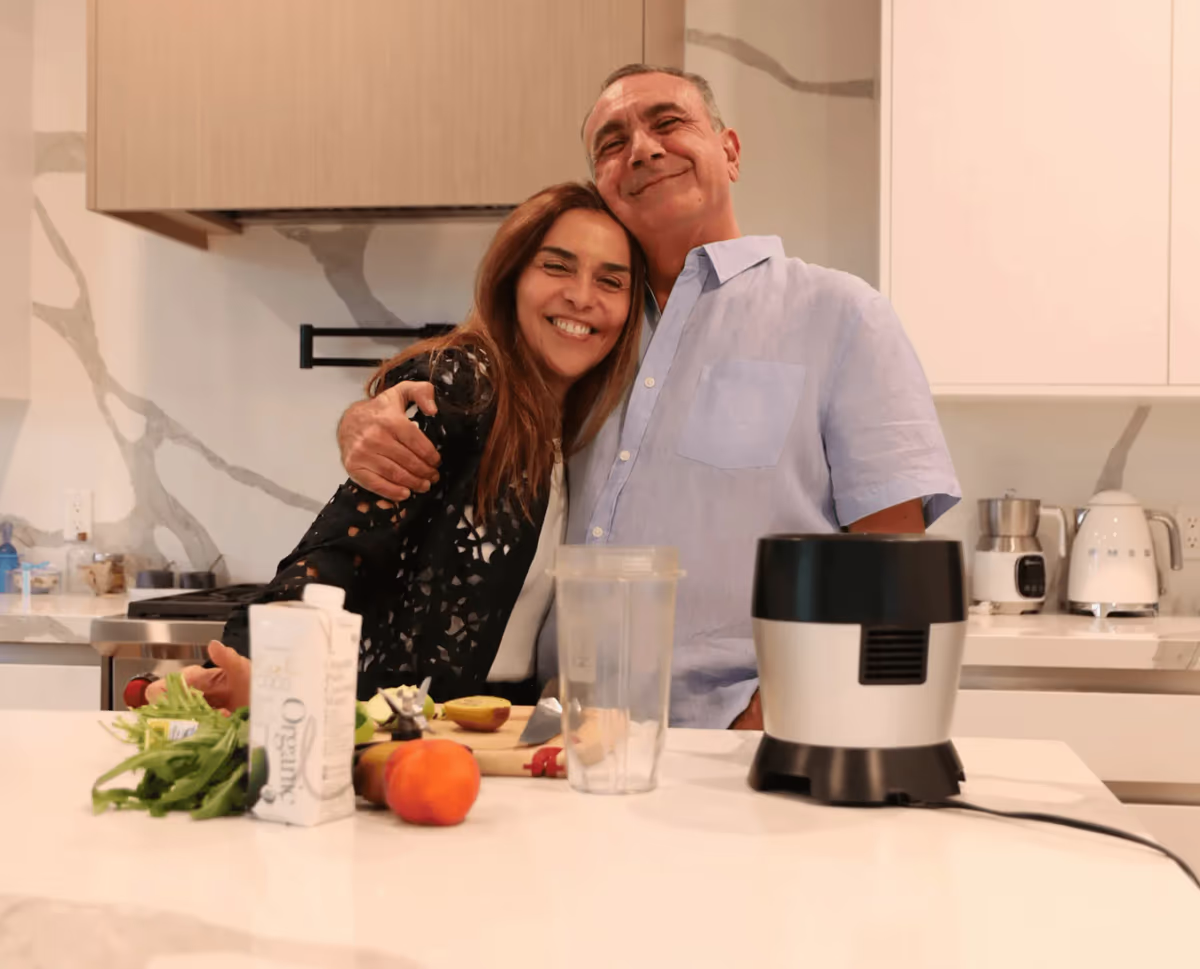
So he built one — at their kitchen table. The result became ProleevaMax, a synergistic formulation targeting six inflammatory pathways with 13 standardized ingredients. Every formulation decision still passes Fabio's family standard: if we wouldn't give it to our own, we won't make it.
Fabio's writing covers the mechanism science behind chronic inflammation — NF-κB, COX-2, NLRP3, the gut-brain axis, and how individual compounds modulate them. He writes the way he explains things at the dinner table: warmth first, then the science.
What Fabio writes about
- Chronic inflammation as a root cause across joint pain, neuroinflammation, metabolic dysfunction, and aging
- The 6-pathway framework — how inflammation goes from acute and protective to chronic and corrosive
- Individual compounds (curcumin, boswellia, resveratrol, panax ginseng, L-glutamine) and how they modulate inflammatory pathways
- NSAID alternatives — what 40 years of pharmaceutical research has and hasn't proven about long-term use
There's a seat at our table
Letters from our family to yours — the science, the recipes, the things that actually helped real families. Leave your email and we'll send the next one.