Standardized Extract vs Whole Herb
Standardized extract or whole herb, which is better in a supplement? What the labels mean, what proprietary blends hide, and how we apply the same test to ourselves.
Ingredients in this letter
A standardized extract is processed so a specific active compound is present at a guaranteed concentration, boswellia at 65% boswellic acids, for example. A whole herb is the dried plant with no such guarantee. The practical difference is consistency: you know what is in each capsule.
What "standardized" means in practice
Take turmeric. The compound most associated with its activity is curcumin, a relatively small fraction of the raw root, and one that absorbs poorly on its own, Shoba et al., 1998. A standardized extract concentrates that fraction, 95% curcuminoids is a common benchmark, so a moderate capsule delivers what would otherwise need an implausible quantity of powder.
Whole-herb turmeric is not useless. It is closer to the culinary form, it contains the fuller spectrum of compounds, and there are traditions built around exactly that. But if you are choosing a supplement because of a specific compound's documented activity, standardization is how you make sure that compound is present in a meaningful amount.
The number that isn't a percentage: extract ratios
There is a third figure on botanical labels, and it is the one most often mistaken for a standardization percentage. An extract ratio like 10:1 is not a percentage of anything.
A 10:1 extract means ten kilograms of raw plant were concentrated into one kilogram of extract. It describes how much material went in — a manufacturing fact. It says nothing about how much of the active compound came out, because that depends on what was in the raw plant and what the extraction process actually captured.
| Label says | What it tells you | What it does not |
|---|---|---|
| 10:1 extract | Concentration of plant material | Any active-compound content |
| 10% standardized | One compound is 10% of the extract by weight | How the extract was made |
| Both | The most complete picture | — |
The two are easy to confuse because they look alike on a panel, and a 10:1 reads as the larger number. It is not the more informative one. Given a choice between "500mg of 10:1 turmeric extract" and "500mg of turmeric extract standardized to 95% curcuminoids", only the second lets you calculate what you are taking.
A ratio is not worthless — it is a real statement about concentration, and for a herb with no agreed marker compound it may be the only figure available. But when a standardization percentage exists for that botanical and the label gives you a ratio instead, the ratio is the less useful of the two numbers, and it is worth asking why it is the one being shown.
The honest case for each
| | Whole herb | Standardized extract |
|---|---|---|
| Active content stated | No | Yes |
| Batch-to-batch consistency | Variable | Guaranteed to spec |
| Comparable to research doses | Difficult | Yes |
| Full compound spectrum | Retained | Reduced |
| Typical cost | Lower | Higher |
| What the label tells you | Weight only | Weight and active fraction |
Whole herb keeps the full compound spectrum, and there are plausible arguments that some botanical effects come from interactions across compounds rather than one in isolation. It is closer to traditional preparation, and it is cheaper. The trade-off is variability, active content depends on where it grew, when it was harvested, and how it was stored, none of which appears on the label.
Standardized extract gives you the dose. Research is done at particular doses of particular compounds, and standardization is what lets you connect what you take to what was studied. It also makes two products genuinely comparable; two whole herbs can only be compared on weight.
The trap in the middle: proprietary blends
There is a third category that limits what either approach can tell you.
A proprietary blend lists several ingredients and gives one combined weight. "Anti-Inflammatory Blend, 1,200mg" might be 1,100mg of the cheapest ingredient and 100mg spread across the rest. You cannot tell, and that is the point of the format.
If a label gives a blend weight rather than per-ingredient doses, a standardization percentage elsewhere tells you how concentrated that extract is, but not how much of it you are taking. Knowing the delivered dose needs both numbers, and a blend gives you one of them.
This applies to us. Our own label declares a 2,401mg proprietary blend covering eleven of the thirteen actives; only Vitamin B6 and Choline are listed with individual quantities. So the limitation described in this section is a limitation of our label too, and you should weigh it the same way you would weigh anyone else's. We set out the full detail at the end of this article.
How to compare two products in ninety seconds
- Is each ingredient listed with its own dose, or is there a blend weight?
- For each botanical, is there a standardization percentage?
- Does the formula address absorption? Curcumin without piperine is a smaller dose than it appears. Absorption is one of the six areas we formulate against for exactly this reason — the full ingredient list shows which active covers which.
- How many distinct mechanisms does it cover, versus how many ingredient names it lists?
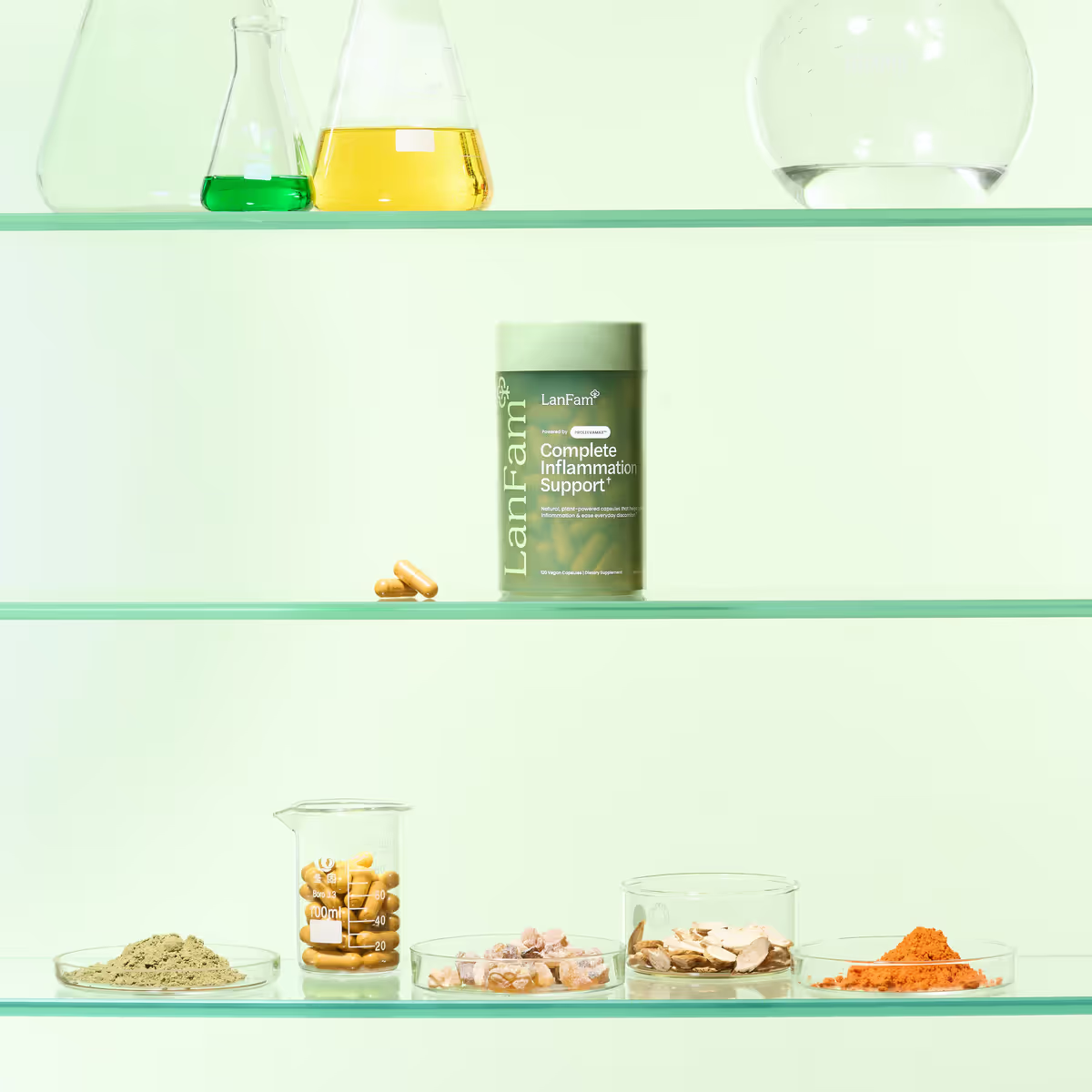
Complete Inflammation Support (Powered by ProleevaMax®) uses standardized extracts, boswellia at 65% boswellic acids among them, with black pepper extract included specifically for absorption.
And since this post argues you should check the label: ours lists Vitamin B6 and Choline individually, with the remaining eleven actives inside a 2,401mg proprietary blend. We would rather tell you that here than have you find it on the bottle. The standardization percentages are stated, so you know how concentrated each extract is, but not how much of it you are getting — that needs the individual milligrams, and those are not published.

Frequently asked questions
There's a seat at our table
Letters from our family to yours — the science, the recipes, the things that actually helped real families. Leave your email and we'll send the next one.