L-Glutamine
The most abundant free amino acid in the body — and the primary fuel the intestinal lining uses to maintain barrier integrity and support a calm systemic inflammatory response.*
A note from Fabio Lanzieri.
When people look at the ingredient list on ProleevaMax and ask me why we included an amino acid under Pathway 5 — Gut Barrier Integrity — I tell them the same thing I'd tell a colleague who'd never heard this story: the gut is not a bystander in chronic inflammation. In many cases it is the initiating event. L-glutamine is the ingredient that closes that loop. This page is how I explain what that means and why the formulation logic led us there.
What it is
L-Glutamine is the most abundant free amino acid in the human body, accounting for roughly 60-80% of the total free amino acid pool in plasma and skeletal muscle. It is conditionally essential — meaning the body synthesizes it from glutamate and ammonia, but under physiological stress (surgery, burn injury, prolonged inflammatory load, intense exercise) endogenous production can fall short of demand. The molecular formula is C₅H₁₀N₂O₃; its systematic name is 2-amino-4-carbamoylbutanoic acid1. It is not the same molecule as glutamate (the neurotransmitter and the anion in MSG) — though the two interconvert under specific enzymatic conditions.
How it works
L-Glutamine is the preferred energy substrate for two categories of rapidly-dividing cells: enterocytes (the epithelial cells lining the small intestine) and lymphocytes (immune cells)1. This dual role is the reason it sits at Pathway 5.
The gut-barrier story runs like this. The intestinal epithelium is one of the highest cell-turnover tissues in the body — enterocytes are continuously replaced on a cycle of days. That constant regeneration is energetically expensive, and L-glutamine is the primary fuel driving it. When circulating glutamine levels drop — as they reliably do under chronic inflammatory stress — enterocyte turnover slows, the tight junctions between cells become less well-maintained, and intestinal barrier permeability rises. When the barrier is compromised, lipopolysaccharide (LPS) and other pro-inflammatory ligands from gram-negative gut bacteria translocate into systemic circulation. The immune system reads that as a threat signal, amplifying the inflammatory response. The loop feeds itself1.
Kim and Kim's 2017 review in International Journal of Molecular Sciences documents this pathway in detail — demonstrating that glutamine supplementation supports enterocyte proliferation, tight-junction protein expression (including claudin-1, occludin, and ZO-1), and reduces markers of intestinal permeability in both preclinical and clinical models2. Cruzat and colleagues' 2018 review in Nutrients deepens the picture: under catabolic stress, plasma glutamine concentration falls measurably, lymphocyte proliferation and immune surveillance capacity fall with it, and exogenous glutamine supplementation supports both the restoration of plasma levels and the downstream immune-cell function that depends on them3.
The implication for a chronic-inflammation formula is direct. If intestinal barrier permeability is a persistent driver of systemic inflammatory signaling — and the evidence suggests it commonly is — then supporting the gut epithelium's primary fuel substrate is not a peripheral intervention. It is upstream of the cascade.
The evidence
Coqueiro and colleagues' 2019 meta-analysis in Nutrients examined glutamine supplementation in the context of physical and inflammatory stress, finding consistent support for reduced markers of muscle damage and fatigue in populations with elevated inflammatory load — relevant to ProleevaMax's target audience of people managing chronic inflammatory pain day-to-day, not elite athletes4.
The Wilson 2019 finding in Blood deserves specific attention for LanFam's audience. That study examined L-glutamine supplementation in patients managing chronic pain and found a statistically significant reduction in opioid use over the study period5. I want to be precise about what that means: it does not mean glutamine is an analgesic. It means that in a population managing chronic pain, addressing the physiological depletion state associated with chronic inflammatory load — including gut-barrier function — correlated with reduced demand for opioid rescue doses. For people in LanFam's NSAID Escaper audience who are trying to step away from dependence on pharmaceutical pain management, that finding is worth knowing.
Glutamine: Metabolism and Immune Function, Supplementation and Clinical Translation
Cruzat V, Macedo Rogero M, Noel Keane K, Curi R, Newsholme P — Nutrients · 2018
The Roles of Glutamine in the Intestine and Its Implication in Intestinal Diseases
Kim MH, Kim H — Int J Mol Sci · 2017
Glutamine: Metabolism and Immune Function, Supplementation and Clinical Translation
Cruzat V, Macedo Rogero M, Noel Keane K, Curi R, Newsholme P — Nutrients · 2018
Glutamine as an Anti-Fatigue Amino Acid in Sports Nutrition
Coqueiro AY, Rogero MM, Tirapegui J — Nutrients · 2019
Glutamine supplementation reduces opioid use in patients with sickle cell disease and chronic pain
Wilson RE, Khimani A, Mathur R, et al — Blood · 2019
Dosage
Clinical trials have used L-glutamine across a wide range — 5-30g/day — with the higher doses typically appearing in acute clinical contexts (burn care, post-surgical recovery, critical illness). Supplement-formulation doses in chronic-condition contexts are at the lower end of this range. ProleevaMax's dose reflects supplementation-level use, not the high-dose protocols used in intensive-care research. Consult your physician before adding glutamine supplementation if you have pre-existing gastrointestinal or hepatic conditions.
Safety & interactions
L-glutamine is well-tolerated for the general adult population. Its baseline concentration in the body is already high — 60-80% of the free amino acid pool — and it is endogenously produced continuously. No serious adverse events have been reported at supplementation-range doses in healthy adults.
One specific caution is worth stating plainly: in advanced hepatic disease, particularly portal-systemic encephalopathy, the glutamine→glutamate→ammonia metabolic pathway can contribute to elevated blood ammonia when hepatic clearance is compromised. If you have advanced liver disease, discuss glutamine supplementation with your physician before starting. At standard supplement doses in adults without hepatic compromise, this pathway is not a concern.
In ProleevaMax
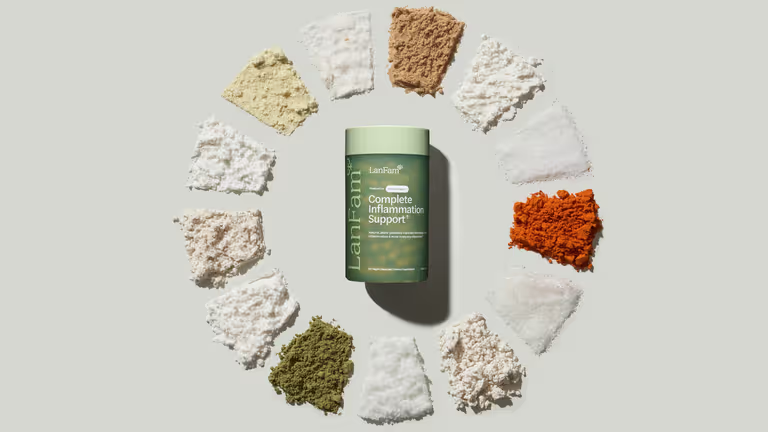
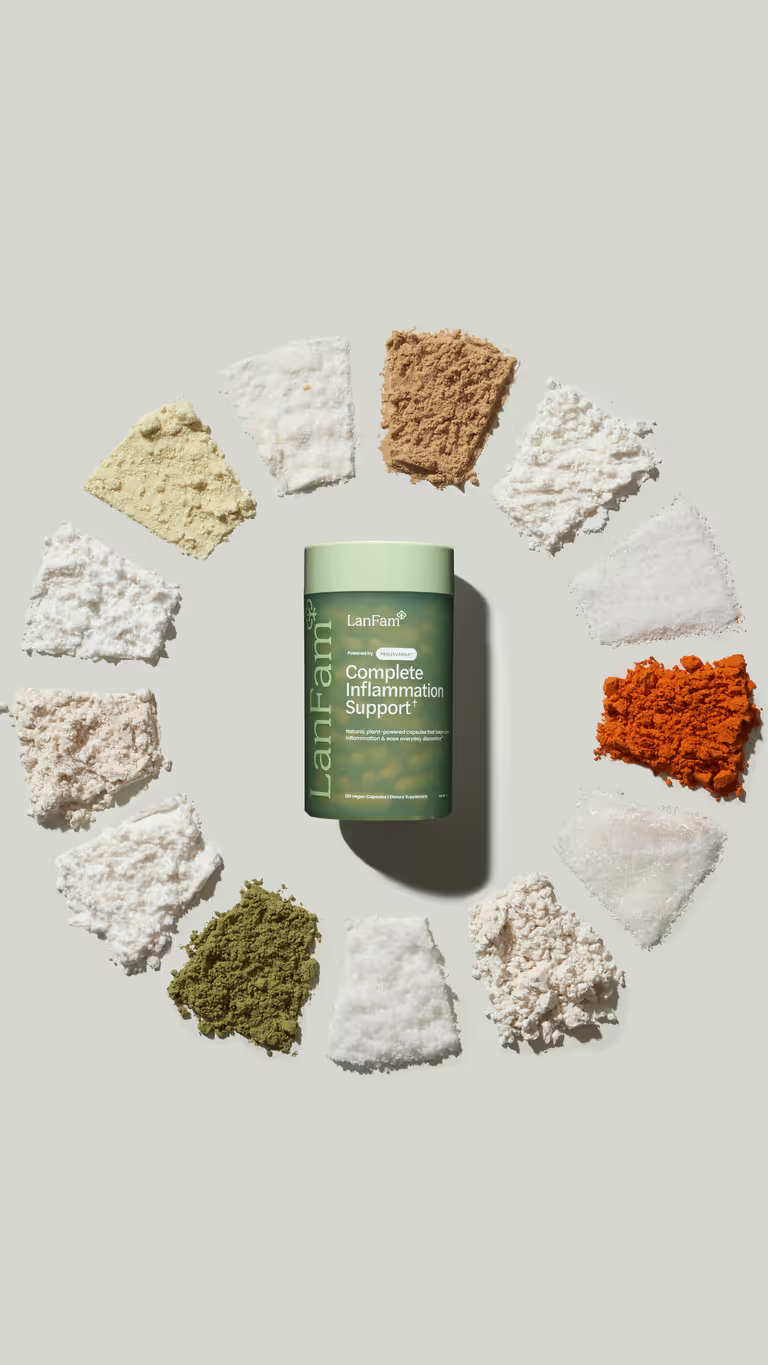
L-Glutamine is the sole ingredient in ProleevaMax's Pathway 5 — Gut Barrier Integrity. The formulation rationale is exactly the mechanism described above: closing the gut-permeability feedback loop that sustains systemic inflammatory signaling. The other five pathways in ProleevaMax address inflammatory signaling directly (Pathway 1), oxidative load (Pathway 2), delivery and bioavailability (Pathway 3), nervous system resilience (Pathway 4), and adaptive energy (Pathway 6). Pathway 5 addresses the upstream gut-barrier contribution — a dimension that most single-pathway inflammation supplements miss entirely.*
Frequently asked questions
The argument for L-glutamine in a chronic-inflammation formula is not about any single dramatic effect. It is about the loop. If gut barrier compromise is contributing to the systemic inflammatory load that your other ingredients are working against, then fortifying the epithelial cells that maintain that barrier is not a nice-to-have. It is formulation logic. That is why it is in there.*
— Fabio
* These statements have not been evaluated by the Food and Drug Administration. This product is not intended to diagnose, treat, cure, or prevent any disease.
— Fabio Lanzieri, Co-founder & CEO

Co-founder & CEO
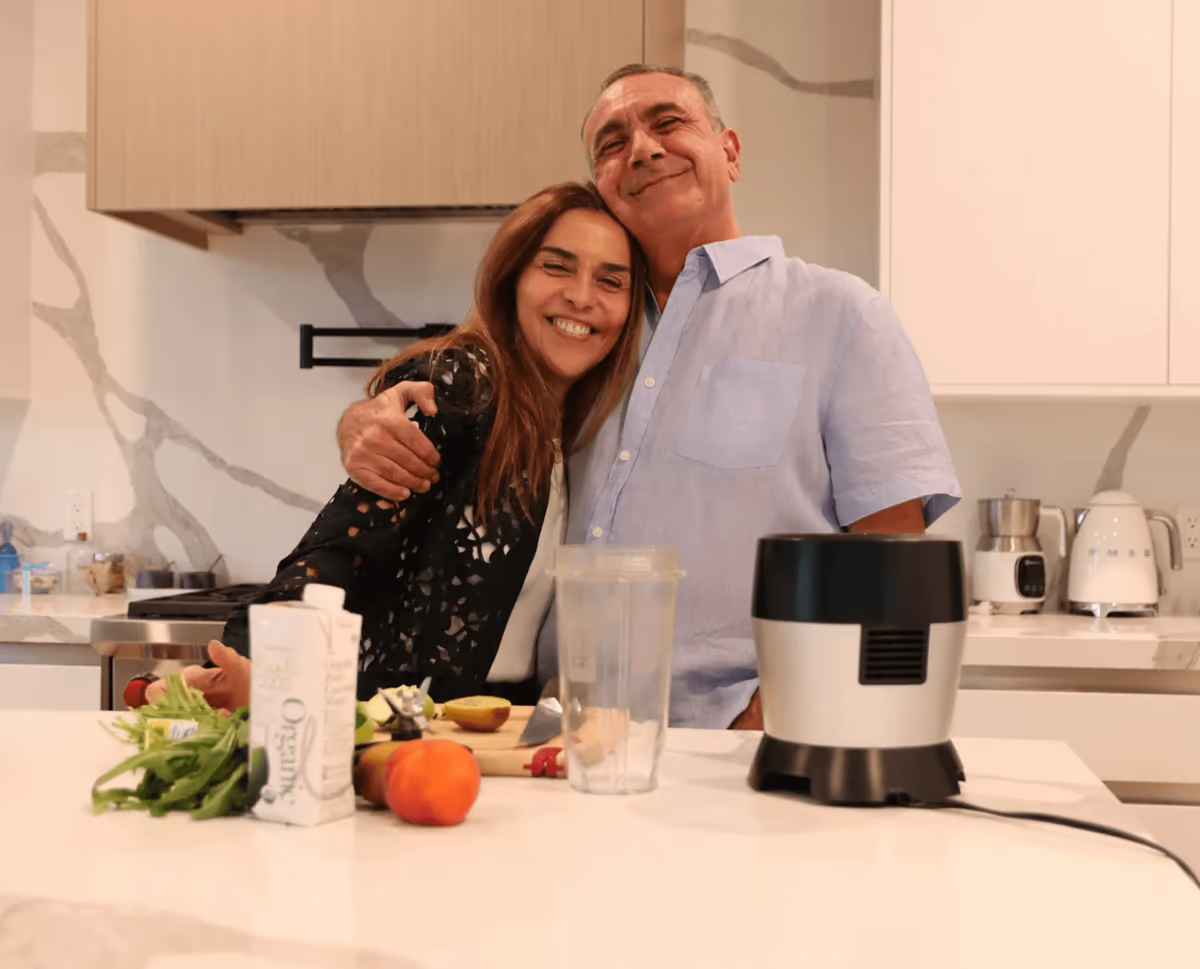
Fabio Lanzieri spent 40 years inside the pharmaceutical industry before founding LanFam Health with his wife Maria and daughter Cristina. When Maria's breast-cancer recovery left her dependent on estrogen-blocking medication and chronic pain that doctors could only address with daily NSAIDs, Fabio went looking for an alternative. Pharma didn't have one. Non-pharma didn't address root cause.
So he built one — at their kitchen table. The result became ProleevaMax, a synergistic formulation targeting six inflammatory pathways with 13 standardized ingredients. Every formulation decision still passes Fabio's family standard: if we wouldn't give it to our own, we won't make it.
Fabio's writing covers the mechanism science behind chronic inflammation — NF-κB, COX-2, NLRP3, the gut-brain axis, and how individual compounds modulate them. He writes the way he explains things at the dinner table: warmth first, then the science.
What Fabio writes about
- Chronic inflammation as a root cause across joint pain, neuroinflammation, metabolic dysfunction, and aging
- The 6-pathway framework — how inflammation goes from acute and protective to chronic and corrosive
- Individual compounds (curcumin, boswellia, resveratrol, panax ginseng, L-glutamine) and how they modulate inflammatory pathways
- NSAID alternatives — what 40 years of pharmaceutical research has and hasn't proven about long-term use
There's a seat at our table
Letters from our family to yours — the science, the recipes, the things that actually helped real families. Leave your email and we'll send the next one.