How long do supplements take to work? Why 90 days
How long do supplements take to work? What curcumin, boswellia and ginseng trials measured, what to log each week, and why 90 days is the fair test to run.
Ingredients in this letter

Longer than most people give them. Published trials of botanicals studied for joint comfort ran from 4 weeks to 6 months: curcumin trials in one review lasted 4 weeks to 4 months, and boswellia trials 4 to 24 weeks. A fair personal test is about 90 days of consistent daily use, with the same few observations logged every week.
Why a one-week test tells you little
Most people judge a supplement the way they judge a painkiller: take it, wait an hour, notice. That test works for a drug designed to act within hours. It is the wrong test for botanicals and amino acids studied over weeks. Three reasons make short trials unreliable.
1. The research itself was measured over weeks
Study duration: the length of time participants took an ingredient before researchers measured the final outcome.
When researchers want to know whether an ingredient affects joint comfort, stiffness or fatigue, they give it for weeks and measure at set points. The shortest trials in this article ran 4 weeks. The longest ran 24 [4]. If the people who designed the studies did not expect an answer in a week, a one-week personal test is asking for something the evidence never measured.
2. Your body changes slowly, and your days vary
Some tissues in the body renew in days. Others take far longer. One study of human tissue estimated the half-life of cartilage collagen at 117 years, against 15 years for skin collagen [7]. No supplement is known to rebuild cartilage, and none of the research here shows that. The point is narrower: the systems involved in how a joint feels are not on a two-day clock.
On top of that, your days vary. Sleep, weather, workload and activity all move how you feel. A good Tuesday after a new capsule proves nothing, and neither does a bad Thursday.
3. Expectation moves the numbers
Placebo response: a measurable change in how people feel that comes from taking something and expecting it to help, not from the substance itself.
A meta-analysis of 193 placebo groups in osteoarthritis trials, covering 16,364 people, found that placebo produced a moderate effect on pain scores (effect size 0.51) [8]. That is why good trials include a placebo group, and why your own early impressions deserve caution in both directions. A log with a baseline, kept the same way every week, is the closest a single person can get to a fair comparison.
How long do supplements take to work in published trials?
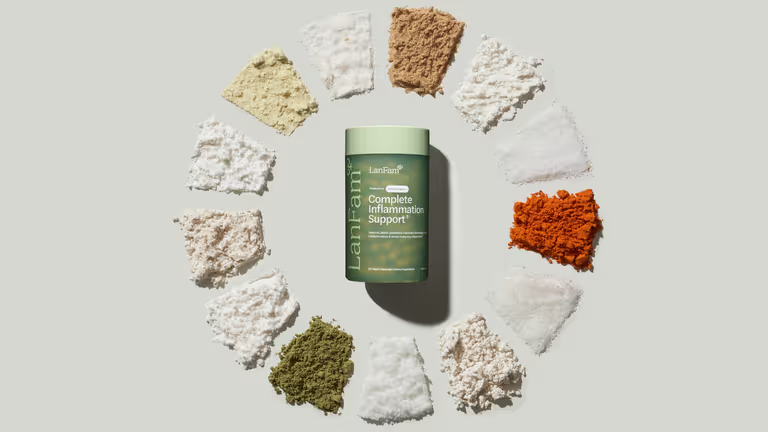
The table below shows how long researchers ran trials for several ingredients found in Complete Inflammation Support (Powered by ProleevaMax®). These are studies of single ingredients at the doses each trial used. They are not studies of ProleevaMax, and their results cannot be transferred to it.
- Turmeric / curcumin — Study: Daily et al., 2016 [1]; Design: Meta-analysis of 8 RCTs in people with arthritis; Duration: 4 weeks to 4 months; Measured at: Varied by trial
- Turmeric (Curcuma domestica) extract — Study: Kuptniratsaikul et al., 2014 [2]; Design: RCT, 367 people with knee osteoarthritis, compared with ibuprofen; Duration: 4 weeks; Measured at: Weeks 2 and 4
- Boswellia serrata extract — Study: Yu et al., 2020 [4]; Design: Meta-analysis of 7 RCTs, 545 people with osteoarthritis; Duration: 4 to 24 weeks; Measured at: Varied by trial
- Boswellia serrata extract (5-Loxin) — Study: Sengupta et al., 2008 [3]; Design: Double-blind, placebo-controlled RCT, 75 randomized, 70 completed; Duration: 90 days; Measured at: Days 7, 30, 60 and 90
- Panax ginseng extract — Study: Kim et al., 2013 [5]; Design: Double-blind, placebo-controlled RCT, 90 people with unexplained chronic fatigue; Duration: 4 weeks; Measured at: Weeks 2 and 4
A few things stand out.
Four weeks is the floor, not the norm. The boswellia review concluded that the evidence supports treatment "for at least 4 weeks," and several of its trials ran 12 or 24 weeks [4]. The turmeric review included trials up to 4 months [1].
Some trials reported early changes. In the 90-day boswellia trial, researchers reported changes in the higher-dose group at the first check, day 7 [3]. That trial was funded by the extract's manufacturer, and several authors were employees or consultants of it [3]. It also measured group averages against placebo, which is different from one person reading their own week.
Short trials say little about longer use. The ginseng trial lasted 4 weeks, and its primary total fatigue score did not reach statistical significance (p=0.068), although a mental fatigue score did [5]. The authors could not say what happens past a month.
The reviews are careful. Both meta-analyses call their evidence limited by small trials and moderate-to-low quality, and ask for larger studies [1][4]. The National Center for Complementary and Integrative Health states that "we don't know enough to definitively conclude" whether turmeric or curcumin is beneficial for any health purpose [6].
For the single-ingredient questions, see our guides on how long turmeric takes to work and what the research on Boswellia serrata covers.
What to track in a 90-day supplement trial
A 90-day supplement trial is a personal test with a fixed start date, a baseline, a consistent daily routine and a planned decision date. It won't give you the certainty of a controlled study. It will give you better information than memory.
Pick four or five things you can observe without equipment. Score them the same way, at the same time of day, every time. The table below is a logging schedule, not a forecast. We can't tell you what you will notice, or when, or whether you will notice anything.
- 3 days before day 1 — What to do: Record your baseline; What to log: Minutes of stiffness on waking · stairs (flights climbed, ease 1–5) · sleep (hours, quality 1–5) · afternoon energy (1–5)
- Days 1–14 — What to do: Start at the serving on the label; take it at the same time each day; What to log: Doses taken (tick daily) · anything unusual, such as stomach upset
- Days 15–28 — What to do: Keep the routine; don't change other habits if you can help it; What to log: Weekly scores for your four measures
- Days 29–56 — What to do: Reorder before you run out so there is no gap; What to log: Weekly scores · note unusual weeks (illness, travel, a new exercise plan)
- Days 57–84 — What to do: Keep going; What to log: Weekly scores
- Day 90 — What to do: Compare with your baseline, not with last week; What to log: All measures side by side: baseline, day 30, day 60, day 90
Keep the measures concrete. "Minutes until my knees feel loose in the morning" is a number. "I feel better" is a mood. If you want help choosing what to watch, our joint stiffness playbook covers morning stiffness in detail.
90-day tracker
If a weekly log is more than you want, keep the short version. It is four questions, answered twice: once on Day 14 and again on Day 90. By Day 90 it's hard to remember how Day 14 felt, so write the first answers down and keep them.
- Stiffness on waking — Ask yourself: How long after getting up before you move easily?
- Stairs — Ask yourself: One flight: how does it feel, and do you reach for the rail?
- Sleep — Ask yourself: How many times did you wake last night?
- Energy — Ask yourself: At 3 p.m., do you have energy to spare, enough, or not enough?
Print this page, or write your answers anywhere you'll find them again: your phone's notes, a calendar, the back of the box. On Day 90, answer the same four and put them next to your Day 14 notes.
These are observations, not a test. Your answers may change over the 90 days, or they may not. Either way, you decide with a written record instead of a guess.
Week three: where many people stop, and how to handle it
The first days of any new routine carry some novelty. By week three it is gone, and the honest answer to "is this doing anything?" is often "not sure yet." At the same time, a 30-serving bottle runs out around day 30, so the reorder decision lands just as doubt peaks.
Three habits help:
- Read your log, not your mood. Compare this week's scores with your baseline. If you have only two data points, you don't have an answer yet, and that is expected.
- Tie the capsules to something you already do. In a study of 96 people building a new daily habit, the median time until it felt automatic was 66 days, with a range of 18 to 254 [9]. Anchoring the new habit to an existing one, such as breakfast or brushing your teeth, removes the daily decision.
- Don't restart the clock over one missed day. The same research found that a single missed day had little effect on forming the habit [9]. Take the next dose as normal. Don't double up.
Set your decision date in advance: day 90. Deciding on day 21 means deciding with a third of the information.
Supplement consistency: what "taking it daily" means
Supplement consistency: taking the labelled serving at the same time every day, without gaps, for the whole trial.
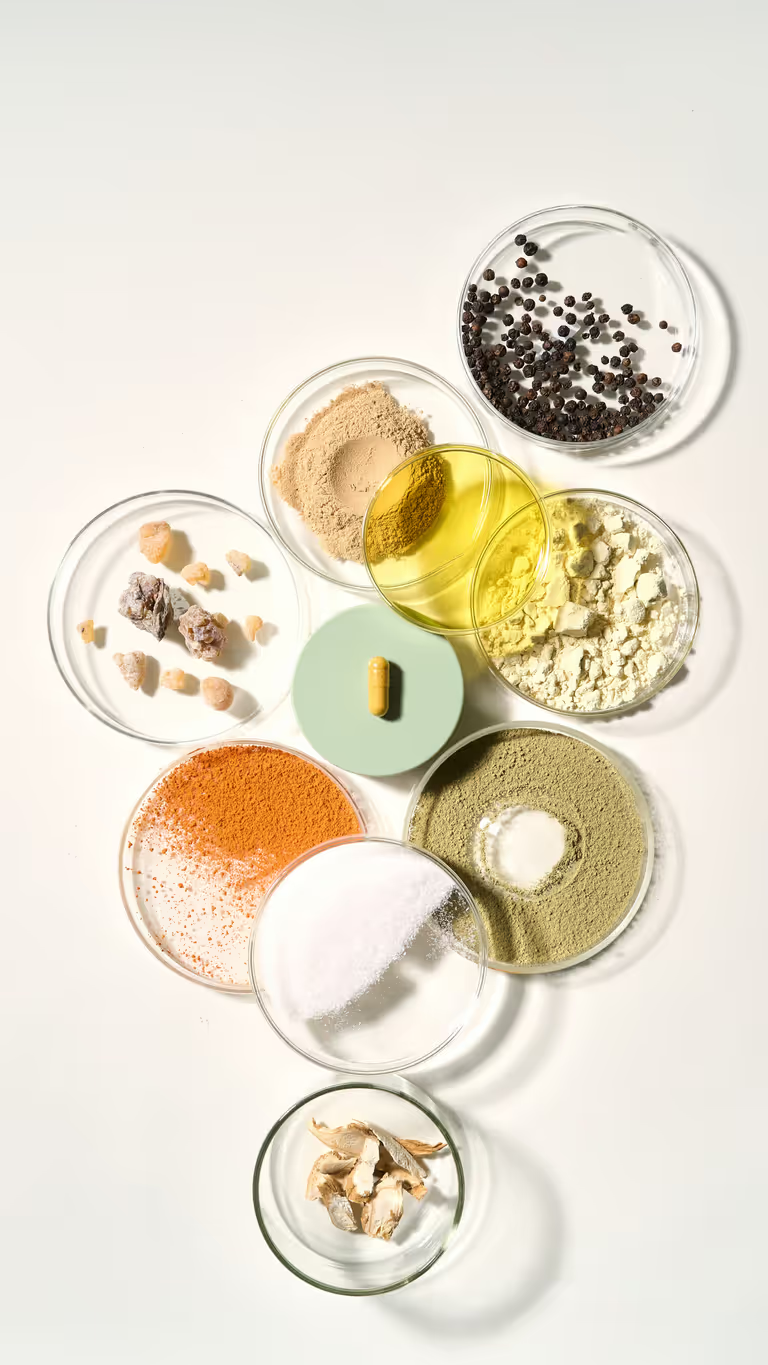
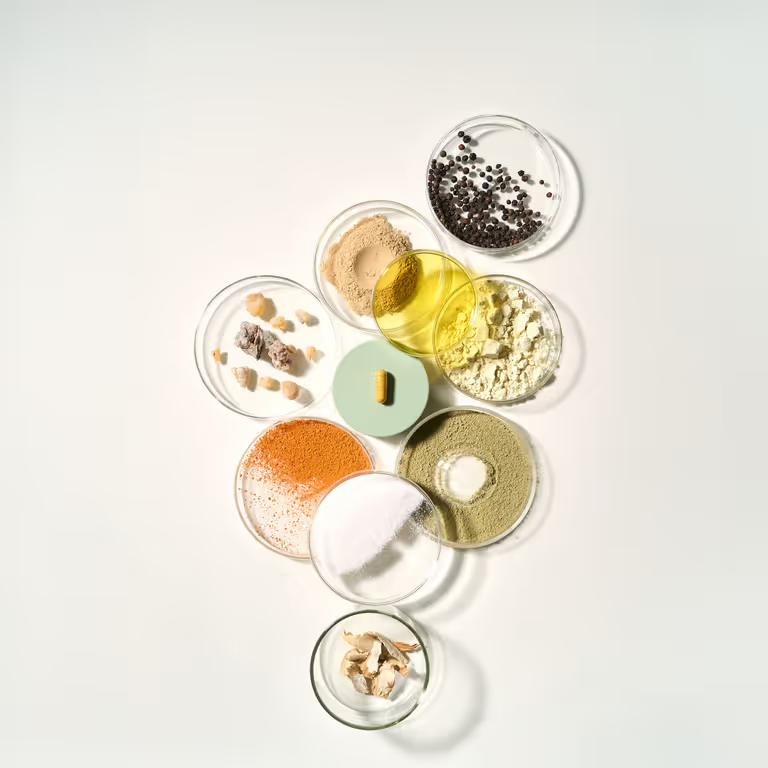
For ProleevaMax, that means 4 vegan capsules a day. The formula combines 13 actives, including Turmeric Root Extract, Boswellia serrata standardized to 65% boswellic acids, and Black Pepper Fruit Extract (piperine), in a routine built for daily use. Most of the actives sit in a 2,401 mg proprietary blend, so we don't publish individual amounts, and the trial doses in the table above can't be compared with it. What you can control is regularity. A trial with 20 missed days out of 90 is a different test from one with 2.
Why LanFam's guarantee is 90 days
Our money-back guarantee lasts 90 days because that is the window a fair test needs. A one-month window would ask you to decide at the point where the evidence says it is too early to know.
Two practical details:
- The guarantee runs 90 days from purchase, and it covers opened bottles. If your order sits on a shelf for two weeks before you start, your day 90 falls outside the window. Start the day it arrives.
- A 3 Month supply covers the whole trial in one order, so there is no reorder gap at day 30. Subscribed, it works out to about $0.89 a day.
When not to wait 90 days
A 90-day test is for judging whether a supplement is worth continuing. It is not a reason to sit through problems. Stop and talk to your doctor or pharmacist if you notice a side effect, or if symptoms are new, worsening, or come with fever, redness or heat in a joint.
Ask before you start if you take prescription medication. ProleevaMax contains 5-HTP, which can interact with SSRIs and other serotonergic medications; that is the most important interaction on the formula. Turmeric raises questions for people on blood thinners. Ask too if you are pregnant, nursing, or scheduled for surgery.
Start your 90 days
If you want a fair test, set it up like one: a baseline, a daily routine, a log and a decision date. ProleevaMax comes with a 90-day money-back guarantee, opened bottles included, so the decision stays yours at day 90. See the full label and start your 90 days, and read the guarantee terms before you begin.
These statements have not been evaluated by the Food and Drug Administration. This product is not intended to diagnose, treat, cure, or prevent any disease.
This article is for education and is not a substitute for advice from your doctor or pharmacist.

References
- 2.Daily JW, Yang M, Park S. Efficacy of turmeric extracts and curcumin for alleviating the symptoms of joint arthritis: a systematic review and meta-analysis of randomized clinical trials. J Med Food. 2016. https://pmc.ncbi.nlm.nih.gov/articles/PMC5003001/
- 3.Kuptniratsaikul V, Dajpratham P, Taechaarpornkul W, et al. Efficacy and safety of Curcuma domestica extracts compared with ibuprofen in patients with knee osteoarthritis: a multicenter study. Clin Interv Aging. 2014. https://pmc.ncbi.nlm.nih.gov/articles/PMC3964021/
- 4.Sengupta K, Alluri KV, Satish AR, et al. A double blind, randomized, placebo controlled study of the efficacy and safety of 5-Loxin for treatment of osteoarthritis of the knee. Arthritis Res Ther. 2008. https://pmc.ncbi.nlm.nih.gov/articles/PMC2575633/
- 5.Yu G, Xiang W, Zhang T, et al. Effectiveness of Boswellia and Boswellia extract for osteoarthritis patients: a systematic review and meta-analysis. BMC Complement Med Ther. 2020. https://pmc.ncbi.nlm.nih.gov/articles/PMC7368679/
- 6.Kim HG, Cho JH, Yoo SR, et al. Antifatigue effects of Panax ginseng C.A. Meyer: a randomised, double-blind, placebo-controlled trial. PLoS One. 2013. https://pmc.ncbi.nlm.nih.gov/articles/PMC3629193/
- 7.National Center for Complementary and Integrative Health. Turmeric. Updated April. 2025. https://www.nccih.nih.gov/health/turmeric
- 8.Verzijl N, DeGroot J, Thorpe SR, et al. Effect of collagen turnover on the accumulation of advanced glycation end products. J Biol Chem. 2000. https://pubmed.ncbi.nlm.nih.gov/10976109/
- 9.Zhang W, Robertson J, Jones AC, Dieppe PA, Doherty M. The placebo effect and its determinants in osteoarthritis: meta-analysis of randomised controlled trials. Ann Rheum Dis. 2008. https://pubmed.ncbi.nlm.nih.gov/18541604/
- 10.Lally P, van Jaarsveld CHM, Potts HWW, Wardle J. How are habits formed: modelling habit formation in the real world. Eur J Soc Psychol. 2010. https://www.bps.org.uk/research-digest/how-form-habit
Frequently asked questions
There's a seat at our table
Letters from our family to yours — the science, the recipes, the things that actually helped real families. Leave your email and we'll send the next one.