Amino acids and inflammation: what the research shows
Amino acids and inflammation: what glutamine, arginine, serine, GABA and 5-HTP do in the body, what the research shows, and who should check with a doctor.
Ingredients in this letter
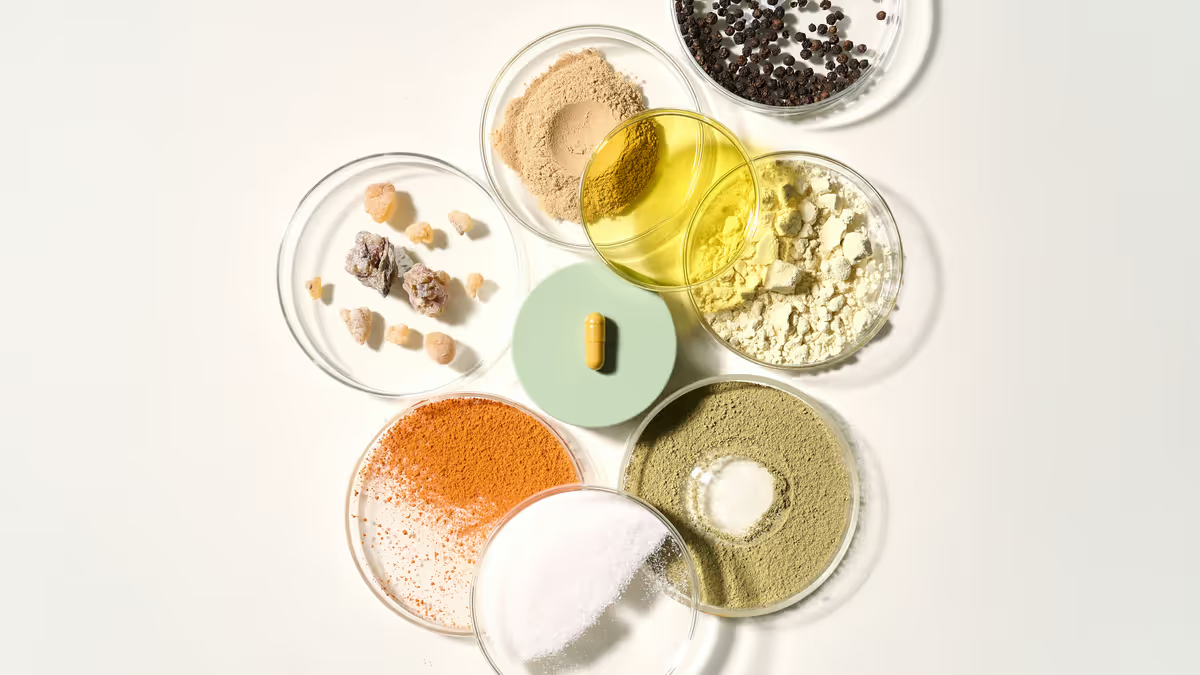
Amino acids matter to inflammation because several of them supply systems that inflammation depends on. L-glutamine fuels the cells lining the gut, L-arginine is the raw material for nitric oxide, and L-serine, GABA and 5-HTP work in the nervous system. Most of the evidence comes from cell and animal studies; human results are mixed.
What is an amino acid, and why would one matter for inflammation?
Definition — amino acid: a small molecule the body links together to build proteins. Many amino acids also do separate jobs on their own, as fuel for cells, as raw material for signaling molecules, or as messengers in the nervous system.
That second role is the one that matters here. Inflammation is carried out by cells, and cells need fuel and raw materials to run. The gut lining uses glutamine as a major fuel. Blood vessels and immune cells turn arginine into nitric oxide. Nerve cells use serine, GABA and the serotonin made from 5-HTP to send signals.
Definition — conditionally essential amino acid: one the body normally makes enough of, but may need more of during stress, illness or injury. Glutamine is the classic example; it is described as conditionally essential in catabolic states such as trauma or sepsis [1].
So the question behind "amino acids and inflammation" is not whether an amino acid acts like a turmeric extract. It does not. The question is whether the systems inflammation leans on are well supplied.
Botanicals and amino acids do different jobs
Standardized botanicals such as turmeric and Boswellia serrata are usually studied for what they do to inflammatory signaling: enzymes like 5-LOX, transcription factors like NF-κB, and oxidative stress.
Amino acids are studied from the other direction. Researchers ask what the body uses them for, and what happens when supply falls short during inflammation. That produces a different kind of evidence: mechanistic, often strong on the biology, and often weak on supplement outcomes in people.
That difference is the whole argument for pairing them. A formula that includes both covers two kinds of biology: signaling on one side, supply on the other. It is a distinct formulation approach. It is not, on current evidence, a proven better one.
L-glutamine and the gut barrier
Definition — tight junctions: protein seals (claudins, occludin, ZO-1) between the cells that line the intestine. They control what passes from the gut into the body.
Glutamine is the most abundant free amino acid in the body, and the intestine uses about 30% of the body's total glutamine [1]. It is a key fuel for the cells lining the gut. In cell studies, removing glutamine "markedly reduced the expression of multiple tight junction proteins, including claudin-1, occludin, and ZO-1" [1]. In rodent models of colitis, glutamine suppressed NF-κB activation [1].
What the evidence does not show. The same review is blunt: "current data from clinical trials do not support the use of glutamine supplementation in patients with intestinal diseases, despite in vitro and animal model studies having shown significant beneficial effects" [1]. Large human trials in critically ill patients did not show clear benefit [1]. The biology is well documented; the supplement outcome in people is not. Our longer article on L-glutamine and the gut lining goes further into the cell biology.
L-arginine and nitric oxide
Definition — nitric oxide (NO): a short-lived gas the body makes from arginine. In blood vessels it signals the muscle wall to relax. In immune cells it is used as a defense molecule.
Arginine sits at a fork. One enzyme family, nitric oxide synthase (NOS), turns it into nitric oxide and citrulline. Another enzyme, arginase, turns it into ornithine and urea, which feed tissue repair through polyamines and proline [2].
Inflammation changes which way arginine goes. Pro-inflammatory signals, including IL-1β, TNF-α and bacterial products, switch on the inducible form of NOS in immune cells called macrophages. Other macrophages express arginase instead. The two routes compete for the same arginine, and "arginase can limit arginine availability for NO synthesis" [2]. Our article on L-arginine and circulation covers the blood vessel side in more detail.
What the evidence does not show. It does not show that taking arginine steers that fork in a healthy direction in people. Memorial Sloan Kettering (MSK) notes that arginine has vasodilatory properties and "may have additive hypotensive effects" with blood pressure medication, and that in patients who had an acute heart attack, arginine supplementation "may increase risk of mortality" [3].
L-serine and the nervous system
Definition — L-serine: an amino acid the body makes from glucose, used to build proteins, cell membranes and sphingolipids, a family of fats concentrated in nerve tissue.
A 2023 review describes L-serine acting through glycine receptors and PPAR-γ, "resulting in neurotransmitter synthesis, neuroprotection, and anti-inflammatory effects" [4]. Much of that work is in animal models of neurological disease.
What the evidence does not show. The human trials are in rare conditions (for example a hereditary nerve disorder, at 400 mg per kilogram of body weight per day) and in early-phase safety studies [4]. The authors conclude that "more studies need to be performed" before L-serine can be applied broadly [4]. There is no human trial of L-serine at supplement doses for everyday inflammation.
GABA as a supplement
Definition — GABA (gamma-aminobutyric acid): the brain's main calming neurotransmitter. It is an amino acid, though not one used to build proteins.
GABA is sold widely for stress and sleep. The research is less settled than the shelf suggests. Whether oral GABA crosses the blood-brain barrier in humans has never been measured directly, and in the four supplement studies one review examined, "at least one of the authors in each of these four studies was affiliated with the company that produces the GABA supplement in question" [5]. The authors propose that any effect may run through the gut's own nervous system and the vagus nerve, but say "the mechanism of action of GABA food supplements is far from clear" [5]. We cover the stress side in GABA supplements for stress.
5-HTP, vitamin B6 and choline
Definition — 5-HTP (5-hydroxytryptophan): an amino-acid derivative made from the amino acid tryptophan. The body converts it into serotonin.
5-HTP is one enzyme step from serotonin: decarboxylation turns 5-HTP into serotonin [6]. That step depends on vitamin B6. Its active form, pyridoxal 5′-phosphate (PLP), is a cofactor for more than 160 enzymes, including those that make serotonin and GABA [9]. B6 also has a link to inflammation that runs both ways: low B6 status is common in conditions with low-grade inflammation, and inflammation itself appears to use up or redistribute B6, so which comes first is unclear [9].
Choline is the building block of acetylcholine. Acetylcholine is the signal in what researchers call the inflammatory reflex: the vagus nerve releases it, it acts on receptors on immune cells, and TNF-α release falls. In experimental lung injury, choline acted on the same receptor and reduced inflammatory markers [10]. That is animal and mechanistic work, not a supplement trial.
What the evidence does not show. None of this shows that 5-HTP, B6 or choline changes inflammation in people taking them as supplements.
Typical single-botanical formula vs botanical + amino acid formula
The table describes the two categories in general. It does not rate any brand.
- What is in it — Typical single-botanical formula: One botanical (for example turmeric or boswellia), sometimes with an absorption enhancer; Botanical + amino acid formula: Standardized botanicals plus amino acids, often with cofactor vitamins
- What the ingredients are studied for — Typical single-botanical formula: Effects on inflammatory signaling (NF-κB, 5-LOX, oxidative stress); Botanical + amino acid formula: Signaling (botanicals) plus supply to the gut lining, nitric oxide and the nervous system (amino acids)
- Main evidence type — Typical single-botanical formula: Cell, animal and some small human trials of the botanical; Botanical + amino acid formula: Same for the botanicals; for amino acids, strong mechanism, mixed human outcomes
- Ease of checking the dose — Typical single-botanical formula: Usually simple: one ingredient, one number; Botanical + amino acid formula: Harder: blends often declare a total, not each ingredient
- Interactions to check — Typical single-botanical formula: Fewer ingredients, fewer checks; Botanical + amino acid formula: More checks; 5-HTP with serotonergic medicines and arginine with blood pressure medicines stand out [3][8]
- Tested as a finished product — Typical single-botanical formula: Rarely; Botanical + amino acid formula: Rarely
- Proven better than the other — Typical single-botanical formula: Not tested; Botanical + amino acid formula: Not tested
The last row is the honest one. Pairing botanicals with amino acids is a coherent design choice. No controlled trial has compared the two approaches head to head.
Where our formula fits
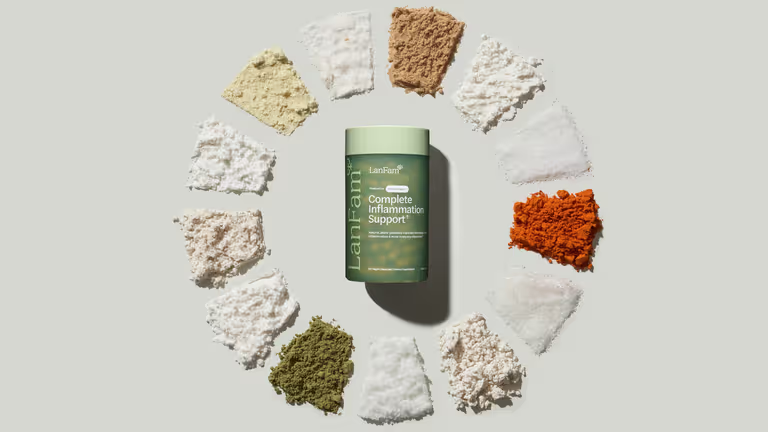
Complete Inflammation Support (Powered by ProleevaMax®) is one of the botanical + amino acid formulas. Alongside turmeric, Boswellia serrata standardized to 65% boswellic acids, trans-resveratrol, matcha, Panax ginseng and piperine, it includes L-arginine HCl, L-serine, L-glutamine, GABA and 5-HTP, plus vitamin B6 (1.7 mg) and choline (250 mg). Eleven of the 13 actives sit in a 2,401 mg proprietary blend. The label gives the blend total and the standardization percentages, not the milligrams of each amino acid, so you cannot check those doses against the studies above. We would sooner say that plainly.
ProleevaMax is formulated to support a healthy inflammatory response, and comfort and mobility. The research on individual amino acids explains why they were chosen. It is not evidence about what the finished formula does.
Who should check first
Talk to your doctor or pharmacist before starting any supplement that contains these ingredients, including ours, if any of the following applies:
- You take an SSRI, SNRI, MAOI, tricyclic antidepressant or any other medicine that raises serotonin. This is the most important interaction on the formula. 5-HTP is a direct serotonin precursor. Combining it with serotonergic drugs can cause serotonin syndrome: a combination of altered mental state, unstable heart rate, blood pressure or temperature, and neuromuscular problems [6]. MSK advises that people on SSRIs, MAOIs or tricyclics "should avoid taking 5-HTP without the supervision of a physician" [8]. A published case describes a man on sertraline who took a 5-HTP supplement and developed serotonin syndrome that led to emergency surgery on both legs; the authors state that combining sertraline with serotonin precursors "is not recommended" [7].
- You take carbidopa. MSK reports an interaction with 5-HTP [8].
- You take blood pressure medication, or you have had a heart attack. Arginine can lower blood pressure, and it has been linked to higher mortality after an acute heart attack [3].
- You are due for a 5-HIAA urine test. 5-HTP can distort the result [8].
- You are pregnant, breastfeeding, or managing a chronic illness. Ask before adding anything new.
If you want to see how the amino acids sit alongside the botanicals on our label, see the full ProleevaMax label. Four capsules a day, 13 actives, and a 90-day money-back guarantee, which gives you a full three months to decide.
These statements have not been evaluated by the Food and Drug Administration. This product is not intended to diagnose, treat, cure, or prevent any disease.
This article is for education and is not a substitute for advice from your doctor or pharmacist.

References
- 2.Kim MH, Kim H. The roles of glutamine in the intestine and its implication in intestinal diseases. Int J Mol Sci. 2017. https://pmc.ncbi.nlm.nih.gov/articles/PMC5454963/
- 3.Rath M, Müller I, Kropf P, Closs EI, Munder M. Metabolism via arginase or nitric oxide synthase: two competing arginine pathways in macrophages. Front Immunol. 2014. https://pmc.ncbi.nlm.nih.gov/articles/PMC4209874/
- 4.Memorial Sloan Kettering Cancer Center. Arginine. About Herbs, Botanicals & Other Products. https://www.mskcc.org/cancer-care/integrative-medicine/herbs/arginine
- 5.Myint SMMP, Sun LY. L-serine: neurological implications and therapeutic potential. Biomedicines. 2023. https://pmc.ncbi.nlm.nih.gov/articles/PMC10452085/
- 6.Boonstra E, de Kleijn R, Colzato LS, Alkemade A, Forstmann BU, Nieuwenhuis S. Neurotransmitters as food supplements: the effects of GABA on brain and behavior. Front Psychol. 2015. https://pmc.ncbi.nlm.nih.gov/articles/PMC4594160/
- 7.Maffei ME. 5-Hydroxytryptophan (5-HTP): natural occurrence, analysis, biosynthesis, biotechnology, physiology and toxicology. Int J Mol Sci. 2020. https://pmc.ncbi.nlm.nih.gov/articles/PMC7796270/
- 8.Patel YA, Marzella N. Dietary supplement-drug interaction-induced serotonin syndrome progressing to acute compartment syndrome. Am J Case Rep. 2017. https://pmc.ncbi.nlm.nih.gov/articles/PMC5580516/
- 9.Memorial Sloan Kettering Cancer Center. 5-HTP. About Herbs, Botanicals & Other Products. https://www.mskcc.org/cancer-care/integrative-medicine/herbs/5-htp-01
- 10.Bjørke-Monsen AL, Ueland PM. Vitamin B6: a scoping review for Nordic Nutrition Recommendations. Food Nutr Res. 2023. https://pmc.ncbi.nlm.nih.gov/articles/PMC10770651/
- 11.Kelly MJ, Breathnach C, Tracey KJ, Donnelly SC. Manipulation of the inflammatory reflex as a therapeutic strategy. Cell Rep Med. 2022. https://pmc.ncbi.nlm.nih.gov/articles/PMC9381415/
Frequently asked questions
There's a seat at our table
Letters from our family to yours — the science, the recipes, the things that actually helped real families. Leave your email and we'll send the next one.