GABA for Anxiety and Stress: Does Oral GABA Actually Reach Your Brain?
Cristina Lanzieri tackles the blood-brain-barrier debate head-on: what oral GABA actually does for anxiety and stress, the gut-brain pathway, the placebo-controlled human studies (Abdou 2006, Yoto 2012), the honest limits, and how nervous-system hyperactivation and inflammation run together.
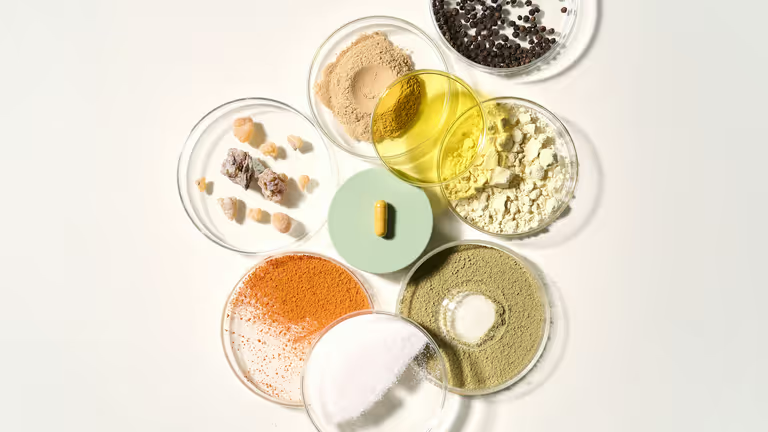
Ingredients in this letter

If you've gone looking for GABA online, you've already hit the wall everyone hits. You read a glowing review on Reddit, you read the product page, and then — buried in some comment thread — someone drops the line that stops you cold: "GABA can't even cross the blood-brain barrier, so oral supplements are useless."
I'm not going to dodge that. It's the first question, so let's make it the first answer. The short version: it's more complicated than the skeptics say, and there is real human data — not vibes, actual placebo-controlled trials — showing oral GABA does something measurable to the stressed nervous system. Whether it gets there the way the skeptics think it should is a separate question from whether it works. Let me show you both.
What GABA does, in plain terms
Your nervous system runs on a balance between two kinds of signals: excitatory (fire, react, alert) and inhibitory (slow down, settle, rest). GABA — gamma-aminobutyric acid — is the dominant inhibitory neurotransmitter in the central nervous system. When GABA binds to its receptors, it makes neurons less likely to fire. It's the brake pedal.
Anxiety, mechanistically, is a state of too much excitation and not enough braking. This is exactly why the most powerful anti-anxiety drugs ever made — benzodiazepines like Xanax and Valium — work by amplifying GABA's signal at the same receptors. They are, in effect, GABA accelerators. That's the strongest possible proof that the GABA system is central to how calm and anxiety are regulated. The open question has never been whether GABA matters for anxiety. It's whether swallowing GABA does anything useful.
The blood-brain-barrier question, answered honestly
Here's the part the Reddit comment gets half-right.
The blood-brain barrier is a tight, selective wall of cells that keeps most things in your bloodstream out of your brain unless they have a specific transporter to wave them through. GABA is small and polar, and the classical view — going back decades — was that ingested GABA mostly stays in the periphery and can't meaningfully raise brain GABA levels. On that point, the skeptics aren't making it up.
But three things complicate the simple "it can't get in, so it's useless" conclusion:
1. The gut-brain axis. Your gut has its own nervous system — the enteric nervous system — densely packed with GABA receptors and wired directly to your brain through the vagus nerve. Oral GABA can act there, on the periphery, and that signal travels upward. You don't need a molecule to cross the barrier if it can trigger a message that does. This is the leading explanation for why oral GABA produces measurable effects despite poor direct penetration.3
2. The barrier isn't equally tight for everyone, all the time. Under chronic stress and chronic inflammation, blood-brain-barrier permeability can increase. So the people most likely to be reaching for GABA — stressed, inflamed, not sleeping — may be exactly the people whose barrier is slightly more open than the textbook assumes.
3. The human data exists regardless of the mechanism debate. And this is the part I care about most, because at some point the question stops being "how does it get there" and becomes "does the outcome change." On that, we have trials.
What works: the two human studies that matter
Abdou et al., 2006 (BioFactors). This is the study that broke the "useless" narrative. In one arm, healthy volunteers took oral GABA, water, or L-theanine, and researchers recorded their brain waves. Sixty minutes after GABA, alpha-wave activity went up and beta-wave activity went down — the EEG signature of a relaxed, less-anxious state. In a second arm, participants with a fear of heights crossed a suspension bridge (a real, acute stressor). Stress normally crashes a salivary immune marker called secretory IgA; the group that took GABA beforehand didn't show that crash. So GABA tracked with both self-reported calm and a physiological stress-resilience marker.1
Yoto et al., 2012 (Amino Acids). Sixty-three adults, randomized, placebo-controlled, crossover. Participants did stressful mental arithmetic tasks while researchers tracked their EEG. Mental stress flattened their alpha and beta brain-wave activity; thirty minutes after a 100 mg dose of GABA, that stress-induced flattening was reduced compared to placebo. Translation: a modest dose of oral GABA blunted the brain's measurable response to acute stress.2
Two independent, placebo-controlled human studies, two different stressors, both pointing the same way. That's not nothing. That's the data the "it can't cross the barrier" argument conveniently leaves out.
What doesn't (yet): the honest ceiling
I'd be doing exactly what I hate if I stopped there, so here's the other side.
A 2020 systematic review in Frontiers in Neuroscience gathered the oral-GABA human studies and graded them as a body. Its conclusion was measured: there is limited evidence for a stress benefit and very limited evidence for a sleep benefit. The trials are mostly small, some are short, several are industry-adjacent, and the field needs larger, longer, fully independent studies before anyone can call this settled.4 A widely-cited 2015 review in Frontiers in Psychology put the open question even more bluntly: many users report benefits, but it remains genuinely unclear how much of the effect exceeds placebo, precisely because the central mechanism for ingested GABA is not fully nailed down.5
So if a product promises GABA will cure your anxiety, walk away. The honest claim is narrower and more interesting: oral GABA has real, replicated effects on markers of the stress response, with a clean safety profile, inside a body of evidence that's still maturing.
The part most articles miss: anxiety and inflammation run together
Here's the angle that actually drives why GABA is in our formula, and it's the one almost nobody connects.
Your nervous system and your immune system aren't separate departments. They talk constantly — and they tend to escalate together. Chronic inflammation sensitizes the nervous system; a hyperactivated nervous system feeds back into inflammatory signaling. GABA sits right at one of those exchange points. Recent research describes the GABA and GABA-receptor system as an active participant in inflammation and immune signaling — not a bystander to it.6
That's the bigger picture our family keeps coming back to: the "wired and inflamed" state isn't two problems, it's one loop. I wrote more about that overlap in what neuroinflammation actually is, and if you want the pain-specific version of how GABA quiets an over-firing system, my note on how GABA modulates what you feel goes deeper on the signaling side. For the mood-chemistry context — what actually moves the needle versus what just sounds good — there's the neurochemistry of feeling good.
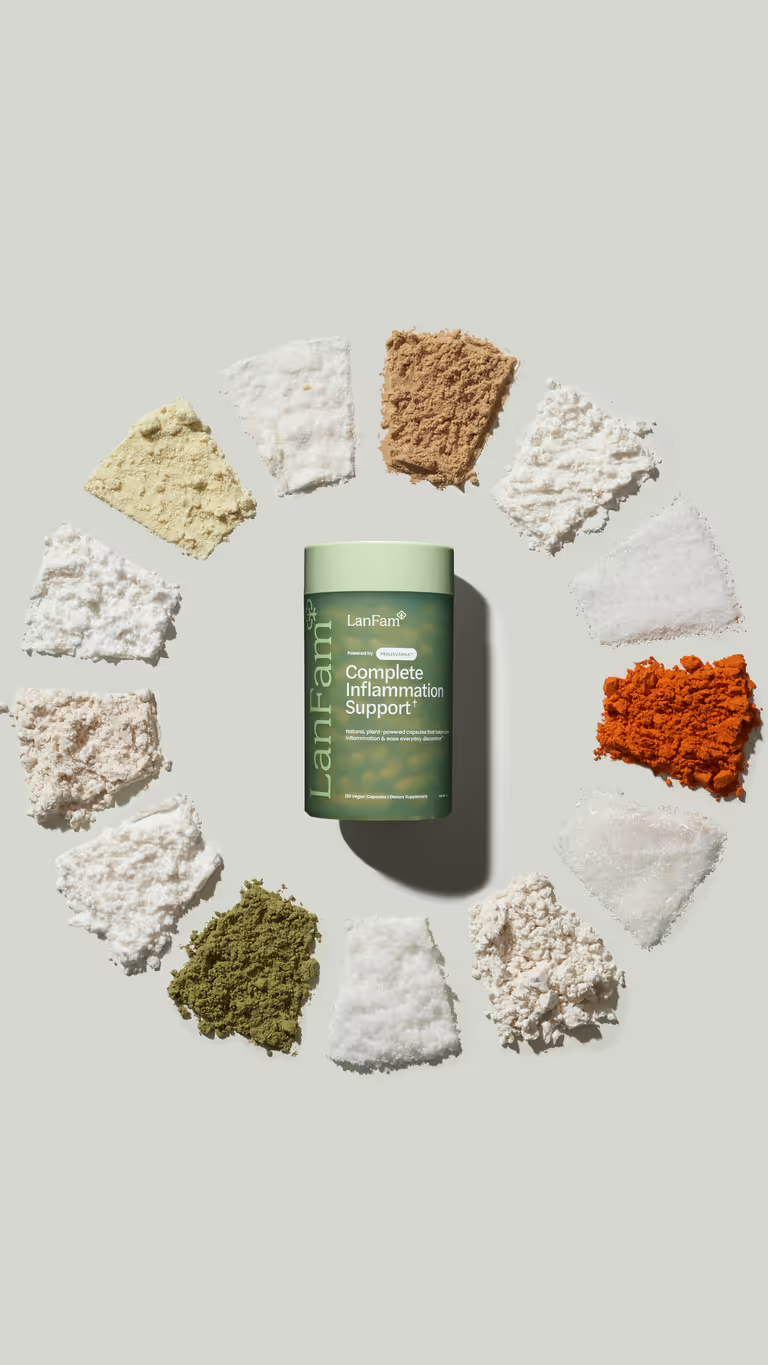
This is why GABA is one of the actives in ProleevaMax, at 99% purity — the same standardized form used in the research. It's not there as a sedative. It's there as the quieting piece of a formula built around the idea that a nervous system stuck on high alert and a body stuck in low-grade inflammation are the same fire, seen from two angles.* If sleep is the specific thing keeping you up — and inflammation is often the hidden reason it won't hold — the sleep-and-inflammation piece is the more targeted read.
A few practical notes
- Dose. Human studies use roughly 100–500 mg/day. The Yoto trial saw effects at just 100 mg. More is not automatically better.
- Timing. Most people prefer it in the evening — mild drowsiness is the most common side effect, which is a feature at night, not a bug.
- Speed. This is not a benzo. Don't expect it to abort a panic attack. The research looks at consistent use, and effects are gentle and gradual.
- Safety. A 2021 U.S. Pharmacopeia review found no serious adverse events at supplemental doses.7 But talk to your doctor first if you take sedatives, sleep medication (benzodiazepines, zolpidem, gabapentin), or antidepressants (SSRIs, SNRIs, MAOIs) — the nervous-system overlap means additive effects are possible.

References
- 2.Abdou AM, Higashiguchi S, Horie K, Kim M, Hatta H, Yokogoshi H. Relaxation and immunity enhancement effects of gamma-aminobutyric acid (GABA) administration in humans. Biofactors. 2006. https://doi.org/10.1002/biof.5520260305
- 3.Yoto A, Murao S, Motoki M, et al. Oral intake of gamma-aminobutyric acid affects mood and activities of central nervous system during stressed condition induced by mental tasks. Amino Acids. 2012. https://doi.org/10.1007/s00726-011-1206-6
- 4.Ngo DH, Vo TS. An Updated Review on Pharmaceutical Properties of Gamma-Aminobutyric Acid. Molecules. 2019. https://doi.org/10.3390/molecules24152678
- 5.Hepsomali P, Groeger JA, Nishihira J, Scholey A. Effects of Oral Gamma-Aminobutyric Acid (GABA) Administration on Stress and Sleep in Humans: A Systematic Review. Front Neurosci. 2020. https://doi.org/10.3389/fnins.2020.00923
- 6.Boonstra E, de Kleijn R, Colzato LS, Alkemade A, Forstmann BU, Nieuwenhuis S. Neurotransmitters as food supplements: the effects of GABA on brain and behavior. Front Psychol. 2015. https://doi.org/10.3389/fpsyg.2015.01520
- 7.Tian J, Kaufman DL. The GABA and GABA-Receptor System in Inflammation, Anti-Tumor Immune Responses, and COVID-19. Biomedicines. 2023. https://doi.org/10.3390/biomedicines11020254
- 8.Oketch-Rabah HA, Madden EF, Roe AL, Betz JM. United States Pharmacopeia (USP) Safety Review of Gamma-Aminobutyric Acid (GABA). Nutrients. 2021. https://doi.org/10.3390/nu13082742
Frequently asked questions
There's a seat at our table
Letters from our family to yours — the science, the recipes, the things that actually helped real families. Leave your email and we'll send the next one.