L-Glutamine and the Gut Lining — The Amino Acid Your Intestinal Cells Actually Run On
Most gut-health content talks about probiotics and skips the cells holding the barrier together. L-glutamine is the primary metabolic fuel for enterocytes — the epithelial cells that form your intestinal lining. Here's the biology, the evidence, and where supplementation honestly fits.
Ingredients in this letter

A friend of mine — someone I've known since my early years at the lab bench — texted me a few weeks ago. She'd been down a rabbit hole of "leaky gut" content on Instagram and wanted to know what I thought. The reel she sent featured a practitioner holding a probiotic bottle, explaining that "leaky gut" was the root cause of everything from fatigue to brain fog, and that four weeks of their supplement would seal it right up.
I told her I'd write this letter.
Not because the concern is wrong — there's real science underneath the "leaky gut" label, and the people drawn to that content often have legitimate symptoms that deserve a serious answer. But the content she was seeing was doing what a lot of gut-health content does: it was reaching straight for probiotics and skipping the biology entirely. The cells lining your gut — the ones holding the barrier together in the first place — are barely mentioned. And the fuel those cells actually run on? Never.
That's what I want to talk about today. Because if you care about gut barrier integrity, the conversation has to start with a molecule most people have never thought about as a gut-health nutrient: L-glutamine.
Why your gut lining is unlike anything else in the body
The intestinal epithelium — the single-cell layer that lines your small and large intestine — is one of the most structurally demanding tissues in the body. It has to do two things simultaneously that seem to contradict each other: stay highly permeable to nutrients so your body can actually absorb what you eat, and stay tightly sealed against the bacteria, undigested proteins, and immune-activating fragments that live on the other side of it.
That surface area runs to roughly 32 square meters in an average adult — about the size of a studio apartment floor — compressed into the folds and villi of an organ that fits inside your abdomen. And every cell in that layer turns over completely every three to five days, which makes it one of the fastest-renewing tissues anywhere in the body. Fast turnover means the epithelium can repair itself after insult. It also means it has enormous energy requirements — the manufacturing cost of building and rebuilding that lining, continuously, is substantial.¹
The gatekeeping at the cell-to-cell boundary is handled by structures called tight junctions — protein complexes that seal the gaps between adjacent epithelial cells. When tight junctions are intact, large molecules and pathogens can't pass between cells. When they're disrupted, they can. That "when they're disrupted" is where increased intestinal permeability begins.
What enterocytes actually run on — and it isn't what most people expect
Here's the piece of biology that I find most underappreciated, even among people who spend a lot of time thinking about gut health.
The epithelial cells lining the gut — enterocytes — do not run primarily on glucose, the way most of your other tissues do. Their primary metabolic fuel is L-glutamine.¹
In normal conditions, enterocytes extract glutamine from the bloodstream and use it to power their own cellular respiration. Glutamine isn't just a building block for protein here — it's the substrate the cell's mitochondria are burning to generate ATP. The intestinal epithelium accounts for a disproportionately large share of whole-body glutamine consumption relative to its size, because the cells are turning over that fast and burning that much fuel.²
This matters for what happens when things go wrong. The body's circulating glutamine pool is maintained by skeletal muscle, which synthesizes and releases glutamine continuously. Under normal conditions, supply roughly meets demand. But glutamine is a conditionally essential amino acid — meaning under physiological stress (serious illness, major surgery, sepsis, intense and prolonged exercise, chronic systemic inflammation), demand exceeds what the body can synthesize on its own.²
When that happens, the gut gets short-changed. Enterocytes running low on their preferred fuel slow down. Cell division slows. Repair after injury slows. And the tight junctions — those protein scaffolds that hold the barrier together — start to lose integrity.
Tight junctions and the barrier: what the research shows
The Kim & Kim review published in International Journal of Molecular Sciences in 2017 is the most thorough summary of this mechanism I'm aware of¹. The authors trace the pathway step by step: glutamine depletion in the intestinal mucosa disrupts tight junction protein expression — specifically the proteins claudin-1, occludin, and ZO-1, which are the structural anchors of those cell-to-cell seals. When glutamine is restored, tight junction protein expression recovers.
This isn't speculative. The evidence comes from cell culture studies, animal models, and human surgical populations — multiple lines of evidence pointing in the same direction. The gut barrier isn't just a passive wall. It's an active structure that requires continuous metabolic support to maintain itself, and L-glutamine is the currency that buys that maintenance.
I've written before about how gut barrier disruption feeds the whole-body inflammatory cascade — the sequence where a compromised barrier allows lipopolysaccharides and bacterial fragments to enter systemic circulation, triggering immune activation that can look like joint pain, brain fog, and elevated inflammatory markers far removed from the gut itself. The mechanism I'm describing here — glutamine depletion → tight junction breakdown → barrier compromise — is one of the upstream drivers of that cascade.
When demand exceeds supply: stress states and the depleted gut
Surgical stress is where the evidence is clearest. Following major abdominal surgery, plasma glutamine levels drop sharply — sometimes by 50% or more within 24 hours — because the whole-body stress response draws down circulating glutamine for immune cell function and wound repair simultaneously. The gut, which needs that glutamine to maintain its lining, is competing with everything else.²
Sepsis creates a similar picture, often more severe. The metabolic demands of systemic infection exhaust glutamine stores faster than muscle can replenish them, and gut barrier integrity tends to deteriorate in parallel — which then contributes to bacterial translocation that can worsen the septic state. This is one of the reasons glutamine supplementation became a standard component of surgical and ICU nutrition protocols over the past two decades.
What's less often discussed is the more moderate but more common scenario: prolonged intense exercise, chronic psychological stress, or longstanding systemic inflammation. Cordova-Martinez and colleagues, in a 2021 review in Nutrients, documented the depletion pattern in athletic populations — high training load consistently pushes plasma glutamine downward, and the recovery of gut function after exercise is partly gated by glutamine restoration.³ Cruzat and colleagues' 2018 review in the same journal puts the immune angle into the picture: glutamine is the preferred fuel for rapidly dividing immune cells as well as enterocytes, so systemic demand spikes every time the immune system is working hard — whether from training, illness, or chronic low-grade inflammation.⁴
If you spend time with the research on chronic inflammation symptoms, you'll recognize that the people most likely to have a glutamine supply problem are also the people most likely to have gut-related symptoms: digestive irregularity, intermittent bloating, general immune fragility that doesn't resolve between colds. The cluster makes biological sense when you trace the fuel-supply logic.
The "leaky gut" framing — what's right and what's overstated
I want to be plainspoken about this, because the term has become a flashpoint.
Increased intestinal permeability is a real, measurable phenomenon. It's been documented in peer-reviewed literature, measured with validated tools (lactulose-mannitol ratio, serum zonulin, intestinal fatty acid binding protein), and implicated in a range of conditions from IBD to celiac to critical illness. The biology I've described above — tight junction disruption, barrier compromise, translocation of luminal contents — is not contested.
"Leaky gut," the consumer wellness term, is something different. It's a loose framework that gets applied to symptoms ranging from documented GI disease to vague malaise, sometimes used to sell products with claims that far outrun the evidence. The overhang of marketing has made the underlying science harder to take seriously, which is frustrating — because the underlying science is serious.
Roth's 2008 paper on the nonnutritive effects of glutamine, published in the Journal of Nutrition, describes the signaling role glutamine plays beyond fuel — regulating gene expression in gut epithelial cells, supporting heat shock protein expression (which protects cells under stress), and modulating the inflammatory signaling pathways activated when the barrier is stressed.⁵ This is not probiotic biology. It's not fermentation. It's substrate availability for the cells that build and maintain the wall in the first place.
The people who respond to "leaky gut" content are often onto something real. The solutions being offered just frequently miss the cellular biology.
What the supplementation evidence actually shows
The cleanest evidence is in populations where glutamine depletion is documented and measurable: post-surgical patients, critical illness, prolonged exercise, and some IBS populations.
In surgical and ICU settings, glutamine supplementation has been shown to support gut barrier function, reduce infection rates, and shorten hospital stays in multiple clinical trials. This is the domain where the mechanism is least ambiguous, because the depletion is acute, measurable, and the intervention window is short.²
In athletic populations, the evidence is consistent with the mechanism: glutamine supplementation supports gut barrier integrity markers under exercise stress and supports immune function between training bouts.³,⁴ This is particularly well documented in endurance athletes with high training volume, where plasma glutamine depression is reproducible and correlated with increased intestinal permeability markers.
Shah and colleagues, in a 2020 review in Animals, examined glutamine's immune function across species — the translation to human physiology is imperfect, but the consistent finding is that glutamine supports the proliferation and function of rapidly dividing immune cells (lymphocytes, neutrophils, macrophages) that share the same fuel preference as enterocytes.⁶ This matters because the gut-associated lymphoid tissue (GALT) — the immune surveillance system that lines your intestine — is also running on glutamine. Barrier function and immune function in the gut are not separate systems.
In IBS populations, results are more mixed. Some trials show benefit on permeability markers; others show modest or no effect on symptom scores. The multi-ingredient gut research I've covered elsewhere suggests that the gut barrier problem in IBS rarely has a single driver — there's usually an interplay between epithelial integrity, microbiome composition, immune activation, and motility. Glutamine addresses one of those inputs. It's not a standalone cure, and I wouldn't frame it as one.
Garlick's 2001 safety review in the Journal of Nutrition remains the most comprehensive safety assessment published: oral glutamine supplementation at doses commonly used (5-20 g/day) shows a strong safety profile across the populations studied.⁷ It's worth saying clearly, because "conditionally essential" sometimes reads as alarming. It isn't. It means the body normally makes enough, except when it doesn't.
Where supplementation fits — honestly
The gut microbiome letter I wrote earlier in this series is about the trillions of bacteria on the luminal side of your gut lining. This letter is about the cells the bacteria live next to — and the fuel those cells need to hold the line. They're both real, and they're both worth understanding.
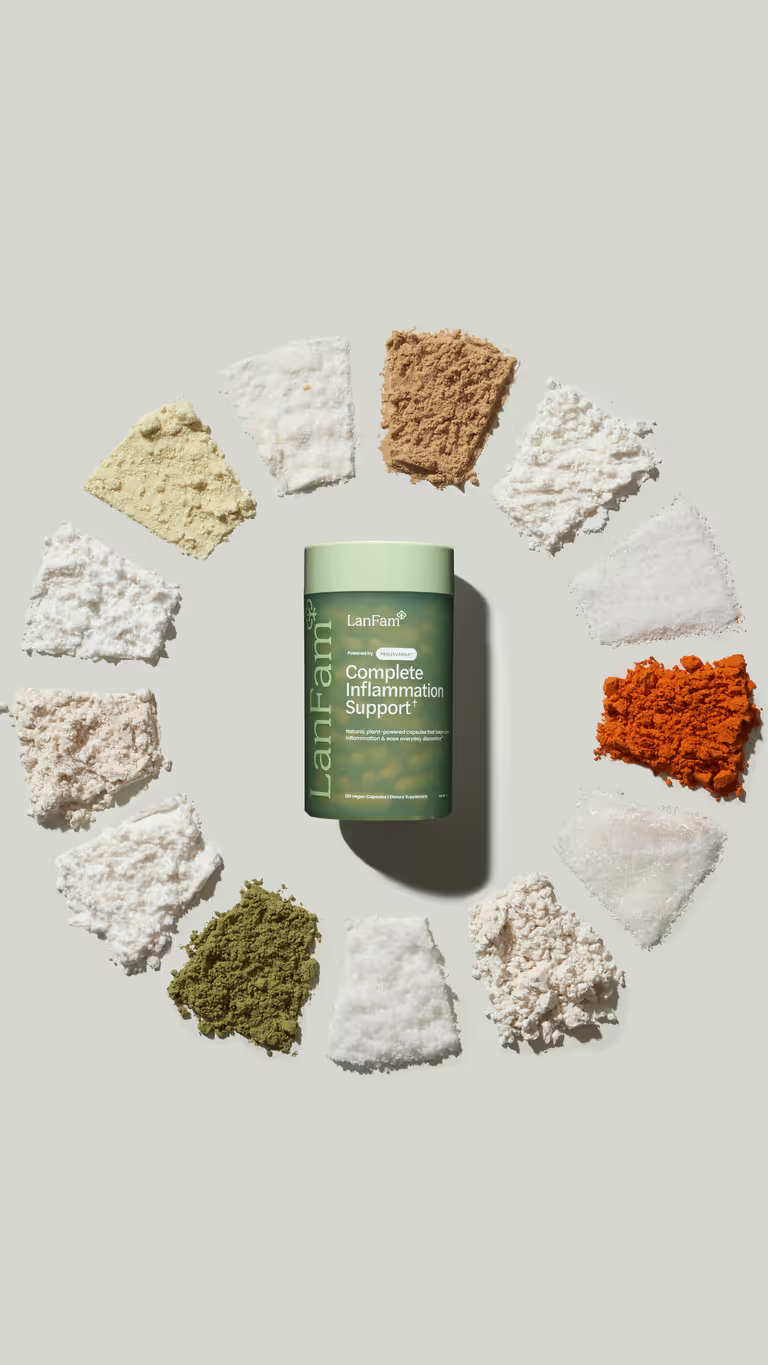
L-glutamine is one of the ingredients in ProleevaMax, and it's there for exactly the reason I've described.* The formula was built for Maria — someone navigating chronic systemic inflammation — and the gut-barrier pathway was part of the design logic from the beginning. When the whole-body inflammatory burden is high, glutamine demand goes up. The gut lining is one of the first things to feel that supply shortfall. Supporting it directly is the right call.
What I'd push back on is the idea that glutamine supplementation is only for serious athletes or surgical patients. If you're carrying meaningful chronic inflammation, your glutamine economy is under pressure in ways that may be subtler but are no less real. Daily baseline support — not as a crisis intervention, but as consistent supply for tissue that's always working — is exactly how I think about it.
The thing about the gut lining is that it never stops. Every three to five days, a new layer of cells. Every day, the tight junctions either holding or not. It's not the kind of repair work you can catch up on when you're ready. It's happening right now, and it needs what it needs.
Until next time
My friend read a draft of this letter and said: "Okay. So probiotics feed the bacteria, and glutamine feeds the wall?"
That's a good way to say it.
The bacteria matter. The research on the microbiome is real and genuinely important. But the cells holding the barrier together have their own story — their own fuel requirements, their own vulnerability to stress, their own role in whether what lives on one side of that wall stays on that side. That story has been sitting in the research literature for years, waiting for someone to translate it out of the surgical nutrition context and into the conversation that most people are actually having.
That's the gap I wanted to close.
Take care of the wall. It's doing work you don't notice until it isn't.
— Fabio
* These statements have not been evaluated by the Food and Drug Administration. This product is not intended to diagnose, treat, cure, or prevent any disease.

References
- 2.Kim MH, Kim H. The Roles of Glutamine in the Intestine and Its Implication in Intestinal Diseases. Int J Mol Sci. 2017. https://doi.org/10.3390/ijms18051051
- 3.Cruzat V, Macedo Rogero M, Noel Keane K, Curi R, Newsholme P. Glutamine: Metabolism and Immune Function, Supplementation and Clinical Translation. Nutrients. 2018. https://doi.org/10.3390/nu10111564
- 4.Cordova-Martinez A, Caballero-Garcia A, Bello HJ, Perez-Valdecantos D, Roche E. Effect of Glutamine Supplementation on Muscular Damage Biomarkers in Professional Basketball Players. Nutrients. 2021. https://doi.org/10.3390/nu13062073
- 5.Coqueiro AY, Rogero MM, Tirapegui J. Glutamine as an Anti-Fatigue Amino Acid in Sports Nutrition. Nutrients. 2019. https://doi.org/10.3390/nu11040863
- 6.Roth E. Nonnutritive effects of glutamine. J Nutr. 2008. https://doi.org/10.1093/jn/138.10.2025S
- 7.Shah AM, Wang Z, Ma J. Glutamine Metabolism and Its Role in Immunity, a Comprehensive Review. Animals. 2020. https://doi.org/10.3390/ani10020326
- 8.Garlick PJ. Assessment of the safety of glutamine and other amino acids. J Nutr. 2001. https://doi.org/10.1093/jn/131.9.2556S
- 9.Ciampa BP, et al. Emerging Therapeutic Role for Supplements in Gastrointestinal Disorders. Gastroenterol Hepatol (N Y). 2017.

There's a seat at our table
Letters from our family to yours — the science, the recipes, the things that actually helped real families. Leave your email and we'll send the next one.