Does Dairy Cause Inflammation? What Evidence Shows
Does dairy cause inflammation? For most people the evidence says no, and fermented dairy may even help. Here is what the research documents, plainly.
Ingredients in this letter

Does dairy cause inflammation? For most people, the evidence says no. Large reviews of clinical trials find that dairy does not raise inflammatory markers in healthy adults, and fermented dairy like yogurt and kefir may even support a healthy inflammatory response. The real story is about you, not dairy in general: a smaller group of people with a true sensitivity or a reaction to certain milk proteins can feel worse after dairy. The honest answer depends on which group you fall into.
The short version, then the nuance
If you have ever cut dairy "to fight inflammation," you are not alone. It is one of the most common elimination experiments women in their 40s to 60s try. The instinct is reasonable. The evidence, though, is more interesting than the headlines suggest.
Here is the honest summary up front. For the general population, the best available research does not support the idea that dairy drives chronic inflammation. Some dairy foods, especially fermented ones, point in the opposite direction. At the same time, a real minority of people feel worse after dairy for reasons that have little to do with classic inflammation. Both things are true. Let's separate them carefully.
What the clinical trials actually found
The strongest evidence on this question comes from randomized controlled trials, where researchers assign people to consume dairy or not and then measure inflammation in the blood. When you pool those trials, a consistent picture emerges.
One meta-analysis of 11 randomized controlled trials, covering 663 adults, found that higher dairy intake compared with low or no dairy was associated with lower C-reactive protein (CRP), tumor necrosis factor-alpha (TNF-alpha), interleukin-6 (IL-6), and another inflammatory signal called MCP — the opposite of what you would expect if dairy were inflammatory [1].
A separate updated systematic review of randomized clinical trials reached a similar conclusion. Across studies in healthy people and in people who were overweight or living with a chronic condition, dairy products mostly showed no adverse effect on inflammation, and several showed favorable effects [2].
A large review published in Advances in Nutrition used an "inflammatory score" to summarize the impact of dairy across 52 trials and 98 different inflammatory markers. The overall score was lower — meaning less inflammatory — in diets containing dairy, with similar results for both low-fat and high-fat dairy [3].
And in people who specifically already had low-grade systemic inflammation — the group most likely to be worried about this — a randomized trial found that dairy consumption had no impact on their inflammatory biomarkers in either direction [4].
The takeaway: at the population level, the claim that "dairy causes inflammation" is not supported by controlled research.
Fermented dairy looks like the standout
Not all dairy behaves the same way in the body. Fermented dairy — yogurt, kefir, some cheeses — tends to perform best in the research, and the likely reason is your gut.
A meta-analysis of clinical trials reported that fermented dairy products decreased CRP levels, and found a greater anti-inflammatory effect for fermented dairy than for non-fermented dairy [5].
The mechanism is plausible and worth understanding. Yogurt and other fermented dairy may support immune health through the gut — reducing gut permeability ("leaky gut"), increasing the diversity of beneficial gut bacteria, and limiting the movement of bacterial endotoxins from the gut into the bloodstream [6]. One nine-week trial found that daily yogurt helped attenuate inflammation by improving the intestinal barrier.
Population data agrees. In the long-running Framingham Offspring Study, regular yogurt eaters had lower levels of chronic inflammation than non-consumers [7].
If you enjoy dairy and want the lowest-risk options, plain unsweetened yogurt and kefir are reasonable choices to favor.
So why do some people feel worse after dairy?
This is the part most "dairy is fine" articles skip, and it matters. Real people have real reactions. They are mostly not classic chronic inflammation, but they are not imaginary either.
Lactose intolerance
Lactose intolerance is a digestive issue, not an inflammatory disease. When the body makes less of the enzyme lactase, undigested lactose ferments in the gut and causes bloating, gas, and discomfort. Fermented dairy is often easier to tolerate because fermentation reduces lactose. If your reaction is mostly digestive and shows up within hours, lactose is a likely culprit — and it is manageable.
The A1 versus A2 milk question
Conventional cow's milk contains two main forms of a protein called beta-casein, known as A1 and A2. When A1 beta-casein is digested, it releases a fragment called beta-casomorphin-7 (BCM-7).
A randomized study comparing the two found that milk containing A1 beta-casein was associated with increased markers of gastrointestinal inflammation and worse post-dairy digestive discomfort, while milk containing only A2 beta-casein did not aggravate those symptoms relative to baseline [8]. A broader review of human studies reached the same general direction, while noting the evidence is still developing and not uniform [9].
Practical meaning: if regular milk bothers you but you are not lactose intolerant, A2 milk or goat dairy may be worth a personal trial. This is individual, not universal.
High-fat, high-sugar "dairy" is its own thing
A bowl of plain kefir and a fast-food milkshake are both technically dairy, but they are not the same event in your body. The added sugar, refined toppings, and large saturated-fat loads in many dairy-based desserts can drive a short-term inflammatory response after the meal. Interestingly, a natural component of the milk fat globule membrane (MFGM) appears to blunt some of that postprandial inflammation from high-fat meals [10]. The lesson is to judge the whole food, not the word "dairy."
A simple way to read your own dairy
| If you experience... | Likely explanation | A reasonable next step |
|---|---|---|
| Bloating, gas within a few hours | Lactose intolerance | Try lactose-free or fermented dairy |
| Digestive discomfort with regular milk, fine with yogurt | Possible A1 beta-casein sensitivity | Trial A2 or goat dairy |
| No symptoms at all | Likely tolerant | No need to eliminate |
| Reaction only to sweetened, high-fat dairy | The sugar and fat load, not dairy itself | Choose plain, simpler dairy |
This is for self-awareness, not diagnosis. Persistent or severe symptoms deserve a conversation with your doctor.
What this won't do, honestly
Cutting dairy is not a reliable inflammation strategy for most people, and it carries trade-offs worth naming.
- Eliminating dairy will not lower inflammation if dairy was never your problem. You may simply lose calcium, protein, and vitamin D while feeling no better.
- No single food explains chronic inflammation. Sleep, stress, activity, body composition, overall diet pattern, and genetics all feed into your inflammatory response. Removing one food rarely moves the needle on its own.
- "Anti-inflammatory" yogurt is not a treatment. Favoring fermented dairy is a sensible food choice. It is not a therapy for any medical condition, and it will not work like a medication.
If you want a deeper look at the full set of inputs, our guide to what causes inflammation in the body covers the bigger picture.
Where dairy fits in a healthy inflammatory response
Inflammation is not a single switch. It is a network of pathways, which is exactly why blaming one food group tends to disappoint. The body manages its inflammatory response through several mechanisms at once, and a calm, balanced response usually comes from supporting several of them together, not from removing one ingredient.
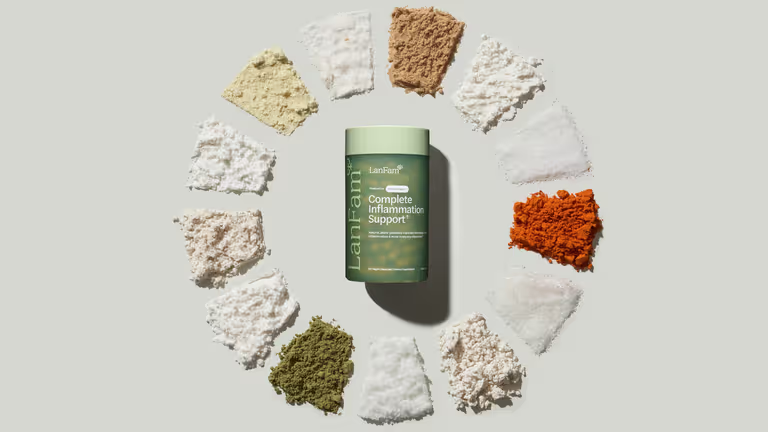
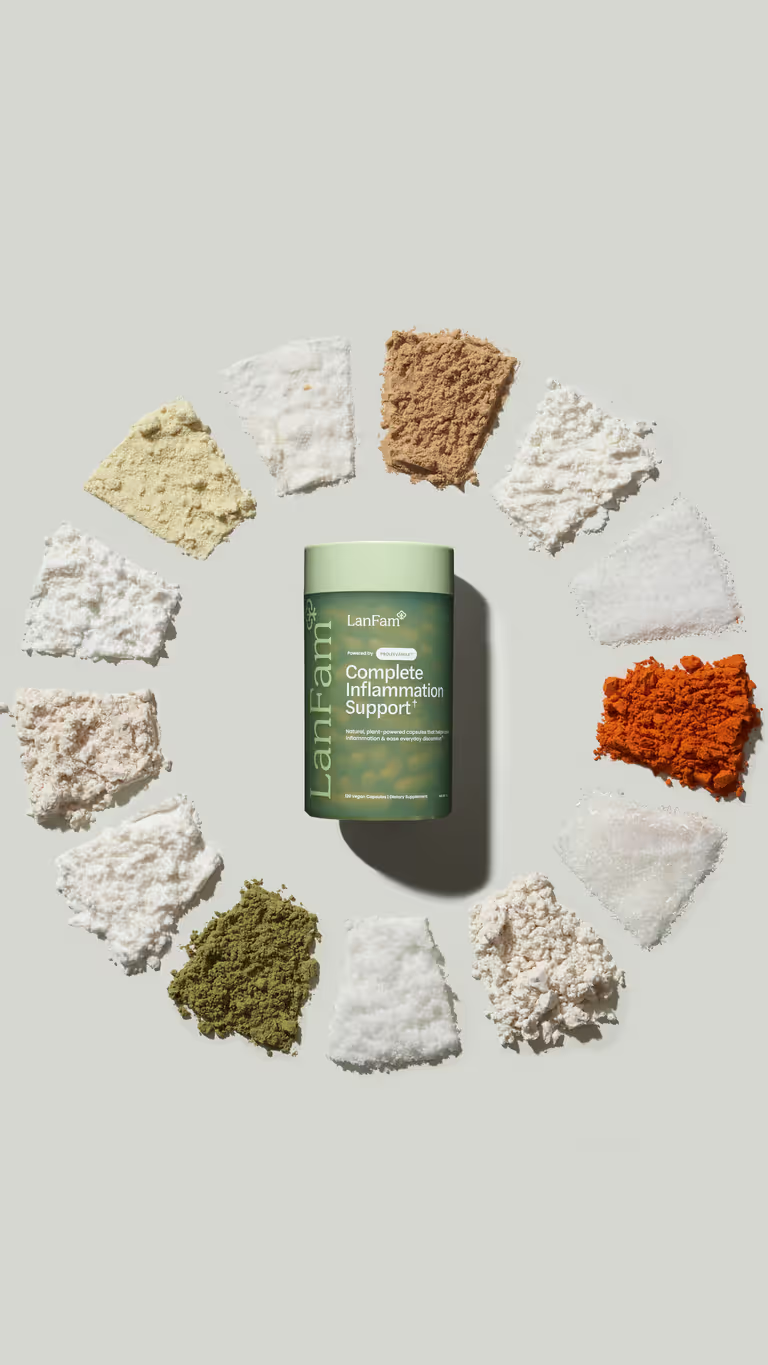
That multi-pathway idea is the same thinking behind Complete Inflammation Support (Powered by ProleevaMax®). ProleevaMax does not contain dairy, and it is not a substitute for a balanced diet. What it offers is a formula built around the idea that a healthy inflammatory response has more than one lever.
It pairs standardized botanicals — including Boswellia (Indian Frankincense) standardized to 65% boswellic acids, a compound studied in randomized, placebo-controlled trials for joint comfort and mobility [11] and whole-root turmeric — with amino acids like L-Glutamine and L-Serine that support nervous system resilience. The goal is to support the body's own inflammatory balance through more than one pathway, instead of asking a single nutrient to do everything.
To be transparent: ProleevaMax is not a probiotic and does not aim to replace the gut benefits of fermented dairy. They are different tools. If you tolerate yogurt and kefir, keep enjoying them.
These statements have not been evaluated by the Food and Drug Administration. This product is not intended to diagnose, treat, cure, or prevent any disease.
The bottom line
For most people, dairy is not the inflammation villain it is made out to be — and fermented dairy may quietly help. Pay attention to your own body, favor plain and fermented options, and judge whole foods instead of single ingredients. If you want to support a healthy inflammatory response more broadly, think in pathways, not in one food at a time.
Explore how a multi-pathway approach works: see Complete Inflammation Support (Powered by ProleevaMax®), the full ingredients list, the science behind the formula, and how it works. Every order is backed by our 90-day money-back guarantee, the same length as our 90-Day Protocol — with checkpoints at Week 2, Week 4, Week 8, and Day 90 — because real change in your inflammatory response takes time, and we want you to have it.
For more food-and-inflammation guides, read does gluten cause inflammation and the worst foods for inflammation.

References
- 2.Moosavian SP, Rahimlou M, Saneei P, Esmaillzadeh A. Effects of dairy products consumption on inflammatory biomarkers among adults: a systematic review and meta-analysis of randomized controlled trials. Nutrition, Metabolism and Cardiovascular Diseases. 2020. https://doi.org/10.1016/j.numecd.2020.01.011
- 3.Ulven SM, Holven KB, Gil A, Rangel-Huerta OD. Milk and dairy product consumption and inflammatory biomarkers: an updated systematic review of randomized clinical trials. Advances in Nutrition. 2019. https://doi.org/10.1093/advances/nmy072
- 4.Hess JM, Stephensen CB, Kratz M, Bolling BW. Exploring the links between diet and inflammation: dairy foods as case studies. Advances in Nutrition. 2021. https://doi.org/10.1093/advances/nmab108
- 5.Labonté MÈ, Cyr A, Abdullah MM, et al. Dairy product consumption has no impact on biomarkers of inflammation among men and women with low-grade systemic inflammation. Journal of Nutrition. 2014. https://doi.org/10.3945/jn.114.200576
- 6.Zhang X, Luo Q, Guan X, et al. Effects of fermented dairy products on inflammatory biomarkers: a meta-analysis. Nutrition, Metabolism and Cardiovascular Diseases. 2023. https://doi.org/10.1016/j.numecd.2022.12.014
- 7.Hasegawa Y, Bolling BW. Yogurt consumption for improving immune health. Current Opinion in Food Science. 2023. https://doi.org/10.1016/j.cofs.2023.101017
- 8.Yuan M, Singer MR, Moore LL. Yogurt consumption is associated with lower levels of chronic inflammation in the Framingham Offspring Study. Nutrients. 2021. https://doi.org/10.3390/nu13020506
- 9.Jianqin S, Leiming X, Lu X, Yelland GW, Ni J, Clarke AJ. Effects of milk containing only A2 beta casein versus milk containing both A1 and A2 beta casein proteins on gastrointestinal physiology, symptoms of discomfort, and cognitive behavior of people with self-reported intolerance to traditional cows' milk. Nutrition Journal. 2016. https://doi.org/10.1186/s12937-016-0147-z
- 10.González-Rodríguez N, Vázquez-Liz N, Rodríguez-Sampedro A, Regal P, Fente C, Lamas A. The impact of A1- and A2 β-casein on health outcomes: a comprehensive review of evidence from human studies. Applied Sciences. 2025. https://doi.org/10.3390/app15137278
- 11.Deng L, Michielsen CCJR, Vrieling F, et al. Milk fat globule membrane modulates inflammatory pathways in human monocytes: a crossover human intervention study. Clinical Nutrition. 2024. https://doi.org/10.1016/j.clnu.2023.11.038
- 12.Majeed A, Majeed S, Satish G, et al. A standardized Boswellia serrata extract shows improvements in knee osteoarthritis within five days: a double-blind, randomized, three-arm, parallel-group, multi-center, placebo-controlled trial. Frontiers in Pharmacology. 2024. https://doi.org/10.3389/fphar.2024.1428440
Frequently asked questions

There's a seat at our table
Letters from our family to yours — the science, the recipes, the things that actually helped real families. Leave your email and we'll send the next one.