Does Gluten Cause Inflammation? The Real Answer
Does gluten cause inflammation? The honest answer depends on who you are. Here is what the research shows for celiac, sensitivity, and everyone else.
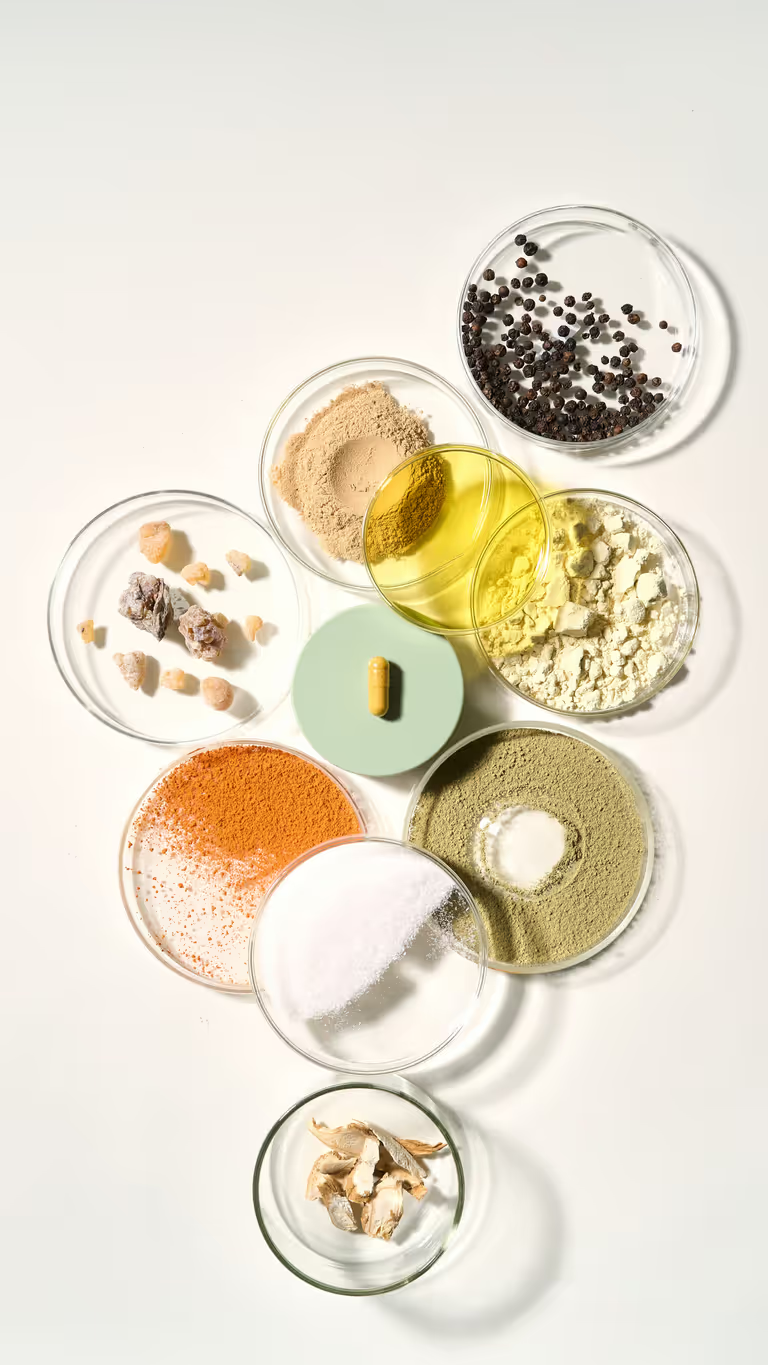
Ingredients in this letter

Does gluten cause inflammation? For some people, yes. For most people, no. If you have celiac disease, gluten triggers a measurable immune-driven inflammatory response in the small intestine. If you have non-celiac gluten sensitivity, the picture is murkier and other parts of wheat may be the real trigger. And if you have neither, the research documents no clear benefit to cutting gluten for inflammation. The honest answer depends entirely on which group you fall into.
The honest answer starts with a question: who are you?
"Does gluten cause inflammation" is one of the most searched health questions, and most articles answer it as if everyone is the same. They are not. The science splits people into three groups, and the answer changes completely depending on which one you belong to.
Let's walk through each one. No fearmongering. Just what the research documents.
Group 1: Celiac disease — yes, gluten causes inflammation
Celiac disease is an autoimmune condition. When someone with celiac eats gluten, their immune system attacks the lining of the small intestine. This is not a vague reaction. It is a measurable, immune-mediated inflammatory cascade.
Here is the mechanism in plain language. Gluten contains a protein fragment called gliadin. In people with the genetic setup for celiac disease, gliadin peptides cross the gut lining and activate gluten-specific T cells. Those T cells release pro-inflammatory signals (cytokines like interferon-gamma, IL-1β, and IL-6). The result is damage to the intestinal lining — villous atrophy, where the tiny finger-like absorbers in your gut flatten out. Researchers describe inflammation as central to the entire disease process, and they have found inflammatory markers elevated in intestinal tissue even before visible damage appears [1].
For this group, the answer is unambiguous. Gluten triggers inflammation, and the only documented management is a strict, lifelong gluten-free diet.
How celiac shows up
Symptoms reach beyond the gut. According to the Mayo Clinic [2], celiac disease can cause bloating, diarrhea, fatigue, anemia, a burning skin rash, headaches, and joint discomfort. Many women in their 40s to 60s carry these symptoms for years before anyone connects them to gluten.
If you suspect celiac disease, get tested before you cut gluten. A blood test looks for specific antibodies, but it only works while you are still eating gluten. Remove gluten first, and the test can read normal even when the condition is present. Talk to your doctor.
Group 2: Non-celiac gluten sensitivity — real symptoms, complicated cause
This is the group that gets the most confusing coverage, so let's be careful and specific.
Non-celiac gluten sensitivity (NCGS) describes people who feel worse after eating gluten-containing foods but do not have celiac disease or a wheat allergy. The symptoms are real: bloating, brain fog, fatigue, joint discomfort, and digestive upset. A multicenter, randomized, double-blind, placebo-controlled gluten challenge confirmed that a subset of people with functional gut symptoms genuinely react when gluten is reintroduced without their knowledge [3].
So far this sounds like a clear yes. Here is the twist.
The fructan plot twist
When researchers test gluten head-to-head against other components of wheat, gluten often loses. A notable randomized, double-blind, placebo-controlled crossover trial in Gastroenterology found that fructans — not gluten — induced more symptoms in people who self-reported as gluten-sensitive [4].
Fructans are a type of fermentable carbohydrate (a FODMAP) found in wheat — and also in onions, garlic, and many other foods. They can cause gas, bloating, and discomfort in sensitive guts through a completely different mechanism than gluten.
A broader review reached a similar conclusion: gluten alone triggers symptoms in a minority of people who believe they are gluten-sensitive, and other wheat compounds (FODMAPs, amylase trypsin inhibitors) are often the real drivers [5].
What does this mean for you? If gluten-containing foods make you feel worse, that experience is valid. But gluten may not be the actual culprit. This matters, because cutting all gluten when fructans are the problem means you restrict your diet far more than necessary — and you might still feel unwell.
Group 3: Everyone else — no, gluten is not your inflammation problem
If you do not have celiac disease and you tolerate gluten without trouble, the evidence here is consistent and a little uncomfortable for the wellness industry.
Harvard Health [6] states it plainly: there is no compelling evidence that a gluten-free diet improves health or prevents disease in people who do not need it. Gluten is not an inflammatory trigger for the general population.
It can be worse than neutral. One study of non-celiac healthy women found that a gluten-free diet reduced diet quality and increased the inflammatory potential of their eating pattern — driven by less fiber, fewer B vitamins, and more fat and sodium from processed gluten-free substitutes [7].
In other words, for this group, going gluten-free to "fight inflammation" can backfire. The whole grains you remove — and the fiber they carry — are part of an anti-inflammatory eating pattern.
So why does gluten get blamed for everything?
Three reasons explain the gap between the headlines and the data.
- Real reactions get mislabeled. People feel better cutting wheat and credit gluten, when fructans, portion size, or processed-food load may deserve the credit.
- "Gluten-free" became a halo. A gluten-free cookie is still a cookie. The label signals "healthy" without changing what is inside.
- Inflammation is complicated. It is tempting to find one villain. The body does not work that way.
Inflammation is a whole-body system, not a single switch
This is the part most gluten articles skip. Your inflammatory response is shaped by sleep, stress, movement, body composition, and your entire dietary pattern — not one protein. Chasing a single ingredient rarely moves the needle for a healthy inflammatory response.
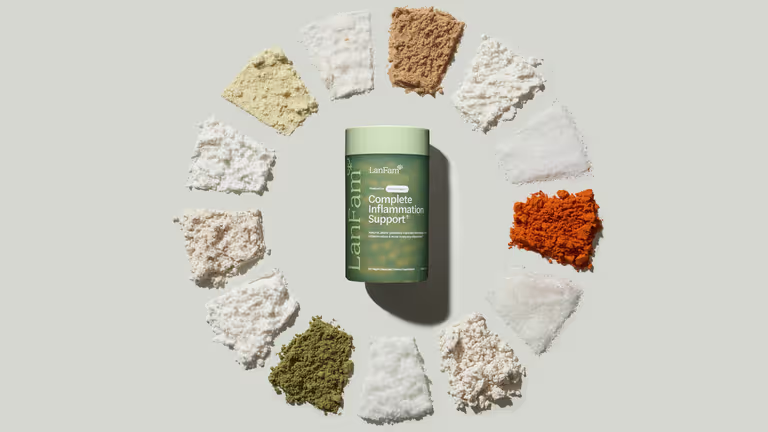
That is the thinking behind how we built Complete Inflammation Support (Powered by ProleevaMax®). Instead of targeting one pathway, ProleevaMax is a multi-pathway formula designed to support a healthy inflammatory response and nervous-system resilience together.
A few examples of the design logic, grounded in research:
- Boswellia (Indian Frankincense), standardized to 65% boswellic acids. Boswellic acids — particularly AKBA — are documented to inhibit the 5-lipoxygenase (5-LOX) enzyme, a key step in the inflammatory signaling pathway [8]. A systematic review and meta-analysis found Boswellia extracts may support joint comfort and mobility [9].
- L-Glutamine + L-Serine. A pairing of amino acids included to support nervous-system resilience — the often-ignored half of how the body experiences inflammation.
- Matcha (EGCG + L-theanine), Asian Ginseng, Resveratrol, GABA, 5-HTP, L-Arginine, Vitamin B6, Choline, and Black Pepper (piperine) round out a proprietary blend built around the idea that inflammation responds best to support across several pathways at once.
ProleevaMax is a supplement that supports a healthy inflammatory response. It is not a treatment for celiac disease, gluten sensitivity, or any condition, and it will not let you eat gluten safely if your body cannot tolerate it.
What this won't do (the honest limitations)
We want your trust more than a quick sale. So here is what neither gluten avoidance nor any supplement can do.
- Cutting gluten will not "cure inflammation" for the general population. The evidence does not support it.
- ProleevaMax does not contain gluten-digesting enzymes. It will not make gluten safe for anyone with celiac disease. If you have celiac, a strict gluten-free diet is the only path, full stop.
- ProleevaMax does not contain CoQ10, omega-3 fish oil, vitamin D, magnesium, quercetin, probiotics, or ashwagandha. Those are worth understanding as a category, and some may belong in your routine — but be clear about what is and isn't in any product you buy. ProleevaMax is built on a different, multi-pathway design instead of a single popular ingredient.
- Turmeric in ProleevaMax is a whole-root extract, not an isolated standardized-curcumin dose. We do not claim it delivers a high-curcumin concentration.
- No supplement replaces the basics: sleep, movement, fiber, and managing stress drive your inflammatory response more than any single capsule.
These statements have not been evaluated by the Food and Drug Administration. This product is not intended to diagnose, treat, cure, or prevent any disease.
Support a healthy inflammatory response, the smarter way
Inflammation rarely traces back to one food. If you have celiac disease, your path is clear: strict gluten avoidance, guided by your doctor. For everyone else, the better question is how to support a healthy inflammatory response across your whole life — diet, movement, sleep, and targeted support.
That is what Complete Inflammation Support (Powered by ProleevaMax®) is built for. Explore the science and decide for yourself:
- See the full multi-pathway formula on the ProleevaMax product page
- Review every standardized ingredient and why it's included
- Read the research behind the formula on our science page
- Understand the mechanism step by step in how it works
Curious about other foods and inflammation? Keep reading:
The 90-Day Protocol. Supporting a healthy inflammatory response is a commitment, not a quick fix. With ProleevaMax, many people begin noticing an initial response around Week 2, clearer changes in comfort and mobility by Week 4, meaningful improvement in daily function by Week 8, and the full picture at Day 90. We back that timeline with our 90-day money-back guarantee — the same length as the protocol, so you have the room to judge it honestly.

References
- 2.Barone MV, Auricchio R, Nanayakkara M, Greco L, Troncone R, Auricchio S. Pivotal role of inflammation in celiac disease. International Journal of Molecular Sciences. 2022. https://doi.org/10.3390/ijms23137177
- 3.Mayo Clinic Staff. Celiac disease - Symptoms and causes. Mayo Clinic. https://www.mayoclinic.org/diseases-conditions/celiac-disease/symptoms-causes/syc-20352220
- 4.Elli L, Tomba C, Branchi F, et al. Evidence for the presence of non-celiac gluten sensitivity in patients with functional gastrointestinal symptoms: results from a multicenter randomized double-blind placebo-controlled gluten challenge. Nutrients. 2016. https://doi.org/10.3390/nu8020084
- 5.Skodje GI, Sarna VK, Minelle IH, et al. Fructan, rather than gluten, induces symptoms in patients with self-reported non-celiac gluten sensitivity. Gastroenterology. 2018. https://doi.org/10.1053/j.gastro.2017.10.040
- 6.Leonard MM, Sapone A, Catassi C, Fasano A. Celiac disease and nonceliac gluten sensitivity: a review. JAMA. 2017. https://doi.org/10.1001/jama.2017.9730
- 7.Harvard Health Publishing. Ditch the gluten, improve your health? Harvard Health. https://www.health.harvard.edu/healthy-aging-and-longevity/ditch-the-gluten-improve-your-health
- 8.Fialho Henriques HK, Fonseca LM, de Andrade KS, Shivappa N, Hébert JR, Ferreira AVM, Alvarez Leite JI. Gluten-free diet reduces diet quality and increases inflammatory potential in non-celiac healthy women. Journal of the American Nutrition Association. 2022. https://doi.org/10.1080/07315724.2021.1962769
- 9.Peng C, Yang Y, Wang Y, Gong B, Sun X, Yang X. From bench to bedside, boswellic acids in anti-inflammatory therapy — mechanistic insights, bioavailability challenges, and optimization approaches. Frontiers in Pharmacology. 2025. https://doi.org/10.3389/fphar.2025.1692443
- 10.Yu G, Xiang W, Zhang T, Zeng L, Yang K, Li J. Effectiveness of Boswellia and Boswellia extract for osteoarthritis patients: a systematic review and meta-analysis. BMC Complementary Medicine and Therapies. 2020. https://doi.org/10.1186/s12906-020-02985-6
Frequently asked questions
There's a seat at our table
Letters from our family to yours — the science, the recipes, the things that actually helped real families. Leave your email and we'll send the next one.