The Estrogen-Serotonin Axis: What 5-HTP Actually Does for Perimenopause Mood
How falling estrogen affects the serotonin system in perimenopause, what 5-HTP (and its B6 cofactor) actually supports for mood, and why the research does not support a hot flash claim.
Ingredients in this letter

Someone asked me the other day why she felt so unlike herself — short with the people she loves, teary over things that never used to land that way, anxious at 3 a.m. for no reason she could name. She's in her late forties. Her doctor had checked her thyroid, told her everything looked fine, and that was that. And she said the thing I hear most: "I don't feel depressed exactly. I feel like the floor under my mood moved."
I knew that feeling. And here's what I didn't understand for the longest time — something Fabio explained to me one night at the kitchen table, the way he explains everything, slowly and with too many details I eventually came to love: serotonin was part of what my estrogen had been quietly protecting all along. When estrogen falls, it doesn't just take hot flashes and irregular cycles with it. It pulls on the whole serotonin system. I didn't realize that the chemistry behind feeling steady was tangled up with the hormone everyone only talks about for periods and bone density.
So I want to write you the letter I wish someone had written me — about whether 5-HTP, the serotonin precursor you've probably already read about, actually applies to your perimenopause mood specifically. Not anxiety in general. Not depression as a diagnosis. The particular mood weather of this transition. I'll be honest about what the research supports and, just as honest, about what it doesn't.
Why estrogen and serotonin are tied together
Here's the part that reframed everything for me.
Estrogen is not only a reproductive hormone. It acts directly on the brain, including on the systems that make and use serotonin. In a foundational review of estrogen's brain effects, the neuroscientist Bruce McEwen described how ovarian steroids influence serotonin pathways, mood, and cognition far beyond the hypothalamus.² Estrogen touches serotonin synthesis, the density of serotonin receptors, and how efficiently serotonin gets cleared — which is a long way of saying estrogen has been helping hold your mood system in tune for decades.
So when estrogen starts its long, uneven decline in perimenopause — and "uneven" is the key word, because it doesn't drop in a clean line, it lurches — the serotonin system loses some of that steadying input. That's a mechanistic reason mood can feel less anchored during this window even when nothing in your life has changed. Estrogen's broader role in brain and cognitive aging is well described in the menopause literature.⁷
I want to be careful here, because this is exactly where wellness writing tends to overreach. The estrogen-serotonin link is real and well-documented at the mechanism level. That does not mean every mood change in midlife is "just hormones," or that a precursor supplement rebalances a hormone. It means there's a plausible, studied biological reason the two move together — and that gives us a sensible place to look.
Where 5-HTP fits in the chain
Think of serotonin production as a short assembly line:
- Tryptophan (an amino acid from food) →
- 5-HTP (made from tryptophan) →
- Serotonin (made from 5-HTP).¹
The step from 5-HTP to serotonin is handled by an enzyme called aromatic L-amino acid decarboxylase. That enzyme can't do its job without vitamin B6 in its active form, pyridoxal 5'-phosphate — B6 is the cofactor that makes the final conversion possible.⁵ This is genuinely why B6 keeps showing up next to 5-HTP: it's not marketing pairing, it's the chemistry. Give the body 5-HTP without adequate B6 and you've handed it raw material with no tool to finish the job.
Supplementing 5-HTP raises the available precursor. Because it enters after the rate-limiting first step, it can pass into the brain and be converted to serotonin more readily than dietary tryptophan, which has to compete for transport.¹ That's the whole mechanistic case: more precursor, with the B6 cofactor present, supporting serotonin production.
What the research actually supports — and what it doesn't
I promised honesty, so here's the unvarnished version.
Where there's a real signal: mood and depressive symptoms. A Cochrane systematic review looked at 5-HTP and tryptophan for depression and concluded they appeared more effective than placebo — while flagging that the quality and size of the available trials were limited, so the finding should be read cautiously, not as settled.³ A later study explored 5-HTP in treatment-resistant depression and supported continued investigation of the serotonin-precursor approach.⁴ Translation: the mood-support direction is plausible and has human data behind it, but the evidence base is modest and imperfect. Anyone telling you it's "clinically proven" is overstating it.
Where there is no signal: hot flashes. This is the one I most want you to hear, because it's the most over-promised. A small double-blind trial gave 24 postmenopausal women 150 mg/day of 5-HTP and measured hot flash frequency objectively. It found no significant effect.⁶ The serotonin system is involved in temperature regulation, so the hypothesis was reasonable — but the result was negative. 5-HTP is not a hot flash treatment. If your primary symptom is vasomotor, this is the wrong tool, and I'd rather tell you that now than have you spend three months disappointed.
What this adds up to. 5-HTP is a mood-pathway support with a modest evidence base, paired sensibly with B6, that has a coherent mechanistic story for the perimenopause window specifically — because the serotonin system it feeds is the same system estrogen had been steadying.² It is not a hormone, not a hot flash remedy, and not a substitute for talking to your doctor — especially if you're already on an SSRI or another serotonergic medication, where combining serotonergic agents carries real risk and is a conversation to have with a clinician, not a supplement label.
How I think about it, practically
I'm the CFO of a supplement company, not your doctor, and I'd never write you a letter pretending otherwise. So here's how I actually think about this as a woman who has been through her own long stretch of chronic symptoms.
I think of 5-HTP as one input into a system that estrogen used to subsidize — not a switch that flips the floor back into place. The honest framing is support for a steadier serotonin baseline, with B6 alongside it because the conversion needs it.⁵ Fabio's rule for everything we make is the same rule I'd give a friend: if the mechanism is real and the evidence is honestly stated, it's worth considering as one piece — and if the claim is bigger than the data, walk away.
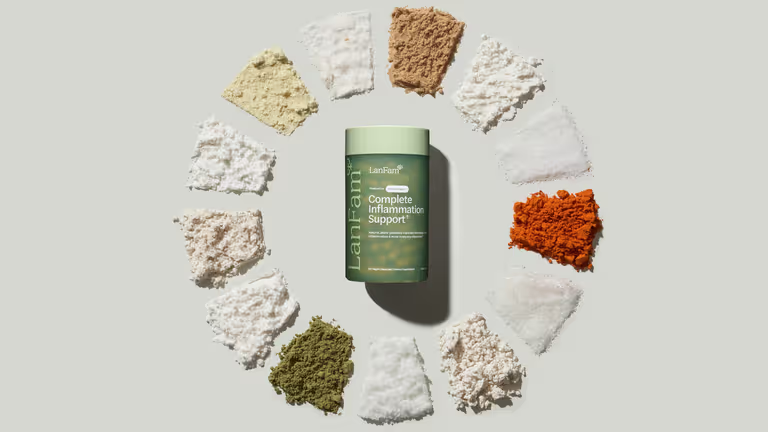
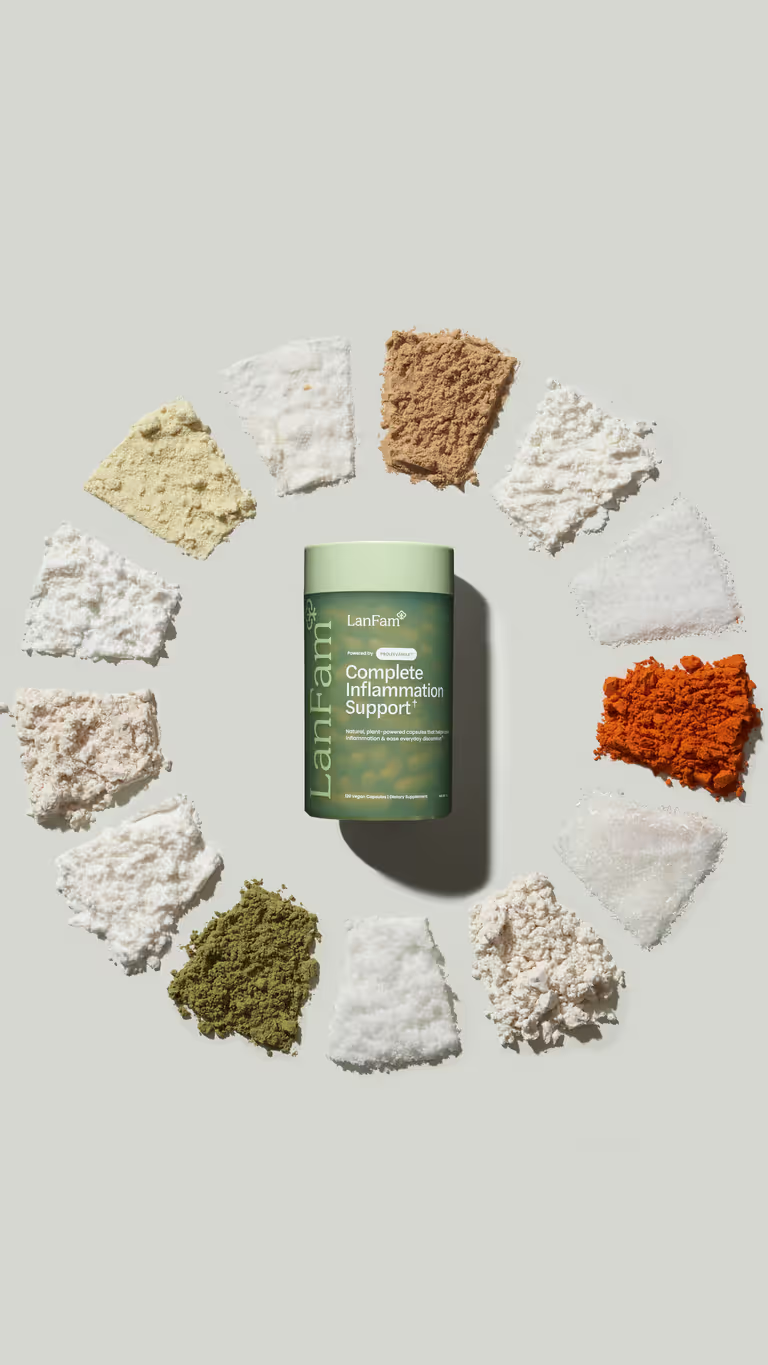
The serotonin-precursor pathway is one of several our family looked at when we were thinking about the nervous-system side of inflammation and midlife. In the formula Fabio built for me — ProleevaMax, our Complete Inflammation Support — 5-HTP and vitamin B6 both appear among the standardized actives, because the mood-and-nervous-system pathway is part of the same picture as the joints and the fog, not a separate one.* I'm not going to oversell it to you. I'm telling you what's in it and why, the way I'd tell you across the table.
Frequently Asked Questions
Is 5-HTP the same as taking estrogen? No. 5-HTP works downstream of estrogen, on the serotonin system, by supplying serotonin's direct precursor.¹ It does not raise estrogen and is not hormone replacement. It addresses one of the systems estrogen used to help regulate, not estrogen itself.²
Will 5-HTP help my hot flashes? The research says no. A double-blind trial in postmenopausal women found 150 mg/day of 5-HTP produced no significant change in hot flash frequency.⁶ It's a mood-pathway support, not a vasomotor one.
Why is vitamin B6 always paired with 5-HTP? Because B6, in its active form, is the cofactor for the enzyme that converts 5-HTP into serotonin. Without enough B6, that final conversion step stalls.⁵ The pairing is chemistry, not marketing.
Can I take 5-HTP with my antidepressant? This is a question for your doctor, not a supplement label — and an important one. Combining 5-HTP with SSRIs or other serotonergic medications raises serotonin-related safety concerns. Don't stack serotonergic agents on your own.
Is this different from 5-HTP for chronic pain or fibromyalgia? Yes — entirely different audience and symptom cluster. Fabio's piece on 5-HTP in chronic pain and fibromyalgia research covers the pain-and-sleep angle. This letter is about the perimenopause mood window specifically, where the estrogen-serotonin link is the relevant frame.
If you want the wider picture — why mood is only one of several things that shift in this transition, and how it fits a bigger inflammatory story — I'd read why you hurt, fog, and fatigue all at once in perimenopause next, alongside Fabio's deeper read on the neurochemistry of feeling good and what actually moves the needle on mood. And if the mood changes came in alongside new aches, the best supplements for menopause joint pain — and what the research actually supports is the place to look at the joint side.
You're not imagining it, and you're not broken. The floor moved because the chemistry moved. Knowing why is the first thing that helped me feel like myself again.
Fabio made this for me. Now we make it for you.
— Maria
These statements have not been evaluated by the Food and Drug Administration. This product is not intended to diagnose, treat, cure, or prevent any disease.

References
- 2.Maffei ME. 5-Hydroxytryptophan (5-HTP): Natural Occurrence, Analysis, Biosynthesis, Biotechnology, Physiology and Toxicology. Int J Mol Sci. 2020. https://doi.org/10.3390/ijms22010181
- 3.McEwen B. Estrogen actions throughout the brain. Recent Prog Horm Res. 2002. https://pubmed.ncbi.nlm.nih.gov/12017552/
- 4.Shaw K, Turner J, Del Mar C. Tryptophan and 5-hydroxytryptophan for depression. Cochrane Database Syst Rev. 2002. https://doi.org/10.1002/14651858.CD003198
- 5.Kious BM, Sabic H, Sung YH, et al. An Open-Label Pilot Study of Combined Augmentation With Creatine Monohydrate and 5-Hydroxytryptophan for SSRI- or SNRI-Resistant Depression in Adult Women. J Clin Psychopharmacol. 2017. https://doi.org/10.1097/JCP.0000000000000754
- 6.Allen GF, Land JM, Heales SJ. Pyridoxal 5'-phosphate deficiency causes a loss of aromatic L-amino acid decarboxylase in patients and human neuroblastoma cells, implications for aromatic L-amino acid decarboxylase and vitamin B6 deficiency states. J Neurochem. 2010. https://doi.org/10.1111/j.1471-4159.2010.06742.x
- 7.Freedman RR. Treatment of menopausal hot flashes with 5-hydroxytryptophan. Maturitas. 2009. https://doi.org/10.1016/j.maturitas.2009.11.025
- 8.Russell JK, Jones CK, Newhouse PA. The Role of Estrogen in Brain and Cognitive Aging. Neurotherapeutics. 2019. https://doi.org/10.1007/s13311-019-00766-9
There's a seat at our table
Letters from our family to yours — the science, the recipes, the things that actually helped real families. Leave your email and we'll send the next one.