How to Test for Chronic Inflammation: What hs-CRP, ESR, and Homocysteine Actually Tell You
A pharma-led guide to testing for chronic inflammation: what hs-CRP, ESR, and homocysteine measure, how to read the ranges, the chronic-vs-acute distinction, and what the evidence says to do if levels are elevated.
Ingredients in this letter

Before anyone in my family buys a supplement to "lower inflammation," I ask them the same question I'd ask in a clinical setting: how do you know you have it? Most people can't answer. They feel tired, achy, foggy — all real, all worth taking seriously — but feelings aren't a measurement. After forty years in pharma, I've learned to respect the difference between a symptom and a number.
The good news is that chronic inflammation does leave fingerprints in the blood, and a few of them are cheap, widely available, and genuinely informative if you know how to read them. The three worth understanding are hs-CRP, ESR, and homocysteine. Let me walk through what each one actually measures, what the ranges mean in the context of chronic — not acute — inflammation, and what to do if yours come back elevated.
Why test at all? The chronic-vs-acute distinction
Here's the thing most articles skip. Inflammation isn't one phenomenon — it's two with the same name.
Acute inflammation is the loud, useful kind: you cut your hand, you catch a virus, and your body mounts a fast, high-amplitude response that resolves when the threat is gone. CRP can spike into the tens or even hundreds of mg/L during an acute infection. That's the system working.
Chronic inflammation is the quiet, corrosive kind — a low-grade signal that never fully switches off. It doesn't spike; it simmers. And it's this persistent, smoldering version that the research increasingly links to the diseases of aging. A major 2019 review in Nature Medicine laid out how chronic, low-grade inflammation participates in the etiology of disease across the entire life span — cardiovascular, metabolic, neurodegenerative.⁷ I've written about that slow-burn process in the inflammaging post if you want the full picture.
This distinction is the whole reason testing has to be done carefully. A CRP of 40 mg/L when you have a head cold tells you nothing about your chronic inflammatory baseline. A CRP of 4 mg/L measured twice, weeks apart, when you feel perfectly well — that's a signal worth acting on. The marker is the same; the interpretation is everything.
hs-CRP: the workhorse marker
If you test one thing, test high-sensitivity CRP.
C-reactive protein is made by the liver in response to inflammatory signaling — chiefly the cytokine IL-6. "High-sensitivity" just means the assay can resolve the low concentrations that matter for chronic, low-grade inflammation, rather than only the high ones that flag acute illness. The standard CRP test answers "is there major inflammation here?" The hs-CRP test answers "where does this person sit on the low-grade spectrum?" — which is exactly the chronic question.
The evidence that this number matters is strong and old. Ridker and colleagues, in a foundational 2000 New England Journal of Medicine study, showed that CRP was among the strongest predictors of future cardiovascular events in apparently healthy women — adding information beyond the standard lipid panel.¹ That paper is a big part of why hs-CRP moved from research curiosity to routine clinical use.
For interpretation, the most widely used framework comes from a 2003 AHA/CDC scientific statement in Circulation, which set out practical hs-CRP risk categories:²
- Under 1 mg/L — lower relative cardiovascular risk
- 1 to 3 mg/L — average relative risk
- Over 3 mg/L — higher relative risk
Two operating rules I'd add as a pharma person who respects how noisy single measurements are:
- Retest to confirm. The AHA/CDC framework itself advises basing risk assessment on the average of two measurements, ideally a couple of weeks apart, when you're free of acute illness.² One number is a data point; two agreeing numbers is a baseline.
- Throw out readings taken when you're sick or injured. A reading above ~10 mg/L usually points to an acute process, not your chronic baseline. Wait until you've recovered and retest.
ESR and homocysteine: the supporting cast
hs-CRP is the lead, but two other markers round out the picture.
ESR (erythrocyte sedimentation rate) measures how fast red blood cells settle in a tube — an indirect signal that rises when inflammatory proteins make cells clump. It's been used for a century and it's cheap. Its limitations: it's slower to rise and fall than CRP, and it's influenced by age, sex, and anemia, which makes it less specific. A clear, practical comparison in Australian Prescriber notes that CRP changes more rapidly and is often the more useful acute and subacute marker, while ESR retains a role in specific conditions.³ In plain terms: if CRP and ESR disagree, CRP is usually the timelier read, but a clinician may want both.
Homocysteine is a different animal — an amino acid, not an acute-phase protein. Elevated homocysteine is associated with vascular damage and cardiovascular risk, and a review in Nutrition Journal summarizes its role in the development of cardiovascular disease, including its links to endothelial dysfunction and oxidative stress.⁴ It's particularly worth knowing about because it's often responsive to B-vitamin status — folate, B12, and vitamin B6 are all involved in homocysteine metabolism. That's a rare case where an elevated marker points to a fairly concrete, testable nutritional lever.
Together, these three give you a more complete read than any one alone: hs-CRP for the cytokine-driven inflammatory baseline, ESR as a corroborating systemic signal, and homocysteine for the vascular/nutritional angle.
How to actually get tested — "at home" honestly
Let me be precise here, because "test for inflammation at home" gets oversold.
What "at home" really means:
- At-home collection kits. You order a kit, do a finger-prick or arrange a phlebotomy visit, and the sample ships to a CLIA-certified lab. The "home" part is the collection; the analysis is still done by a real laboratory. This is legitimate and convenient.
- A standing lab order from your doctor. Ask specifically for hs-CRP (not just "CRP," though many labs run the high-sensitivity assay by default), and consider adding homocysteine and ESR. This is the gold standard because the results land with someone who can interpret them in context.
What "at home" does NOT mean:
- There is no validated wearable or consumer gadget that measures your systemic inflammatory markers from your skin. Be skeptical of any device claiming to read "your inflammation level" in real time. The markers that matter are measured in blood, in a lab.
A sensible protocol: test when you're well (not during or just after an illness), get hs-CRP at minimum, retest in two to four weeks to establish a real baseline rather than reacting to a single number,² and bring the results to a clinician — especially if anything is elevated, since persistently high markers warrant a workup for an underlying cause, not just a supplement.
What works — and what doesn't — once you have a number
Say your hs-CRP comes back at 3.5 mg/L, confirmed on a retest, with no infection to explain it. Now what?
What the evidence supports:
- The foundational levers move CRP. Weight management, regular physical activity, sleep, smoking cessation, and an anti-inflammatory dietary pattern are the highest-yield interventions, and they're upstream of everything else. I've laid these out in the complete guide to reducing inflammation naturally. No supplement substitutes for these.
- Specific compounds have RCT-level support for lowering CRP. This is where supplementation earns a seat at the table — narrowly. An updated meta-analysis of randomized controlled trials found that curcumin significantly reduced CRP as a biomarker of systemic inflammation.⁵ A separate systematic review and meta-analysis of RCTs found that resveratrol supplementation reduced inflammatory markers, including CRP.⁶ These are real, replicated, human-trial findings — not test-tube hand-waving.
What doesn't work, or gets oversold:
- Chasing the number without finding the cause. A persistently elevated CRP can reflect an undiagnosed condition — anything from a smoldering infection to an autoimmune process. The number is a prompt to investigate, not a problem to paper over with capsules.
- Treating a one-off spike. If you tested while fighting a cold, you measured acute inflammation. Don't overhaul your life based on it. Retest when well.²
- Expecting overnight movement. CRP responds to sustained change — weeks of better sleep, diet, and movement — not a single good day or a first dose of anything.
Where supplementation fits — honestly
I'll keep the product part brief, because the spirit of this post is "measure, then act," not "buy something."
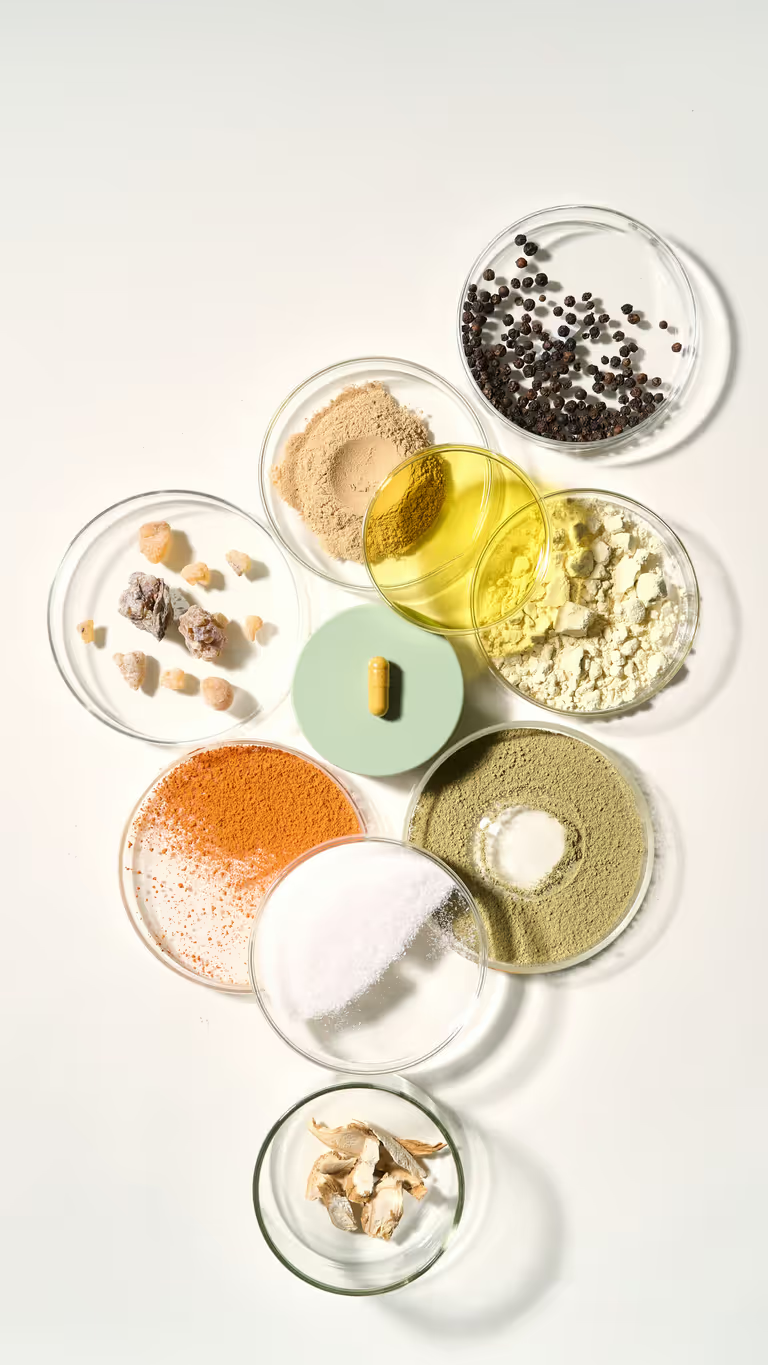
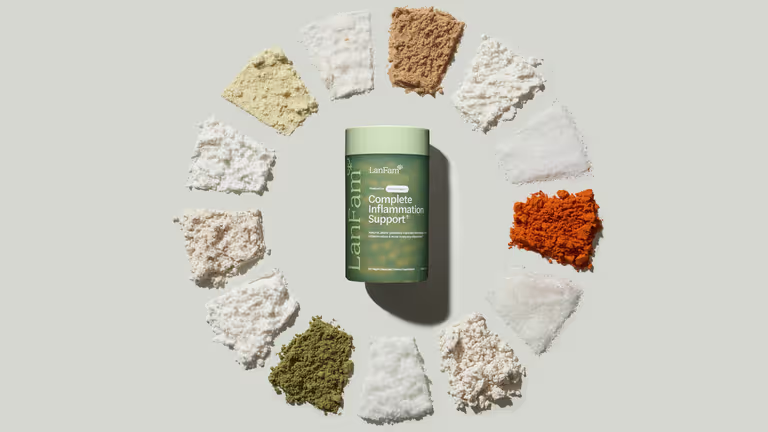
The reason curcumin and resveratrol are in the ProleevaMax formula is precisely the kind of evidence I just cited: both have reduced CRP in randomized human trials.⁵,⁶ Curcumin is paired with piperine in the formula because, on its own, curcumin is poorly absorbed — the trials that show benefit use bioavailability-enhanced forms, and the formula reflects that. The formula is built to support a healthy inflammatory response as part of a daily routine alongside the foundational levers, not in place of them.*
But the order matters, and I'll say it plainly: test first. Know your baseline. Fix sleep, diet, and movement. Then, if you and your physician decide a targeted supplement makes sense for your situation, you'll have a number to retest against in a few months — which is a far better way to know whether anything is working than how you happen to feel on a given Tuesday.
Closing
The reason I push everyone in my life to test before they treat is simple: you can't manage what you don't measure, and you can't know whether anything worked if you never had a baseline. hs-CRP, with ESR and homocysteine for context, gives you that baseline cheaply and reliably.
Get the number. Confirm it with a retest when you're well. Bring it to your doctor. Then do the boring, foundational work — and if a targeted supplement fits, you'll have something real to measure it against in ninety days. That's not as exciting as a quick fix. It's just how you actually find out what's true about your own body.
Be well,
— Fabio
* These statements have not been evaluated by the Food and Drug Administration. This product is not intended to diagnose, treat, cure, or prevent any disease. Always consult your healthcare provider before starting any new supplement or making changes based on lab results, especially if you take medications or have existing health conditions.

References
- 2.Ridker PM, Hennekens CH, Buring JE, Rifai N. C-reactive protein and other markers of inflammation in the prediction of cardiovascular disease in women. N Engl J Med. 2000. https://doi.org/10.1056/NEJM200003233421202
- 3.Pearson TA, Mensah GA, Alexander RW, et al. Markers of inflammation and cardiovascular disease: application to clinical and public health practice: a statement for healthcare professionals from the Centers for Disease Control and Prevention and the American Heart Association. Circulation. 2003. https://doi.org/10.1161/01.cir.0000052939.59093.45
- 4.Harrison M. Erythrocyte sedimentation rate and C-reactive protein. Aust Prescr. 2015. https://doi.org/10.18773/austprescr.2015.034
- 5.Ganguly P, Alam SF. Role of homocysteine in the development of cardiovascular disease. Nutr J. 2015. https://doi.org/10.1186/1475-2891-14-6
- 6.Gorabi AM, Abbasifard M, Imani D, et al. Effect of curcumin on C-reactive protein as a biomarker of systemic inflammation: an updated meta-analysis of randomized controlled trials. Phytother Res. 2022. https://doi.org/10.1002/ptr.7284
- 7.Koushki M, Dashatan NA, Meshkani R. Effect of resveratrol supplementation on inflammatory markers: a systematic review and meta-analysis of randomized controlled trials. Clin Ther. 2018. https://doi.org/10.1016/j.clinthera.2018.05.015
- 8.Furman D, Campisi J, Verdin E, et al. Chronic inflammation in the etiology of disease across the life span. Nat Med. 2019. https://doi.org/10.1038/s41591-019-0675-0
Frequently asked questions
There's a seat at our table
Letters from our family to yours — the science, the recipes, the things that actually helped real families. Leave your email and we'll send the next one.