Boswellia vs. Ibuprofen for Inflammation: A Different Pathway, Not a Replacement
A pharmacist's-eye comparison of boswellia and ibuprofen: boswellic acids inhibit the 5-LOX/leukotriene pathway while ibuprofen inhibits COX/prostaglandins. Why they are complementary, not interchangeable, and what seven RCTs of boswellia for osteoarthritis actually found.
Ingredients in this letter

Two enzymes, two different fires
I spent forty years in the pharmaceutical industry before my family built our formula at the kitchen table, and the habit that follows you out of that world is this: before you compare two anti-inflammatories, you ask which enzyme each one touches. That single question explains most of the differences people find confusing.
Inflammation isn't one chemical. When tissue is irritated, your body releases arachidonic acid, and that fatty acid gets fed into two main downstream assembly lines:
- The COX pathway (cyclooxygenase-1 and cyclooxygenase-2) turns arachidonic acid into prostaglandins — the mediators behind a lot of pain, swelling, and fever.
- The 5-LOX pathway (5-lipoxygenase) turns the same arachidonic acid into leukotrienes — mediators that drive immune-cell recruitment and a more sustained, chronic flavor of inflammation.
Now place the two products on that map.
Ibuprofen works on the COX line. It's a non-selective COX inhibitor — it blocks both COX-1 and COX-2, which lowers prostaglandin production. That's why it brings down pain, swelling, and fever quickly and reliably.² It's also why it carries the side-effect profile it does: COX-1 helps maintain the protective lining of your stomach, so blocking it non-selectively is part of why NSAIDs are hard on the gut over time.²
Boswellia works on the 5-LOX line. The active compounds in Boswellia serrata are the boswellic acids, and the most studied of them — acetyl-11-keto-β-boswellic acid, or AKBA — inhibits the 5-lipoxygenase enzyme by binding it at a site separate from where the arachidonic acid docks. The result is reduced leukotriene formation.³⁴ That is a genuinely different intervention than what ibuprofen does. Ibuprofen leaves the leukotriene line largely running; boswellia is built to act on it.
Here is the part I want you to sit with: because they act on different enzymes, "boswellia vs. ibuprofen" is the wrong framing. It's not boswellia replacing ibuprofen on the same job. It's boswellia covering a different stretch of the same cascade. That distinction is the whole reason I won't tell anyone to just swap one for the other — and it's also the reason the two can be thought of as complementary rather than rivals.
Is boswellia actually a pain reliever? What the human trials show
Mechanism is one thing. I always want to know what happened in actual people, because a clean theory that does nothing in a real knee is worthless.
The strongest summary we have is a systematic review and meta-analysis of seven randomized controlled trials, covering 545 participants, looking at boswellia and boswellia extract for osteoarthritis.¹ Pooled across those trials, boswellia was associated with statistically significant improvements versus control in pain (on visual-analogue and WOMAC pain scales), in stiffness, and in physical function. The authors concluded boswellia may be an effective and safe option for osteoarthritis, and they noted a sensible practical detail: it tends to need at least about four weeks of consistent use to read the benefit.¹
That four-week point is the single biggest difference in experience between boswellia and ibuprofen, and it's worth dwelling on. Ibuprofen is built for now. Boswellia is built for the slow accumulation. If you take boswellia for three days, feel nothing, and quit, you didn't run the experiment the trials ran.
Newer trial data points the same direction. In a double-blind, randomized, placebo-controlled trial of a standardized boswellia extract in 105 people with knee osteoarthritis, the treatment groups saw improvements in pain scores beginning as early as five days, and by day 90 reported large reductions in WOMAC total scores versus placebo, alongside measurable drops in inflammatory markers including hs-CRP, IL-6, and TNF-α.⁵ I read that last part with particular interest, because those markers aren't feelings — they're numbers you can draw and re-draw, and watching them move is more persuasive to me than any testimonial.
And it isn't only joints. A 2025 randomized, double-blind, placebo-controlled pilot trial gave recreationally active men a standardized boswellia extract for ten days around a muscle-damaging downhill-running protocol; the supplemented group reported significantly less muscle soreness and knee-joint pain during recovery, regained leg strength faster, and showed lower C-reactive protein and IL-6 than placebo by day ten.⁶ When the same extract that reads well in chronic osteoarthritis also moves the needle on acute, exercise-induced inflammation, that's the kind of consistency I look for.
So: is boswellia a pain reliever? In the chronic, inflammatory, joint-and-recovery sense — the evidence says it reasonably earns the description. In the acute, take-it-and-feel-it-in-an-hour sense — no, and I'd be lying to you if I said otherwise.
What boswellia does well, and where ibuprofen still wins
I try to be plain about the boundaries, because over-promising is exactly how the supplement aisle lost people's trust in the first place.
Where boswellia has a genuine case:
- Chronic, slow-burn joint inflammation — osteoarthritis-type pain and stiffness that you're managing over months, not minutes. This is where the trial evidence sits.¹⁵
- A different mechanism than your NSAID — it works the 5-LOX/leukotriene line that ibuprofen mostly leaves running, which is why it can be a thoughtful complement.³⁴
- A daily-use tolerability profile — in the trials it was generally well tolerated, which is much of why people look at it as a long-term option in the first place.¹⁵
Where ibuprofen still wins, and I won't pretend otherwise:
- Speed. For acute pain — a fresh injury, a flare, a headache — ibuprofen's fast COX inhibition is the right tool, and boswellia is not a substitute for it.²
- Decades of dosing data. Ibuprofen is one of the most thoroughly characterized drugs in the world. Boswellia's evidence base is real but much smaller.
- Predictability. A standard ibuprofen dose behaves consistently. Boswellia products vary widely in how much actual AKBA they contain, which means "boswellia" on two different labels can mean two very different things.
That GI side-effect issue is the one place the comparison gets genuinely interesting for chronic users. Because ibuprofen blocks COX-1, long-term use carries a known burden on the stomach lining.² Boswellia, working a different enzyme entirely, doesn't share that specific mechanism of harm. That is not me telling you to stop your ibuprofen — please don't make that decision off a blog post — but it is the honest reason a lot of people with chronic joint pain start asking about a different pathway in the first place.
So should you replace ibuprofen with boswellia?
Here is where I'll be as direct as I can, because this is the actual question and it deserves a straight answer.
Do not unilaterally replace a medication your doctor put you on with a supplement. If ibuprofen is managing something real, that's a conversation for you and your physician, not a swap you make because an article online used the word "natural."
What the evidence does support is a more modest, more honest idea: boswellia is a legitimate option to discuss for chronic inflammatory joint problems, precisely because it works a pathway your NSAID doesn't. The mechanistic logic and the trial data both point toward "different and complementary," not "identical and interchangeable." Some people, with their doctor's input, use a 5-LOX-active supplement as part of a longer-term plan while reserving the NSAID for flares. That's a reasonable conversation to have. Quietly stopping a prescription on your own is not.
The thing I most want you to walk away with is the pathway point, because it inoculates you against the marketing: any product sold to you as "the natural ibuprofen" is, by definition, glossing over the fact that it works a different enzyme. The truth is more interesting than the slogan.
Where ProleevaMax fits — honestly
I'm not going to pretend I built our formula for any reason other than the obvious one: my wife needed something for chronic pain she could take every day for years, and a single-pathway approach never felt like enough to me after four decades watching how inflammation actually behaves.
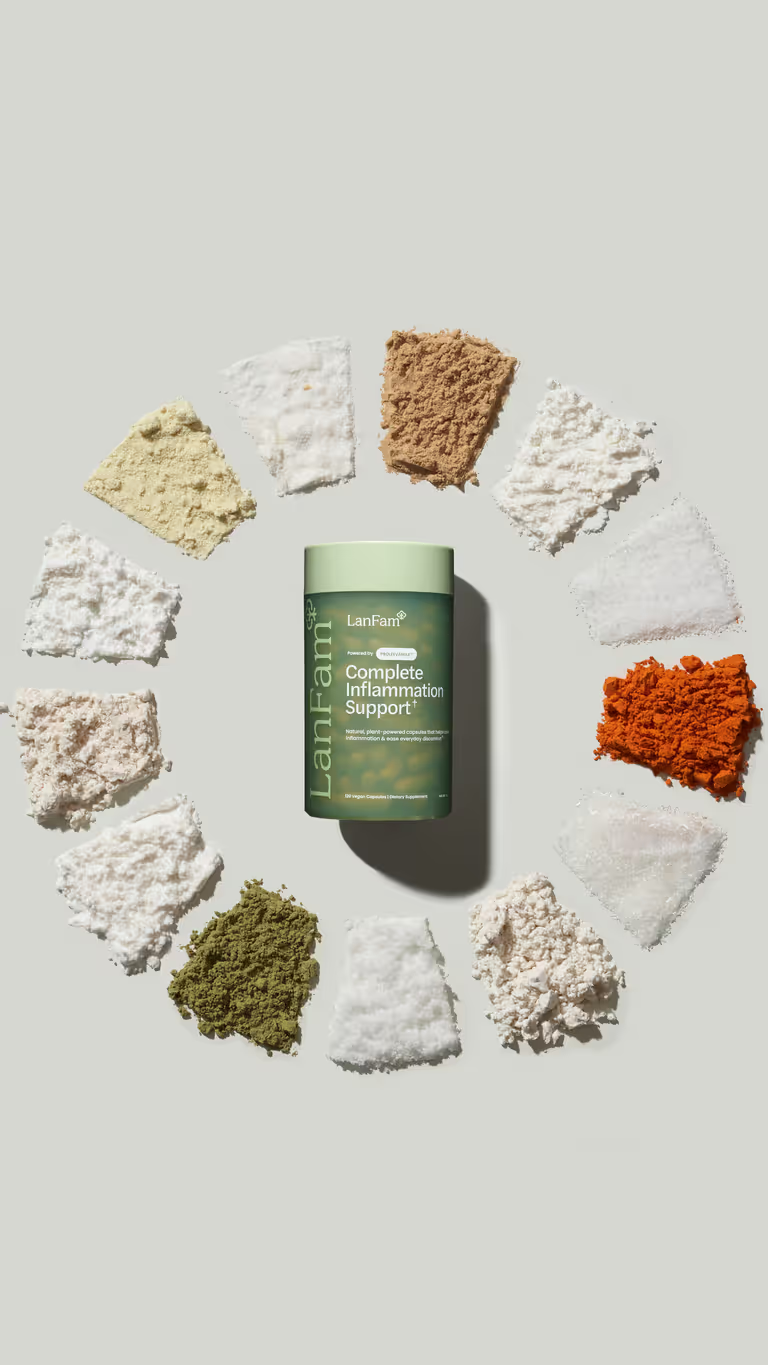
So boswellia serrata is in the formula precisely because of the 5-LOX/leukotriene mechanism this whole letter is about — it covers a stretch of the cascade that a COX-only approach leaves running.* It sits alongside curcumin, which leans on the COX-2/NF-κB side of the story, exactly because the two cover different ground. The point of pairing them is the point of this letter: the inflammatory cascade is not one fire, so I never wanted to fight it with one hose.
If you already take a standardized boswellia product with a real, stated AKBA content and it's working for you — keep using it. I mean that. This letter was never about selling you our bottle. It was about making sure that whatever you take, you understand that boswellia and ibuprofen are doing two different jobs, and that's a feature, not a flaw.
A few questions people actually ask me
Is boswellia as strong as ibuprofen? They're not measured on the same yardstick, because they hit different enzymes. For acute pain, ibuprofen acts faster and more predictably via COX inhibition.² For chronic inflammatory joint pain over weeks, boswellia showed meaningful pain, stiffness, and function improvements in a meta-analysis of seven RCTs — but it builds over time rather than working in an hour.¹
Can I take boswellia and ibuprofen together? Because they act on different pathways (5-LOX vs. COX), some people use them together under medical guidance — boswellia daily, NSAID for flares. But combining anti-inflammatories is a conversation for your doctor, especially if you have GI, kidney, or bleeding risk, or take other medications. Don't improvise it.
How long does boswellia take to work? The trial evidence points to at least about four weeks of consistent daily use to read a joint-pain benefit, with some standardized-extract data showing earlier movement.¹⁵ It is a cumulative, slow-build support, not an acute painkiller.
Does boswellia have the same stomach side effects as ibuprofen? It doesn't share ibuprofen's specific mechanism of GI harm. Long-term NSAID use burdens the stomach lining partly through COX-1 inhibition.² Boswellia works a different enzyme entirely and was generally well tolerated in the trials.¹ That said, "different mechanism" is not "zero risk" — talk to your doctor, particularly if you take other medications.
What should I look for on a boswellia label? Look for a standardized extract with a stated boswellic-acid or AKBA percentage. "Boswellia" with no standardization number can mean almost anything, and the trials that found benefit used standardized extracts. The number is the difference between the studied ingredient and a guess in a capsule.
The one thing to take away
If you remember nothing else from this letter, remember the two enzymes. Ibuprofen works COX and makes its living on prostaglandins and speed. Boswellia works 5-LOX and makes its living on leukotrienes and patience. They are not the same tool, and the moment a label tries to tell you they are, you've learned something about the label.
The right question was never "which one replaces the other." It was "what is each one actually doing" — and once you can answer that, you can have a much smarter conversation with your doctor than the marketing wants you to have.
Take care of yourself,
— Fabio
* These statements have not been evaluated by the Food and Drug Administration. This product is not intended to diagnose, treat, cure, or prevent any disease.

References
- 2.Yu G, Xiang W, Zhang T, Zeng L, Yang K, Li J. Effectiveness of Boswellia and Boswellia extract for osteoarthritis patients: a systematic review and meta-analysis. BMC Complement Med Ther. 2020. https://doi.org/10.1186/s12906-020-02985-6
- 3.Bushra R, Aslam N. An overview of clinical pharmacology of Ibuprofen. Oman Med J. 2010. https://doi.org/10.5001/omj.2010.49
- 4.Safayhi H, Sailer ER, Ammon HPT. 5-Lipoxygenase inhibition by acetyl-11-keto-β-boswellic acid (AKBA) by a novel mechanism. Phytomedicine. 1996. https://doi.org/10.1016/S0944-7113(96)80013-4
- 5.Ammon HPT. Boswellic acids in chronic inflammatory diseases. Planta Med. 2006. https://doi.org/10.1055/s-2006-947227
- 6.Majeed A, Majeed S, Satish G, Manjunatha R, Rabbani SN, Patil NVP, Mundkur L. A standardized Boswellia serrata extract shows improvements in knee osteoarthritis within five days — a double-blind, randomized, three-arm, parallel-group, multi-center, placebo-controlled trial. Front Pharmacol. 2024. https://doi.org/10.3389/fphar.2024.1428440
- 7.Salter D, Yalamanchi H, Yalamanchi A, Yalamanchi A. Ten days of supplementation with a standardized Boswellia serrata extract attenuates soreness and accelerates recovery after repeated bouts of downhill running in recreationally active men. Front Sports Act Living. 2025. https://doi.org/10.3389/fspor.2025.1488821

There's a seat at our table
Letters from our family to yours — the science, the recipes, the things that actually helped real families. Leave your email and we'll send the next one.