Does Coffee Cause Inflammation? What Science Says
Does coffee cause inflammation? Research suggests black coffee may support a healthy inflammatory response. The additives are the real issue. Here's what to know.

For most people, black coffee does not cause inflammation. Research suggests that coffee may support a healthy inflammatory response, because it carries antioxidant compounds like chlorogenic acid. The inflammation problem usually starts with what you add to the cup: sugar, sweetened syrups, and heavy creamers. Individual response varies, and a small group of people are sensitive to caffeine, but the bean itself is not the villain it is often made out to be.
The Short Version: Coffee Itself Is Mostly Anti-Inflammatory
The question "does coffee cause inflammation" comes up because coffee feels stimulating. A racing heart and jittery hands feel like stress, and stress and inflammation are linked. So the assumption is reasonable. The evidence points the other way.
A 2020 systematic review and meta-analysis in Nutrients pooled data from tens of thousands of people and examined the link between coffee intake and C-reactive protein, a standard blood marker of inflammation. The overall pooled result was not statistically significant, but several large individual studies pointed the other way, showing that higher coffee consumption tracked with lower CRP, not higher [1].
That does not mean coffee is a treatment for anything. It means the popular idea that coffee inflames the body is not supported by the population data. For most healthy adults, moderate black coffee sits on the helpful side of the ledger.
Why Coffee Behaves This Way: The Chlorogenic Acid Story
Coffee is one of the largest sources of antioxidants in the typical Western diet. That is not because coffee is exotic. It is because people drink a lot of it, and the bean is dense with polyphenols.
The headline compound is chlorogenic acid, a polyphenol that survives roasting and brewing in meaningful amounts.
How it works, in plain language
Inflammation is a signaling process. Your cells use messenger molecules to decide when to ramp inflammation up and when to wind it down. One central control switch is a protein complex called NF-κB, which acts like a master dimmer for inflammatory genes.
Laboratory research documents that chlorogenic acid interacts with the NF-κB pathway and influences the output of inflammatory messengers such as TNF-α, IL-6, and IL-1β [2]. In cell studies, chlorogenic acid lowered the production of these inflammatory signals after the cells were provoked [3].
A practical note: most of this mechanism work is done in cells and animals, not in long-term human trials. The mechanism is plausible and well-documented at the bench. The whole-body human effect is best described by the population studies above, which lean favorable.
Roast level changes the chemistry
Roasting is a trade-off. Darker roasts lose some chlorogenic acid to heat but generate other compounds called melanoidins that carry their own antioxidant activity.
| Roast level | Chlorogenic acid | What forms during roasting |
|---|---|---|
| Light | Highest | Fewer melanoidins |
| Medium | Moderate | Balanced |
| Dark | Lower | More melanoidins |
A mouse study comparing roast degrees found that lighter and medium roasts produced stronger antioxidant and anti-inflammatory effects on certain markers [4]. The takeaway is not "only drink light roast." It is that every roast keeps useful compounds, and your cup is doing more than delivering caffeine.
The Real Culprit Is Usually in the Cup, Not the Coffee
Here is where the honest answer lives. When someone feels worse after their morning coffee, the additives deserve the first look.
A large flavored latte can carry the sugar load of a dessert. Added sugar is one of the more consistent dietary drivers of inflammatory markers.
An NHANES analysis of US adults found that high sugar intake from sweetened beverages was associated with higher C-reactive protein, with the effect concentrated in people who already had prediabetes or abdominal obesity [5]. Controlled feeding research has also documented rises in inflammatory and metabolic markers after sugar-sweetened beverage intake [6].
So the coffee that "causes inflammation" is often a sugar-delivery system wearing a coffee costume. Strip the costume and the math changes.
A quick audit of what goes in your cup
- Flavored syrups — concentrated sugar, often two to four pumps per drink
- Sweetened creamers — sugar plus refined oils
- Heavy whipped toppings — sugar and saturated fat
- Large amounts of added sugar — the most direct inflammatory contributor
Black coffee, or coffee with a splash of milk and little to no sugar, keeps the polyphenol benefit without the inflammatory payload.
Individual Variation: Why Coffee Is Not the Same for Everyone
Two people can drink the same cup and have different experiences. Genetics is part of why.
Caffeine is broken down mainly by a liver enzyme called CYP1A2, and a common gene variant determines whether you are a fast or slow metabolizer. Slow metabolizers clear caffeine more gradually, so it lingers and the stimulant effects feel stronger. Research on this variant found that heavy coffee intake interacted with slow-metabolizer status for certain health markers, while fast metabolizers showed no such association [7].
What this means for you is simple. If coffee leaves you wired, anxious, or sleeping poorly, the disrupted sleep and stress response can affect how your body feels day to day. That is a caffeine-tolerance question, not proof that coffee inflames everyone. Listening to your own response matters more than any headline.
If caffeine is the issue, decaf keeps most of the polyphenols. Decaffeination removes caffeine, not the chlorogenic acid and melanoidins, so decaf retains much of the antioxidant value while dropping the stimulant.
What Coffee Won't Do
Honesty is part of good health writing, so here are the limits.
- Coffee is not a treatment. It does not treat, cure, or prevent arthritis, autoimmune conditions, or any disease. The research describes associations and mechanisms, not cures.
- Coffee does not undo a poor diet. A daily cup will not offset high sugar intake, ultra-processed food, or sustained poor sleep.
- More is not better. The favorable associations cluster around moderate intake, generally up to about four cups per day in large cohort studies [8]. Past that, the benefit curve flattens and side effects climb.
- It is not right for everyone. Pregnancy, certain heart rhythm issues, anxiety disorders, acid reflux, and some medications are real reasons to limit or skip coffee. Talk with your clinician.
Coffee is a reasonable part of an anti-inflammatory pattern of eating. It is not the foundation, and it is not a shortcut.
How Coffee Fits a Broader Anti-Inflammatory Routine
Single foods rarely decide your inflammatory status. Patterns do. Coffee is one supporting player in a lineup that includes vegetables, fatty fish, olive oil, fiber, sleep, and movement.
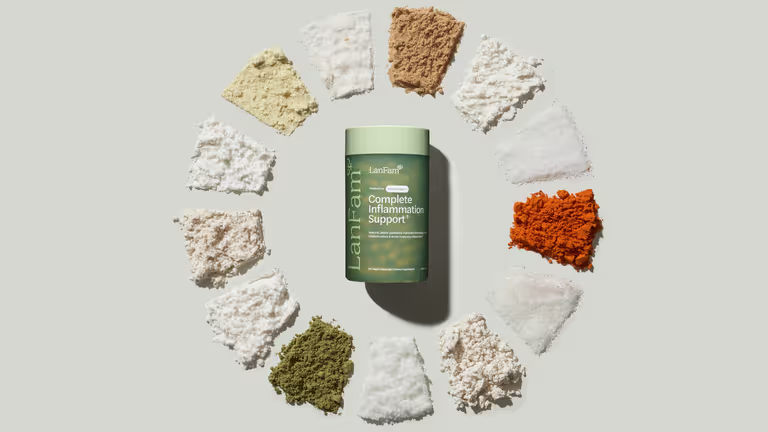
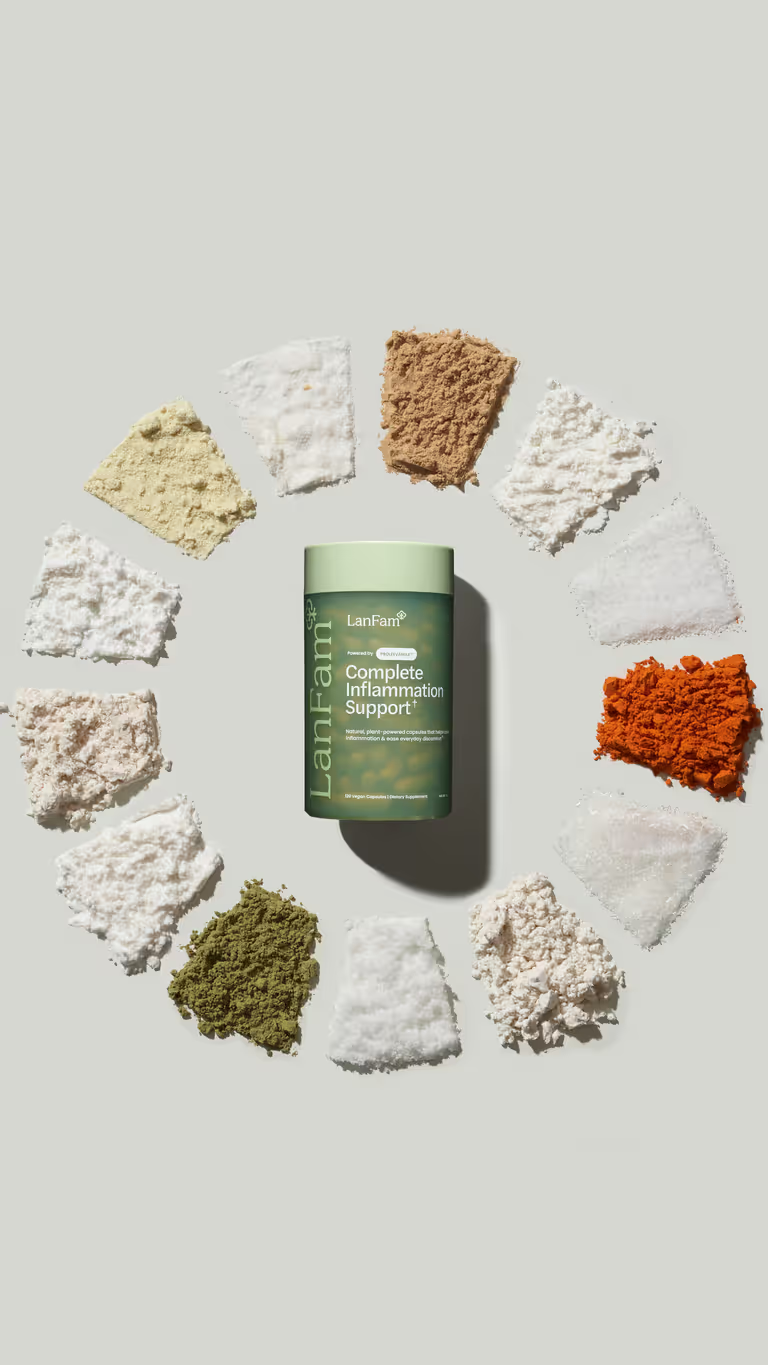
This is also where a focused supplement can have a role. Many compounds studied for inflammatory balance, such as omega-3 fatty acids, vitamin D, magnesium, and CoQ10, are not in coffee at all, and to be clear, they are not in ProleevaMax either. Complete Inflammation Support (Powered by ProleevaMax®) takes a different route. It is a multi-pathway formula built around standardized botanicals and amino acids working together, including Boswellia standardized to 65% boswellic acids, whole-root Turmeric, the L-Glutamine and L-Serine pairing, and Matcha contributing EGCG and L-theanine. The design goal is to support a healthy inflammatory response while also supporting nervous system resilience. Coffee can sit alongside that routine. It does not replace it.
These statements have not been evaluated by the Food and Drug Administration. This product is not intended to diagnose, treat, cure, or prevent any disease.
Support a Healthy Inflammatory Response, Beyond the Coffee Cup
Black coffee can earn a spot in an anti-inflammatory routine. For targeted, multi-pathway support, that is where Complete Inflammation Support (Powered by ProleevaMax®) comes in.
Explore the details:
- How ProleevaMax works and the full ingredient list
- The science behind the formula
- Start with ProleevaMax
Keep reading on the blog:
ProleevaMax is built around the 90-Day Protocol, with natural checkpoints at Week 2, Week 4, Week 8, and Day 90, because consistency is how botanical support builds. Every order is backed by our 90-day money-back guarantee, so you have the full protocol window to feel the difference.

References
- 2.Moua ED, Hu C, Day N, et al. Coffee consumption and C-reactive protein levels: a systematic review and meta-analysis. Nutrients. 2020. https://doi.org/10.3390/nu12051349
- 3.Murai T, Matsuda S. The chemopreventive effects of chlorogenic acids, phenolic compounds in coffee, against inflammation, cancer, and neurological diseases. Molecules. 2023. https://doi.org/10.3390/molecules28052381
- 4.Hwang SJ, Kim YW, Park Y, et al. Anti-inflammatory effects of chlorogenic acid in lipopolysaccharide-stimulated RAW 264.7 cells. Inflammation Research. 2014. https://doi.org/10.1007/s00011-013-0674-4
- 5.Choi S, Jung S, Ko KS. Effects of coffee extracts with different roasting degrees on antioxidant and anti-inflammatory systems in mice. Nutrients. 2018. https://doi.org/10.3390/nu10030363
- 6.Lin WT, Kao YH, Li MS, et al. Sugar-sweetened beverages intake, abdominal obesity, and inflammation among US adults without and with prediabetes—an NHANES study. International Journal of Environmental Research and Public Health. 2023. https://doi.org/10.3390/ijerph20010681
- 7.Aeberli I, Gerber PA, Hochuli M, et al. Low to moderate sugar-sweetened beverage consumption impairs glucose and lipid metabolism and promotes inflammation in healthy young men: a randomized controlled trial. American Journal of Clinical Nutrition. 2011. https://doi.org/10.3945/ajcn.111.013540
- 8.Mahdavi S, Palatini P, El-Sohemy A. CYP1A2 genetic variation, coffee intake, and kidney dysfunction. JAMA Network Open. 2023. https://doi.org/10.1001/jamanetworkopen.2022.47868
- 9.Zhao Y, Wu K, Zheng J, et al. Association of coffee drinking with all-cause mortality: a systematic review and meta-analysis. Public Health Nutrition. 2014. https://doi.org/10.1017/S1368980014001438
Frequently asked questions

There's a seat at our table
Letters from our family to yours — the science, the recipes, the things that actually helped real families. Leave your email and we'll send the next one.