Why Am I So Sore After Working Out? Understanding DOMS and the Inflammation Behind It
Why are you so sore after working out — sometimes two days later? What DOMS actually is, why the soreness is an inflammation story, and when it's worth worrying.
Ingredients in this letter
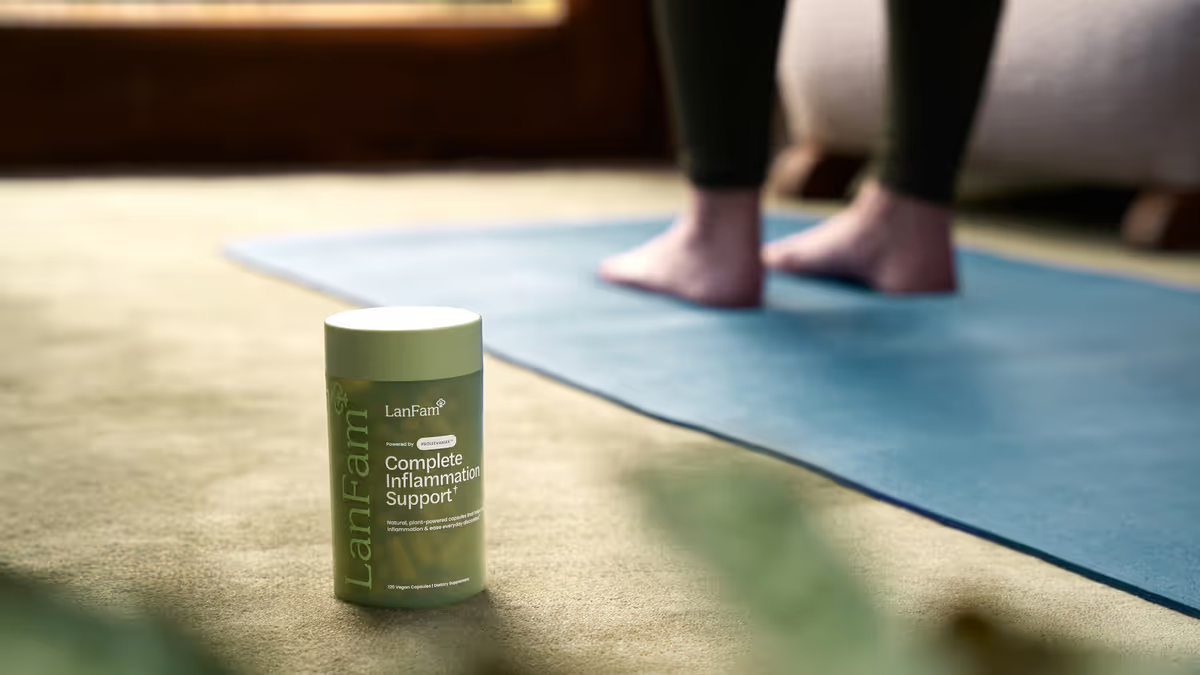
You had a good workout. You felt strong, maybe even a little smug about it. And then — not that night, but the morning after the morning after — you go to sit down and your legs stage a quiet rebellion. The stairs become a negotiation. Reaching for something on a high shelf reminds you exactly which muscles you used two days ago. And you find yourself asking the question everyone who moves their body eventually asks: why am I this sore, and why now?
I get this one a lot from people in my generation who train, and I love it, because the honest answer is genuinely reassuring once you understand it. So let me walk you through what that soreness actually is — not a list of pills to make it disappear, but the real story of what your body is doing.
First, the Reassuring Part: Soreness Isn't Damage You Did Wrong
Here's the reframe that changes how this feels: being sore after a workout, within reason, usually means the workout worked. It's not a sign you injured yourself or did something wrong. It's a sign you gave your body a stimulus it wasn't fully adapted to yet — and adaptation is the entire point of training.
The technical name for the delayed kind is DOMS — delayed-onset muscle soreness. The "delayed" is the part that confuses everyone. You'd expect to feel worst right after, or that evening. Instead the soreness builds overnight, peaks somewhere between 24 and 72 hours later, and then fades over a few days [1]. That timeline is a clue to what's really happening — because it doesn't track with the workout itself. It tracks with your body's response to the workout.
So What Is Actually Making Me Sore?
Let me clear up the biggest myth first, because it's everywhere and it's wrong: lactic acid is not the cause of DOMS. Lactate builds up during hard effort and produces that burning feeling in the moment — but it clears out of your muscles within an hour or so of finishing. It's long gone by the time the two-days-later soreness shows up. So whatever's making you sore on Wednesday from Monday's workout, it isn't lactic acid sitting in your legs [1].
Here's what's actually going on. When you challenge a muscle past what it's used to — especially during the lowering part of a movement, like the descent of a squat or walking downhill — you create tiny, microscopic tears in the muscle fibers. This sounds alarming and isn't; it's a normal, intentional part of how muscle gets stronger. Your body notices the micro-damage and responds the way it responds to anything that needs cleaning up and rebuilding: with inflammation [2].
Immune cells move into the area to clear out the damaged bits and kick off repair. Fluid shifts in. The local nerves get more sensitive. And all of that — the immune activity, the swelling, the heightened sensitivity — is what you feel as soreness. The ache isn't the damage itself; it's the repair crew showing up to work. That's why it's delayed: it takes a day or two for that inflammatory repair response to ramp up to full volume.
If you've read anything else of mine, you'll recognize the theme — soreness is an inflammation story, the same way so much of how the body feels comes back to inflammation. The difference is that this kind is sharp, useful, and time-limited: it rises, does its job, and recedes. That's exactly the kind you want, as opposed to the low-grade simmer that never settles, which Fabio wrote about in signs of chronic inflammation.
Why It Hits Harder Some Days Than Others
If you've noticed that some workouts wreck you for days and others barely register, you're not imagining it. A few things reliably crank up DOMS:
- Newness. Anything your body isn't adapted to yet — a new exercise, a new class, the first run of spring — hits harder. As you repeat it, your muscles adapt and the same workout produces far less soreness. This is called the "repeated bout effect," and it's why week one of anything is always the sorest.
- Eccentric load. The lowering, lengthening-under-tension phase of a movement (the down of a squat, the descent of a hill, the negative of a curl) causes more micro-damage than the lifting phase. Workouts heavy on eccentrics — or downhill running — are notorious for DOMS.
- Intensity and volume jumps. Doing more than your body is currently used to, whether heavier or longer, raises the repair demand.
- Where you are in your life. Sleep, stress, and how recovered you already were all shape how sore you get and how fast you bounce back.
None of this means you did anything wrong. It means you gave your body a real stimulus — which is what you came for.
The Honest Truth About "Fixing" Soreness
Here's where I'll be plainspoken, because this is exactly where the fitness internet oversells. There is no magic switch that erases DOMS, and — this is the part most people don't expect — you wouldn't want one even if it existed.
That inflammatory repair wave is part of how your body knows to adapt and come back stronger. Research has raised real questions about whether trying to crush all post-workout inflammation (with mega-doses of antioxidants, for instance) might also blunt some of the training adaptations you're working so hard for [3]. So the smart goal isn't "zero soreness as fast as possible." It's supporting a clean, well-resolving recovery — helping the wave do its job and recede on schedule — rather than carpet-bombing it.
What genuinely helps the experience of soreness, by the way, is mostly free: gentle movement on sore days (a walk, easy mobility work — total rest often makes you stiffer), real sleep (where the actual rebuilding happens), good hydration and protein to fuel the repair, and sensible progression so you're not constantly shocking an unprepared body. Those move the needle more than anything in a bottle.
There is a supportive supplement layer for the inflammation-and-recovery side — curcumin has the most directly relevant human evidence for muscle soreness and damage markers [4], with glutamine [5][6] and arginine [7] playing supporting roles — but this letter isn't a supplement roundup, and I won't turn it into one. If you want the honest, graded breakdown of what actually has evidence for the recovery side of things, my dad and I put it all in one place: anti-inflammatory supplements for exercise recovery. That's the right place to go deep. Here, I just want you to understand the soreness itself.
That said — the reason the formula we make at home leans on standardized actives like curcumin (paired with piperine so it actually absorbs) is the same reason this whole letter keeps circling back to inflammation: recovery is an inflammatory process, and supporting how cleanly it resolves is the honest, modest thing a supplement can do.* It was never built as a pre-workout or a soreness eraser, and I'd never pretend it is one.
When Soreness Is Not Just DOMS
Almost all post-workout soreness is the normal, healthy kind. But I'd be doing you a disservice if I didn't draw the line clearly. Stop and get it checked if you notice:
- Sharp, stabbing, or one-sided pain — especially during a movement, rather than the dull, both-sides ache of DOMS. That can be a strain or injury, not soreness.
- Significant swelling, bruising, or a joint that's hot or won't move through its normal range.
- Pain that's getting worse after day three instead of fading — normal DOMS is on its way out by then.
- Dark, tea-colored urine alongside extreme soreness and weakness after an unusually intense session. This is rare, but it can signal a serious condition called rhabdomyolysis and is a same-day medical situation — don't wait on it.
None of those are ordinary soreness. Ordinary DOMS is a dull, symmetric ache that peaks around day two and fades by day four or five. If what you're feeling doesn't fit that, listen to it.
So, Why Are You So Sore?
Because you gave your body a stimulus it wasn't fully adapted to, your muscle fibers took on a little intentional micro-damage, and now the repair crew — your inflammatory response — has shown up to clean up and rebuild stronger. The soreness is that repair crew at work, which is why it's delayed, why it peaks around day two, and why it's actually a sign the workout did something. It's not lactic acid, it's not damage you did wrong, and it's not something to fully erase. Support it gently, sleep, fuel up, progress sensibly — and let your body do the remarkable thing it's built to do. That's how you come back stronger, not just less sore.
These statements have not been evaluated by the Food and Drug Administration. This product is not intended to diagnose, treat, cure, or prevent any disease.
This article is for general education and isn't medical advice. Sharp or one-sided pain, significant swelling, or extreme soreness with dark urine isn't normal soreness — please see a doctor.

References
- 2.Cheung K, Hume PA, Maxwell L. Delayed onset muscle soreness: treatment strategies and performance factors. Sports Medicine. 2003. https://doi.org/10.2165/00007256-200333020-00005
- 3.Peake JM, Neubauer O, Della Gatta PA, Nosaka K. Muscle damage and inflammation during recovery from exercise. Journal of Applied Physiology. 2017. https://doi.org/10.1152/japplphysiol.00971.2016
- 4.Merry TL, Ristow M. Do antioxidant supplements interfere with skeletal muscle adaptation to exercise training?. The Journal of Physiology. 2016. https://doi.org/10.1113/JP270654
- 5.Beba M, Mohammadi H, Clark CCT, Djafarian K. The effect of curcumin supplementation on delayed-onset muscle soreness, inflammation, muscle strength, and joint flexibility: a systematic review and dose-response meta-analysis of randomized controlled trials. Phytotherapy Research. 2022. https://doi.org/10.1002/ptr.7477
- 6.Cordova-Martinez A, Caballero-Garcia A, Bello HJ, et al. Effect of glutamine supplementation on muscular damage biomarkers in professional basketball players. Nutrients. 2021. https://doi.org/10.3390/nu13062073
- 7.Coqueiro AY, Rogero MM, Tirapegui J. Glutamine as an anti-fatigue amino acid in sports nutrition. Nutrients. 2019. https://doi.org/10.3390/nu11040863
- 8.Hnia K, Gayraud J, Hugon G, et al. L-arginine decreases inflammation and modulates the nuclear factor-kappaB pathway in dystrophic muscle. American Journal of Pathology. 2008. https://doi.org/10.2353/ajpath.2008.071009
Frequently asked questions
There's a seat at our table
Letters from our family to yours — the science, the recipes, the things that actually helped real families. Leave your email and we'll send the next one.