Piperine: Why Black Pepper Extract Is in Every Serious Anti-Inflammatory Supplement
A mechanism explainer on piperine (black pepper extract): how it raised curcumin bioavailability 2,000%, enhances resveratrol absorption, and quiets the NF-kB inflammation pathway directly.
Ingredients in this letter

The ingredient you've seen a hundred times and never learned
Walk down any supplement aisle and read the labels on the anti-inflammatory products — the turmeric ones, the joint ones, the "complete" formulas. Somewhere on most of the good ones, in small type, you'll find black pepper extract or piperine.
It's the ingredient hiding in plain sight. People recognize curcumin. They recognize resveratrol, boswellia, green tea. But piperine — the one quietly making half of those work better — they walk right past. After forty years in the pharmaceutical industry, I find that fascinating, because in drug development the absorption problem is often the whole problem. You can have the most active molecule in the world, and if it doesn't get into the bloodstream, you have nothing.
Piperine is the natural-products answer to that problem. And once you understand what it's doing, you'll never read a supplement label the same way again.
How piperine actually works: the absorption story
Here's the mechanism, in plain terms.
When you swallow a compound like curcumin, your body treats it as something to get rid of. Enzymes in your gut wall and liver tag it — a process called glucuronidation is the big one — and that tag marks it for rapid clearance. By the time the curcumin would have reached an inflamed joint, most of it has already been processed and flushed. This is why plain curcumin is famously hard to deliver: it's not that it isn't active, it's that it barely arrives.
Piperine interferes with that clearance machinery. It slows the enzymes responsible for the first-pass metabolism and glucuronidation, and it affects the transport proteins (like P-glycoprotein) that pump compounds back out of your cells. The 2022 pharmacology review by Tripathi and colleagues lays this out in detail — piperine modulates P-glycoprotein, cytochrome P450 3A4, and several related transport and metabolic proteins, which is precisely the set of doors that control how much of a compound reaches your blood.¹ Slow those down, and more of the partner compound survives long enough to do its job.
The 2,000% finding
The single piece of evidence that made piperine a staple of serious formulas is over twenty-five years old and still the cleanest demonstration we have.
In 1998, Shoba and colleagues published a pharmacokinetic study in Planta Medica. They gave volunteers curcumin alone, then curcumin with just 20 mg of piperine, and measured what showed up in the blood. With piperine added, curcumin's bioavailability rose by 2,000% in the human volunteers — a twenty-fold increase — with no change to the curcumin dose itself.²
I want to be precise about what that number means, because it's easy to wave around. It does not mean piperine makes curcumin "twenty times stronger." It means twenty times more of the curcumin you already paid for actually reached your bloodstream instead of being cleared. That's the difference between a curcumin dose that's mostly theater and one that arrives. (I went deep on the dosing side of this — the milligrams, the standardization, the forms — in a separate letter on curcumin dosage for inflammation.)
It's not just curcumin
What makes piperine genuinely useful in a multi-ingredient formula is that the same mechanism helps more than one partner. Resveratrol — the polyphenol people know from red wine — has its own absorption problem, cleared quickly through that same glucuronidation pathway. In a 2011 study in Molecular Nutrition & Food Research, Johnson and colleagues co-administered resveratrol with piperine in mice and measured a 229% increase in resveratrol exposure (AUC) and a sharp jump in peak blood concentration, driven by piperine slowing resveratrol's glucuronidation.³
So in a formula that carries both curcumin and resveratrol — as ours does — a single well-chosen dose of piperine is supporting the absorption of multiple actives at once. That's not a coincidence of the label. That's the design reason it's there.
Piperine's own anti-inflammatory action
Here's the part even a lot of supplement-literate people miss: piperine isn't only a delivery vehicle. It has direct anti-inflammatory activity in its own right, and the mechanism overlaps with the compounds it's helping deliver.
The master switch for inflammation in the body is a transcription factor called NF-κB. Think of it as a fire alarm wired into your cells — it's supposed to turn on when there's a real threat, drive the inflammatory response, and turn off. In chronic inflammation, it gets stuck partway on. A great deal of anti-inflammatory pharmacology, natural and synthetic, comes down to quieting NF-κB.
Piperine does exactly that in laboratory models. In a 2004 study in International Immunopharmacology, Pradeep and Kuttan showed piperine inhibited NF-κB activation and the expression of proinflammatory genes, blocking the nuclear translocation of the NF-κB subunits that switch inflammation on.⁴ A 2022 study in Foods using LPS-stimulated immune cells found piperine suppressed both the NF-κB and MAPK signaling pathways and lowered the production of TNF-α, IL-1β, and IL-6 — three of the central inflammatory messengers — while raising the anti-inflammatory signal IL-10.⁵ And the Tripathi pharmacology review situates this in the broader picture: piperine regulates NF-κB and COX-2, two of the pathways that matter most in the inflammatory cascade.¹
These are laboratory and cell-based findings, and I'll say plainly that "quiets NF-κB in cultured immune cells" is not the same as "treats your arthritis." But it tells you something important about why piperine earns a place in an anti-inflammatory formula beyond absorption: it's working on the same switch the rest of the ingredients are working on, from a different angle.
What works, and what doesn't
I try to draw these lines honestly, because the absorption story is real enough that it gets oversold.
What the evidence supports:
- Piperine substantially improving the absorption of curcumin and resveratrol — that's well-demonstrated, including in humans for curcumin.²³
- Piperine having direct anti-inflammatory activity on the NF-κB pathway in laboratory models, lowering key inflammatory messengers.⁴⁵
- A small dose doing the job — the studied amounts are modest (the curcumin study used 20 mg), which is part of why it's a quiet line on the label rather than a headline.
What it does not do, and where I'll be careful:
- Piperine is not a standalone treatment for anything. Its value is as a partner — an absorption enhancer and a supporting anti-inflammatory, not the main event.
- The "2,000%" figure is curcumin-specific. Don't assume it multiplies every ingredient by twenty; the resveratrol number was 229%, and many compounds aren't piperine-sensitive at all.
- The same enzyme inhibition that helps supplements absorb can also affect how some prescription medications are metabolized. This is the one I take seriously: if you're on medication, talk to your doctor or pharmacist before adding a piperine-containing supplement. That's not boilerplate — it's the actual reason the mechanism deserves respect.
- The direct anti-inflammatory data is mostly preclinical. Real, mechanistically coherent, and worth knowing — but not human-outcome proof on its own.
Why we put piperine in ProleevaMax
When Maria needed something she could take every single day for years, the first practical wall we hit at the kitchen table was absorption. We could choose the best-studied anti-inflammatory actives in the world — curcumin, resveratrol — and watch most of them get cleared before they could help. That's not a hypothetical; that's the entire reason curcumin has a reputation for being hit-or-miss.
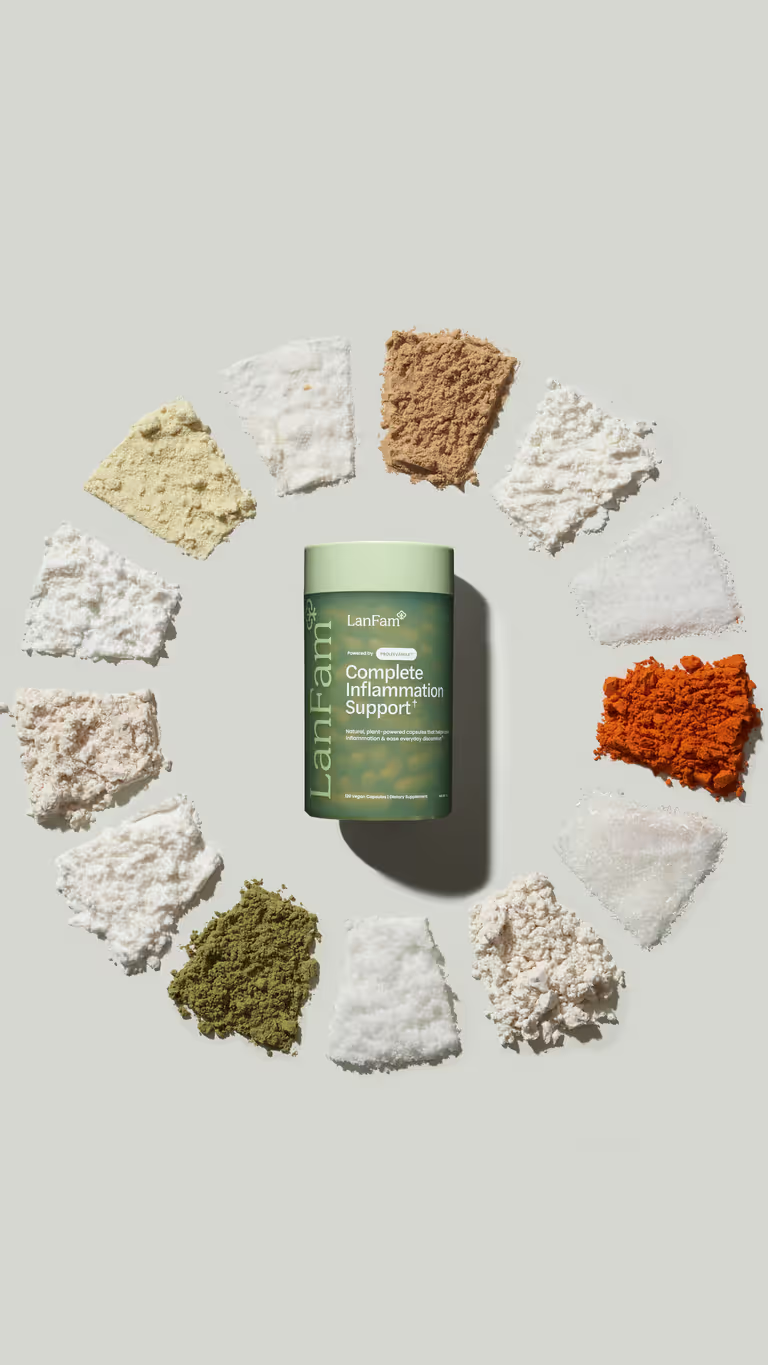
So ProleevaMax carries piperine deliberately, to support the absorption of the actives around it — so more of what's on the label can actually be put to work, and so a single small dose supports multiple ingredients at once.* It's also one of the actives doing real anti-inflammatory work itself, on the NF-κB pathway, alongside the curcumin and resveratrol it's helping deliver.
I keep the dose on the label, like everything else in the formula — no proprietary blend, every amount stated. If you're going to include the ingredient that makes the rest of the formula work, the least you can do is tell people how much of it is in there.
So no — to my friend at the table, and to you — black pepper extract is not filler. In a serious anti-inflammatory formula, it might be the most quietly important line on the whole label.
A few questions people actually ask me
What does piperine actually do in a supplement? Two things. It dramatically improves the absorption of poorly-absorbed actives like curcumin and resveratrol by slowing the enzymes that clear them, and it has its own anti-inflammatory activity on the NF-κB pathway. It's a partner ingredient, not a standalone one.
Is black pepper extract the same as piperine? Effectively yes — piperine is the active alkaloid in black pepper, and "black pepper extract" (often branded BioPerine) is the standardized form used in supplements. When you see either on a label, it's there primarily for absorption.
How much does piperine increase curcumin absorption? In the landmark 1998 human study, adding 20 mg of piperine raised curcumin's bioavailability by 2,000% — about twenty-fold — without changing the curcumin dose.²
Does piperine help resveratrol too? Yes, though so far this is shown in animals rather than humans. In a 2011 study, co-administering piperine increased resveratrol exposure by 229% through the same mechanism of slowing its breakdown.³ That's why piperine appears on formulas carrying multiple poorly-absorbed actives.
Is piperine safe to take every day? The doses used in supplements are small and generally well-tolerated, but piperine's enzyme effects can change how some prescription medications are metabolized. If you take any medication, check with your doctor or pharmacist before adding a piperine-containing supplement.
The one thing to take away
The next time you read an anti-inflammatory supplement label and your eye snags on "black pepper extract," you'll know it isn't an afterthought. It's the ingredient making sure the expensive actives above it on the label actually reach your bloodstream — and quietly working on the inflammation switch itself while it does. The best ingredient in the formula is sometimes the one nobody can name.
Take care of yourself,
— Fabio
* These statements have not been evaluated by the Food and Drug Administration. This product is not intended to diagnose, treat, cure, or prevent any disease.

References
- 2.Tripathi AK, Ray AK, Mishra SK. Molecular and pharmacological aspects of piperine as a potential molecule for disease prevention and management: evidence from clinical trials. Beni Suef Univ J Basic Appl Sci. 2022. https://doi.org/10.1186/s43088-022-00196-1
- 3.Shoba G, Joy D, Joseph T, Majeed M, Rajendran R, Srinivas PSSR. Influence of piperine on the pharmacokinetics of curcumin in animals and human volunteers. Planta Med. 1998. https://doi.org/10.1055/s-2006-957450
- 4.Johnson JJ, Nihal M, Siddiqui IA, Scarlett CO, Bailey HH, Mukhtar H, Ahmad N. Enhancing the bioavailability of resveratrol by combining it with piperine. Mol Nutr Food Res. 2011. https://doi.org/10.1002/mnfr.201100117
- 5.Pradeep CR, Kuttan G. Piperine is a potent inhibitor of nuclear factor-kappaB (NF-kappaB), c-Fos, CREB, ATF-2 and proinflammatory cytokine gene expression in B16F-10 melanoma cells. Int Immunopharmacol. 2004. https://doi.org/10.1016/j.intimp.2004.08.005
- 6.Duan Z, Xie H, Yu S, Wang S, Yang H. Piperine Derived from. Piper nigrum. 2022. https://doi.org/10.3390/foods11192990

There's a seat at our table
Letters from our family to yours — the science, the recipes, the things that actually helped real families. Leave your email and we'll send the next one.