Inflammaging — The Slow-Burning Process That Quietly Ages Everything
Inflammaging is the chronic, low-grade inflammatory baseline that rises with age and underlies cardiovascular disease, type 2 diabetes, neurodegeneration, and sarcopenia. Fabio Lanzieri — 40 years in pharma — explains the Franceschi and Furman research and what you can actually do about it.

A friend of mine — someone I've known for close to thirty years — lost both of her parents within eighteen months of each other. Her mother went first, to heart failure. Her father followed, and by the end he had type 2 diabetes, dementia that had started as "just some forgetfulness," and joints that had locked up so badly he couldn't dress himself. She was telling me this over coffee last fall. "Why," she asked, "did they fall apart like that? Was it just age? Was it genetics? Or is there something that explains all of it at once?"
That question is one I've been thinking about for most of my forty years in pharmaceuticals. And the honest answer — the one that researchers have been converging on for the last twenty-five years — is that there is something that explains much of it at once. It's called inflammaging. It's not a disease. It's not a dramatic diagnosis you get from a lab panel. It's a slow, measurable shift in the body's inflammatory baseline that rises with age, runs quietly in the background, and appears to accelerate the wear on almost every major system simultaneously.
I want to explain what this is, what the research actually shows, and why I think it's one of the most underappreciated levers in how we age. Not because I want to make you feel anxious about a process that's happening to all of us — but because the evidence is clearer than you might expect, and the levers are more accessible than almost any pharmaceutical I ever worked with.
Aging isn't just wear and tear — there's a chemistry to it
When most people think about aging, they think about mechanics. Joints wear out. Arteries stiffen. Neurons slow down. That's the intuitive model — the body as a machine that gradually breaks from use.
The machine model isn't wrong exactly, but it's incomplete. What the science has been showing with increasing precision is that there's a chemistry underneath the mechanics — a molecular environment that either accelerates the breakdown or slows it. And at the center of that chemistry, in older adults, is a measurably elevated inflammatory signal.
This isn't the sharp inflammation that follows an injury or an infection — the kind that triggers the full cascade, does its job in days or weeks, and ideally resolves. This is something different: a persistent, low-grade, subclinical elevation of inflammatory markers that doesn't resolve because there's no wound to heal, no pathogen to clear. It just sits there, simmering. Hence the name — inflamm-aging, compressed to inflammaging.
What inflammaging actually is
The term was coined in 2000 by Claudio Franceschi and colleagues in a landmark paper published in the Annals of the New York Academy of Sciences¹. Franceschi's framework was evolutionary: as the immune system ages, it becomes chronically overactivated — not because it's fighting a specific threat, but because the accumulated cellular debris of a lifetime (damaged proteins, dysfunctional mitochondria, senescent cells that have stopped dividing but haven't cleared) continuously triggers low-level immune activity. The immune system treats this debris the way it treats any unfamiliar signal: with inflammation.
The concept was refined and substantially expanded nineteen years later, in 2019, when David Furman, Judith Campisi, Eric Verdin, and their colleagues published a comprehensive review in Nature Medicine that drew on decades of research across populations and disease categories². Their core finding: chronic, low-grade inflammation — the kind that doesn't require an acute diagnosis to be present — is associated with the onset and progression of cardiovascular disease, type 2 diabetes, neurodegeneration, musculoskeletal decline, and other conditions that cluster in older adults. Inflammaging, in their framing, is not one of several pathways to disease. It appears to be a unifying mechanism underneath many of them.
The measurability matters here. Inflammaging isn't theoretical. It shows up in the bloodwork. Older adults, on average, carry higher circulating levels of specific cytokines — particularly interleukin-6 (IL-6) and tumor necrosis factor-alpha (TNF-α) — even when they appear clinically healthy. These aren't the massive spikes you'd see in an acute inflammatory response. They're shifts of 30, 40, 50 percent above what younger adults show. Enough, apparently, to matter.
Why it matters — across systems
The striking thing about the inflammaging literature is how consistently the elevated baseline shows up across conditions that otherwise seem unrelated.
Cardiovascular disease. Systemic inflammatory markers, particularly IL-6, are independent predictors of cardiovascular events — heart attack, stroke, arterial disease — in longitudinal population studies². The mechanisms are well-studied: chronic inflammation damages the endothelium (the lining of blood vessels), promotes plaque formation, and shifts the coagulation environment. Cardiovascular disease remains the leading cause of death in adults over 65 in most of the developed world.
Metabolic disease and type 2 diabetes. Chronic low-grade inflammation disrupts insulin signaling at the cellular level. The global prevalence of type 2 diabetes continues to rise — Saeedi and colleagues estimated 463 million adults affected worldwide as of 2019, with projections to 700 million by 2045³. The connection between adipose tissue inflammation and insulin resistance is one of the most thoroughly documented relationships in modern metabolic research.
Neurodegeneration. The brain has its own population of immune-like cells — microglia — that regulate local inflammatory signaling. In older adults, microglial activity shifts toward a more chronically activated state, and this shift correlates with the accumulation of amyloid and tau pathology seen in Alzheimer's disease. If the connection between neuroinflammation and cognitive change feels under-discussed, that's because the field is still catching up — but the evidence is building quickly.
Musculoskeletal decline and sarcopenia. Chronic IL-6 elevation is associated with accelerated muscle wasting in older adults — a condition called sarcopenia that affects an estimated 10-30% of adults over 60 depending on the criteria used. Elevated TNF-α, similarly, is associated with cartilage degradation and the joint stiffness that many people write off as inevitable. The physical signs of this process can be subtle for years before they become clinically obvious.
The molecular fingerprint
Three signaling molecules appear consistently in the inflammaging literature. Understanding what they do — and why their baseline elevation matters — is the clearest way I know to explain why this process has such broad effects.
NF-κB is what I'd call the master switch of the inflammatory response. Think of it as the alarm panel for your immune system — when it detects a threat signal, it activates and dispatches the molecules that produce inflammation. In acute situations, this is exactly what you want. The alarm goes off, the response fires, the threat is cleared, and the alarm resets. Liu and colleagues published a detailed review of this signaling pathway in 2017 that maps out both the normal operation and what happens when activation becomes persistent⁴. In inflammaging, the alarm doesn't fully reset — it stays at a low, sustained activation level. Chronic NF-κB activation is implicated in cartilage degradation, vascular inflammation, and neuronal damage, among other outcomes.
IL-6 (interleukin-6) is one of the major signaling molecules NF-κB dispatches. In acute settings, IL-6 has important roles in coordinating the immune response — it's not inherently harmful. But when IL-6 is chronically elevated in the bloodstream, the effects shift. Tanaka and colleagues' comprehensive review of IL-6 in disease outlines how persistent IL-6 signaling is associated with autoimmune activity, metabolic dysregulation, and systemic tissue damage⁵. The reason IL-6 is used as a biomarker for inflammaging is precisely because it's elevated so consistently in older adults with accelerated disease trajectories.
TNF-α (tumor necrosis factor-alpha) is another downstream mediator with well-documented roles in inflammaging. Bradley's review of TNF-mediated inflammatory disease documents the range of damage chronic TNF-α elevation produces — from joint and cartilage destruction to endothelial injury and muscle wasting⁶. It's the molecule that several rheumatoid arthritis drugs specifically target, which gives you a sense of what elevated baseline levels can do over time.
The resolution side of this equation matters too. The body has its own pro-resolving system — specialized lipid mediators that Serhan and colleagues have characterized extensively — designed to actively shut down inflammation once the acute phase is complete⁷. In inflammaging, this resolution system appears to underperform. The alarm fires, but the all-clear signal is weaker. The relationship between resolution failure and the slow burn of inflammaging is an active research area — sleep disruption is one of the variables that appears to impair resolution capacity consistently.
Why some people age inflammatorily and others don't
Here's the part of the story I find most compelling — and the part that makes me want to write letters about this instead of just filing it under "interesting biology."
Inflammaging is not uniformly distributed. Centenarians — people who reach 100 in good health — consistently show lower inflammatory marker profiles than their peers who died decades earlier of cardiovascular and metabolic disease. Furman et al.'s 2019 review specifically highlights centenarian data as evidence that the inflammaging trajectory is not an inevitable feature of aging but rather a variable one². Some people at 90 have inflammatory profiles closer to healthy 60-year-olds. Some 60-year-olds show inflammatory profiles consistent with accelerated aging.
The differences correlate, consistently, with a specific cluster of modifiable variables:
None of these are surprising as "healthy living" recommendations. What the inflammaging literature adds is a specific, measurable mechanism that connects these behaviors to a biological process — and makes visible why this process matters across so many disease categories simultaneously. The practical guide on reducing this load naturally covers the behavioral side of these levers in more detail.
Where supplementation fits — honestly
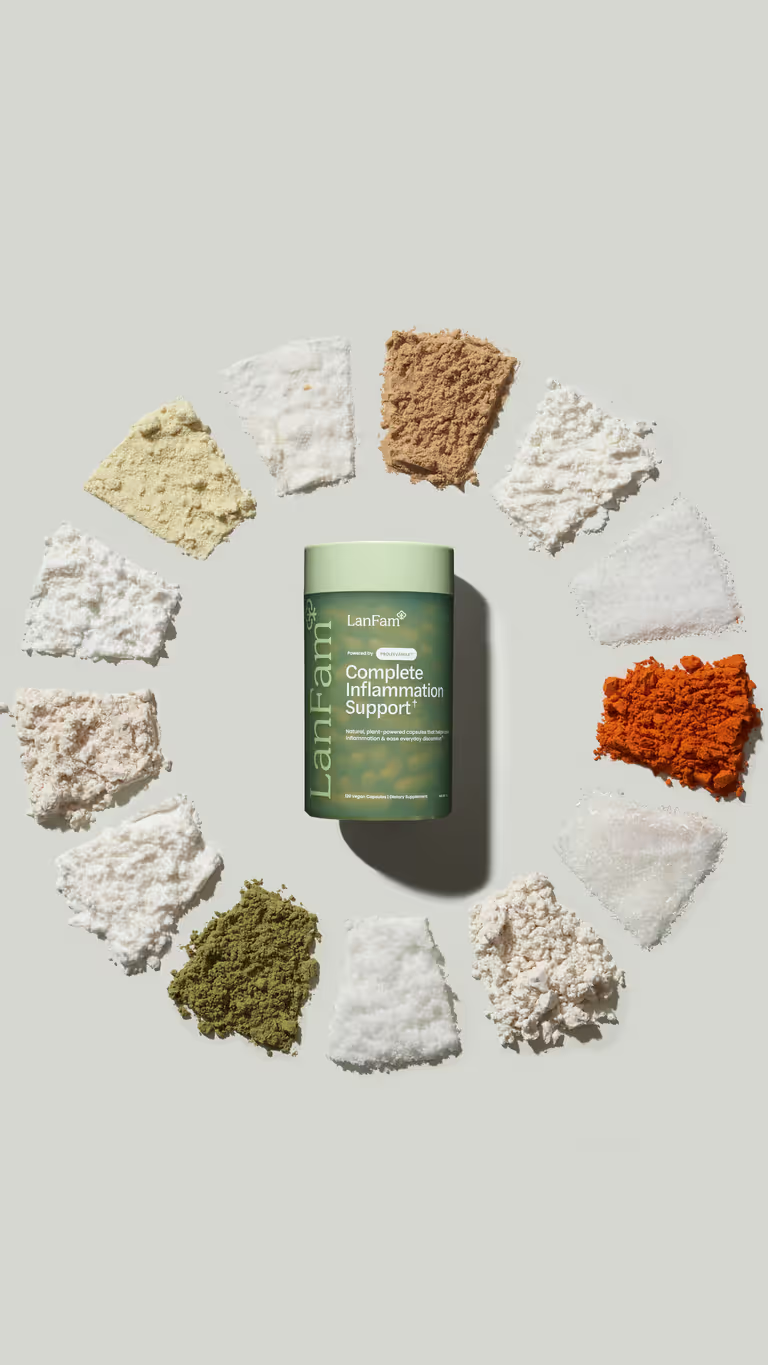
I built ProleevaMax for Maria, not as a replacement for the above — I want to be clear about that — but as a way to address the molecular mechanisms that diet, sleep, and movement alone may not fully cover.*
The formulation targets multiple nodes in the inflammatory cascade simultaneously: the NF-κB pathway, the COX-2 and 5-LOX eicosanoid branches, oxidative stress, and the gut-inflammation interface. The reason I care about the inflammaging data — specifically — is that it makes the multi-pathway logic more defensible. When you're trying to support the body's inflammatory regulation in the context of a slowly elevated baseline rather than an acute event, a single-ingredient approach to a single pathway is working against a distributed problem. The inflammaging research is one of the clearest arguments I know for thinking about the whole regulatory system, not just one part of it.
That said: if someone came to me tomorrow and asked whether they should take the formula or fix their sleep first, I'd say fix the sleep. The supplement is a support layer, not a substitute for the behaviors that do the most fundamental work on the baseline.*
Coming back to my friend
I spent about thirty minutes that afternoon walking her through the inflammaging concept — the slow-burning baseline, the centenarian data, what it means that both of her parents' conditions were related underneath the surface. She cried a little. I think what landed was not the science but the reframing: it wasn't random. There was a coherent process underneath it.
Then she asked what she could do. I told her what I always tell people: look at the list of modifiable variables and pick one. Not all of them — one. For her it was sleep, because she'd been running broken sleep for fifteen years and knew it. We agreed she'd start there and we'd talk again in sixty days.
That's where I'd leave you too. The inflammaging research is, at its core, a map of how biological aging works at the molecular level — and a map of where the levers are. Not every lever is equally accessible, and none of them work overnight. But the data from people who age well suggests they're working the levers consistently, over years, starting earlier than most of us think to start.
You have more time to use this information than you think you do. I'd start today.
— Fabio
* These statements have not been evaluated by the Food and Drug Administration. This product is not intended to diagnose, treat, cure, or prevent any disease.

References
- 2.Franceschi C, Bonafè M, Valensin S, Olivieri F, De Luca M, Ottaviani E, De Benedictis G. Inflamm-aging: an evolutionary perspective on immunosenescence. Ann N Y Acad Sci. 2000. https://doi.org/10.1111/j.1749-6632.2000.tb06651.x
- 3.Furman D, Campisi J, Verdin E, Carrera-Bastos P, Targ S, Franceschi C, Ferrucci L, Gilroy DW, Fasano A, Miller GW, Miller AH, Mantovani A, Weyand CM, Barzilai N, Goronzy JJ, Rando TA, Effros RB, Lucia A, Kleinstreuer N, Slavich GM. Chronic inflammation in the etiology of disease across the life span. Nat Med. 2019. https://doi.org/10.1038/s41591-019-0675-0
- 4.Saeedi P, Petersohn I, Salpea P, Malanda B, Karuranga S, Unwin N, Colagiuri S, Guariguata L, Motala AA, Ogurtsova K, Shaw JE, Bright D, Williams R; IDF Diabetes Atlas Committee. Global and regional diabetes prevalence estimates for 2019 and projections for 2030 and 2045: Results from the International Diabetes Federation Diabetes Atlas, 9th edition. Diabetes Res Clin Pract. 2019. https://doi.org/10.1016/j.diabres.2019.107843
- 5.Liu T, Zhang L, Joo D, Sun SC. NF-κB signaling in inflammation. Signal Transduct Target Ther. 2017. https://doi.org/10.1038/sigtrans.2017.23
- 6.Tanaka T, Narazaki M, Kishimoto T. IL-6 in inflammation, immunity, and disease. Cold Spring Harb Perspect Biol. 2014. https://doi.org/10.1101/cshperspect.a016295
- 7.Bradley JR. TNF-mediated inflammatory disease. J Pathol. 2008. https://doi.org/10.1002/path.2287
- 8.Serhan CN. Pro-resolving lipid mediators are leads for resolution physiology. Nature. 2014. https://doi.org/10.1038/nature13479

There's a seat at our table
Letters from our family to yours — the science, the recipes, the things that actually helped real families. Leave your email and we'll send the next one.