Curcumin vs. Turmeric: What the Absorption Science Actually Means for Your Supplement
Turmeric is the root; curcumin is the active compound inside it. Why the curcuminoid percentage and curcumin's poor bioavailability mean standardized extract plus an absorption strategy is what the research is actually about.

Someone asked me this last week, holding up two bottles — one said "turmeric," one said "curcumin" — and wanting to know if she'd accidentally bought the same thing twice. It's the right question, and almost everyone who reads supplement labels eventually asks it. The short version is that they're related but not interchangeable, and the difference is the entire reason some turmeric products do something and others don't.
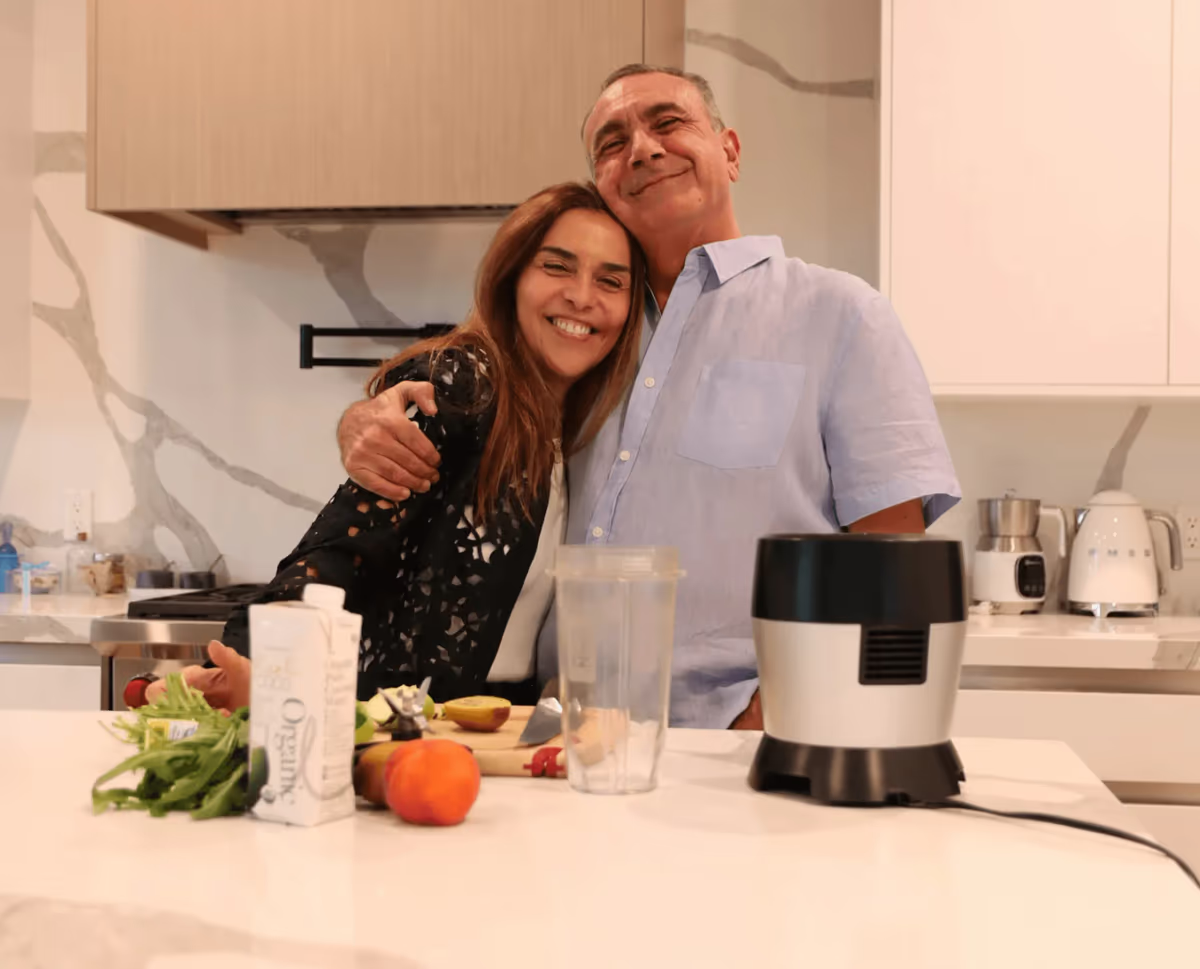
I'm Fabio. I spent forty years in pharmaceutical formulation before my wife's chronic pain pulled me into making a supplement at our kitchen table, and that career left me with one stubborn habit: I don't care what a compound can do in a test tube until I know how much of it actually reaches your bloodstream. Turmeric versus curcumin is, underneath the naming confusion, an absorption question. Let me walk you through it the way I'd explain it to a friend at that same table.
Why the percentage matters more than it sounds
Let's make the arithmetic concrete, because this is where good intentions go to die.
The trials that built curcumin's reputation for joint and inflammatory conditions generally used standardized extract in the range of 500 to 2,000 mg of curcuminoids per day.³ In one of the cleaner head-to-head studies, Kuptniratsaikul and colleagues compared 1,500 mg/day of standardized Curcuma domestica extract against ibuprofen in knee osteoarthritis patients over four weeks — the curcumin arm held its own on pain and function scores.⁴
Now run the kitchen math. If turmeric root is, generously, around 3% curcuminoids by weight,¹ then reaching even 1,000 mg of curcuminoids from raw turmeric would require on the order of 30+ grams of turmeric powder a day — many heaping tablespoons, every day, indefinitely. Nobody eats turmeric like that, and your gut wouldn't be happy if you tried. That is the gap between turmeric as a healthy spice and curcumin as a studied intervention. It isn't that food turmeric is worthless — it's that you can't reach trial-level doses through the spice rack. The arthritis and rheumatology community makes the same point when it cautions that turmeric as a culinary spice is unlikely to meaningfully change joint symptoms on its own. That caution is correct — and it's precisely the argument for a standardized extract rather than against curcumin itself.
The second problem: even pure curcumin barely absorbs
Here's the part that separates people who understand this molecule from people who just print "turmeric" on a label in a bigger font.
Even when you take concentrated curcumin, very little of it gets into your bloodstream on its own. Curcumin is poorly soluble and is rapidly metabolized in the liver and intestinal wall, so a large oral dose can produce serum levels that are low or, in some studies, barely detectable.² This is the well-documented bioavailability problem, and it's the reason two products with the same milligrams of curcumin can behave completely differently in your body.
The landmark study here is Shoba and colleagues, 1998. They gave human volunteers 2 grams of curcumin alone — and measured serum levels that were undetectable or very low. Then they gave the same curcumin with just 20 mg of piperine, the active compound in black pepper. Curcumin absorption rose by 2,000%.² Piperine works by slowing the liver and intestinal enzymes that would otherwise clear curcumin before it can be used, so more of what you swallow stays in circulation long enough to matter.
Twenty milligrams. One small pairing. A twenty-fold difference in how much active compound reaches your blood. That is what "formulation" means, and it's why I won't make a curcumin product without solving absorption.
What works, and what doesn't — honestly
I want to be straight with you here, including about my own ingredient choices, because the absorption field is more nuanced than "just add black pepper."
What's settled:
- Plain turmeric powder is the weakest delivery. Low curcumin percentage and low absorption of what little is there. Good food; poor therapeutic vehicle.¹ ²
- Standardized extract clears the dosing problem. 95% curcuminoids gets you to trial-relevant amounts in a capsule instead of a soup pot.²
- An absorption strategy is non-negotiable. Curcumin without an absorption fix is, for most people, an expensive way to make yellow urine.²
Where the honesty comes in: piperine is the best-known absorption enhancer, but it is not the only one, and a careful 2021 head-to-head trial by Flory and colleagues compared several strategies — piperine adjuvants, phytosome complexes, micellar formulations, cyclodextrin complexes — and found that the largest bioavailability gains came from micellar and cyclodextrin formulations, with the biggest jumps tied to improving curcumin's post-digestive solubility rather than only blocking its breakdown.⁵ In other words: piperine is real and well-evidenced (Shoba's 2,000% is not a typo), but it's one valid tool among several, and the newer data suggests solubility-focused formulations can do even more. A formulator who tells you piperine is the only answer is oversimplifying. A formulator who tells you absorption doesn't matter is selling you spice.
I'd rather you walk away knowing the real shape of the evidence than a tidy slogan.
So what should you actually look for on a label?
Three things, in order:
- Does it say "curcumin" or "curcuminoids" with a standardization percentage (e.g., "95% curcuminoids")? If the label only says "turmeric powder" with no curcuminoid figure, you're buying spice-aisle inventory at supplement prices.
- Is there an absorption strategy — piperine/black pepper extract, a phytosome, or a micellar/solubility-enhanced form? Without one, the milligrams on the front are mostly theoretical.²
- Is the dose in the studied range — somewhere in the 500–2,000 mg/day curcuminoid neighborhood that the trials used?³ ⁴
If a product checks those three boxes, the underlying trial evidence for curcumin in inflammatory and joint conditions — supported by meta-analyses of randomized trials — actually becomes reachable for you, rather than something that happened to other people in a study.⁶
Where this lands for us
This is the formulation logic behind ProleevaMax. We use standardized 95% curcuminoid curcumin — the form the trials used — paired with piperine to address the absorption problem, because curcumin without an absorption strategy is, as I said, mostly theater. Curcumin anchors what we think of as the inflammatory-signaling part of the formula, where its mechanism of modulating inflammatory pathways is best characterized.
I'll leave the product talk there. The reason I wrote this isn't to move a bottle — it's because "turmeric vs. curcumin" is one of the most common honest confusions in this whole category, and the answer is genuinely useful whether or not you ever buy anything from my family. Standardized curcumin, at a real dose, with absorption solved. That's the whole story in one line.
Frequently Asked Questions
Is turmeric the same as curcumin? No. Turmeric is the root of the Curcuma longa plant — the spice. Curcumin is the principal active compound found within turmeric, making up only a small fraction of the root by weight (commonly cited around 2–9%).¹ Clinical research on inflammation almost always uses a standardized curcumin extract, not raw turmeric powder.²
Can I just eat turmeric instead of taking a curcumin supplement? For general healthy eating, turmeric is a fine spice. But you can't realistically reach the doses used in clinical trials — roughly 500–2,000 mg of curcuminoids a day — through food, because turmeric is only a few percent curcumin by weight.¹ ³ Reaching even 1,000 mg of curcuminoids would take many tablespoons of turmeric powder daily. That's the gap between turmeric as food and curcumin as a studied intervention.
Why does curcumin need black pepper (piperine)? Because curcumin on its own absorbs poorly and is cleared quickly by the liver and intestine. In a landmark human study, adding just 20 mg of piperine (the active in black pepper) increased curcumin absorption by 2,000%.² Piperine slows the enzymes that would otherwise break curcumin down before your body can use it.
Is curcumin extract better than turmeric for inflammation? For reaching the doses studied in inflammatory and joint conditions, yes — a standardized extract delivers far more active curcumin than the spice, and meta-analyses of randomized trials support curcumin's role at those doses.⁶ But the extract only matters if absorption is addressed too; standardized curcumin with no absorption strategy still absorbs poorly.²
Is black pepper the only way to improve curcumin absorption? No — and this is where the science has moved. Piperine is the best-known and well-evidenced approach, but a 2021 head-to-head trial found micellar and cyclodextrin formulations produced the largest absorption gains, largely by improving curcumin's solubility after digestion.⁵ Piperine is one valid, well-studied tool among several.
For the practical dosing question — how much curcumin, how often, and over what timeframe — read curcumin dosage for inflammation. The absorption story has its own deeper read at piperine: benefits and how it works. If you're weighing curcumin against everything else on the shelf, the best anti-inflammatory supplement puts it in context, and if you came here from the NSAID question, curcumin vs. ibuprofen is the one to read next.
Turmeric is food. Curcumin is the active inside it. Standardized, dosed correctly, and absorbed — that's the version the research is actually about.
— Fabio
These statements have not been evaluated by the Food and Drug Administration. This product is not intended to diagnose, treat, cure, or prevent any disease.

References
- 2.Hewlings SJ, Kalman DS. Curcumin: A Review of Its Effects on Human Health. Foods. 2017. https://doi.org/10.3390/foods6100092
- 3.Shoba G, Joy D, Joseph T, Majeed M, Rajendran R, Srinivas PSSR. Influence of piperine on the pharmacokinetics of curcumin in animals and human volunteers. Planta Med. 1998. https://doi.org/10.1055/s-2006-957450
- 4.Gupta SC, Patchva S, Aggarwal BB. Therapeutic roles of curcumin: lessons learned from clinical trials. AAPS J. 2013. https://doi.org/10.1208/s12248-012-9432-8
- 5.Kuptniratsaikul V, Dajpratham P, Taechaarpornkul W, et al. Efficacy and safety of Curcuma domestica extracts compared with ibuprofen in patients with knee osteoarthritis: a multicenter study. Clin Interv Aging. 2014. https://doi.org/10.2147/CIA.S58535
- 6.Flory S, Sus N, Haas K, et al. Increasing post-digestive solubility of curcumin is the most successful strategy to improve its oral bioavailability: a randomized cross-over trial in healthy adults and in vitro bioaccessibility experiments. Mol Nutr Food Res. 2021. https://doi.org/10.1002/mnfr.202100613
- 7.Daily JW, Yang M, Park S. Efficacy of turmeric extracts and curcumin for alleviating the symptoms of joint arthritis: a systematic review and meta-analysis of randomized clinical trials. J Med Food. 2016. https://doi.org/10.1089/jmf.2016.3705
There's a seat at our table
Letters from our family to yours — the science, the recipes, the things that actually helped real families. Leave your email and we'll send the next one.