Tropical Turmeric Anti-Inflammatory Smoothie
A creamy tropical smoothie of mango, peach, pineapple, and turmeric — with the one black-pepper trick that lets your body actually absorb the curcumin.
The Recipe
- Prep
- 8 min
- Cook
- None
- Total
- 8 min
- Serves
- 2
Yield · About 4 2/3 cups (two glasses, ~2 1/3 cups each)
Ingredients
- 2 1/2 cups unsweetened refrigerated coconut milk beverage
- 1 cup frozen mango chunks
- 1 cup frozen sliced peaches
- 3/4 cup frozen pineapple chunks
- 1/2 cup whole-milk plain Greek yogurt (see the dairy-free swap below)
- 1/3 cup chopped pitted Medjool dates (about 3)
- 2 tbsp chia seeds
- 1 1/2 tsp grated fresh ginger
- 1 tsp ground turmeric
- 1 small pinch ground black pepper (do not skip — see below)
Instructions
- 1
Add the coconut milk beverage, mango, peach, pineapple, Greek yogurt, dates, chia seeds, ginger, turmeric, and the pinch of black pepper to a blender.
- 2
Blend on high until completely smooth, about 2 minutes, stopping once or twice to scrape down the sides.
- 3
Divide between two glasses, about 2 1/3 cups each.
Nutrition · per serving
- Calories
- 397
- Protein
- 10 g
- Carbohydrate
- 67 g
- Fat
- 13 g
- Fiber
- 10 g
- Sugar
- 50 g
- Sodium
- 40 mg
Variations & swaps
- Don't skip the black pepper — It's the one ingredient that lets your body absorb the curcumin — leave it out and most of the turmeric goes to waste.[2]
- For a dairy-free / vegan version, swap the Greek yogurt for a plant-based plain yogurt or 1/4 of a ripe avocado for the same creaminess.
- Use papaya in place of the peaches — it brings papain, an enzyme in the same family as pineapple's bromelain, plus its own tropical sweetness.
- Any unsweetened plant milk works in place of coconut — almond, soy, and oat all blend well; soy adds the most protein.
- Pour leftovers into an ice-cube tray and freeze; drop the cubes straight into your next smoothie so nothing's wasted.
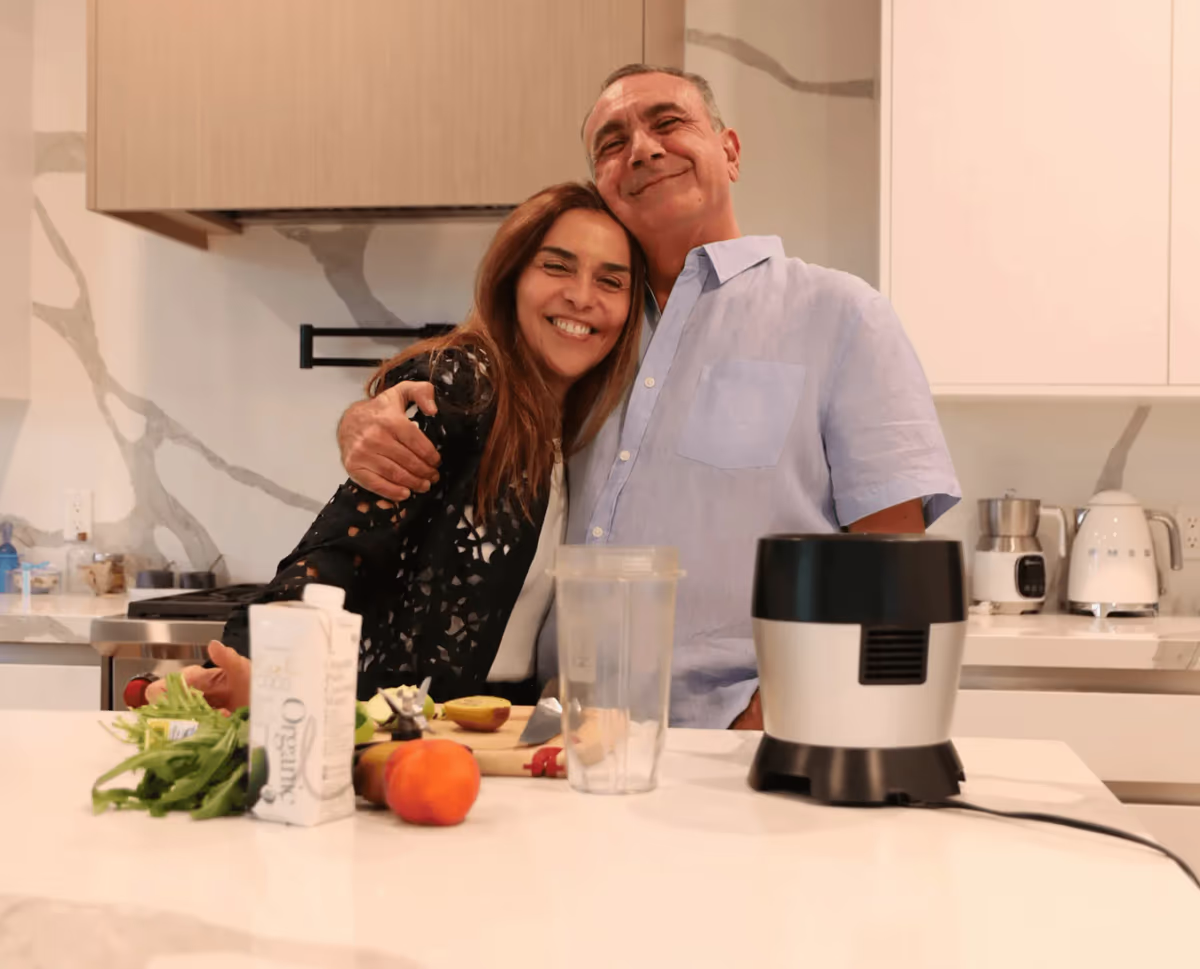
Here's the thing nobody tells you about turmeric: you can stir a teaspoon into everything you eat and your body will let almost all of it walk right back out the door. I didn't know that for the first year I was adding it to smoothies. Fabio finally sat me down and explained it, the way he does, and it genuinely changed how I cook.
The fix is almost insultingly simple — a pinch of black pepper. Fabio taught me that the black pepper holds the door open so far more of the turmeric actually gets absorbed. The numbers from the study he showed me were not subtle. So now there's a little black pepper in this smoothie, you will not taste it, and it is the single most important thing in the recipe.
The rest is a tropical vacation in a glass — mango, peach, pineapple, a little Greek yogurt for body, dates for sweetness so there's no added sugar. It makes two, which is the real reason it lives in our rotation: one for me, one for whoever's in the kitchen.
Why This Smoothie Fights Inflammation
The plainspoken version: these are foods, not medicine, and no smoothie can treat or prevent a condition. What this glass does is deliver a daily, food-level dose of plant compounds researchers study for calming inflammation — and, in turmeric's case, do it in a way your body can actually use. Turmeric's active compound, curcumin, is one of the most-studied plant compounds here. The catch: on its own it's poorly absorbed. Black pepper fixes that — a pinch raises absorption dramatically (studies have measured roughly a 2,000% jump), which is why the pepper is non-negotiable, and it's the same turmeric-plus-pepper pairing inside ProleevaMax.[1][2] Around that hero pairing, pineapple adds bromelain, the fresh ginger adds gingerols, the mango adds mangiferin, and the chia adds a little plant omega-3. Worth drinking regularly — not as a fix, but as a reliable daily source.
Getting the Full Dose
The research is consistent on one point: curcumin and the other compounds here show their clearest, most measurable effects at concentrated, steady doses — generally more than a teaspoon of turmeric in a shared smoothie provides, even with the pepper trick maximizing what you absorb. A daily glass is a real and worthwhile source; it simply sits below the levels most studies used. That's precisely the gap ProleevaMax was built to close — it pairs standardized Curcumin with Piperine at the same labeled doses every day, so the absorption boost you get from a kitchen pinch of pepper becomes something measured and repeatable. Make the smoothie because it's delicious. Let the supplement handle the dose.
If you take one thing from me, let it be the pepper. It's the difference between turmeric that does something and turmeric that's just pretty and yellow. Make this for two, hand the second glass to someone you love, and tell them the black-pepper story — it's the kind of thing that makes people actually change how they cook. That's how it worked on me.

References
- 1.Zhou H, Beevers CS, Huang S. Targets of curcumin. Curr Drug Targets. 2011. https://doi.org/10.2174/138945011794815356
- 2.Shoba G, Joy D, Joseph T, et al. Influence of piperine on the pharmacokinetics of curcumin in animals and human volunteers. Planta Med. 1998. https://doi.org/10.1055/s-2006-957450
- 3.Insuan O, Janchai P, Thongchuai B, et al. Anti-Inflammatory Effect of Pineapple Rhizome Bromelain through Downregulation of the NF-kB- and MAPKs-Signaling Pathways in Lipopolysaccharide (LPS)-Stimulated RAW264.7 Cells. Curr Issues Mol Biol. 2021. https://doi.org/10.3390/cimb43010008
- 4.van Breemen RB, Tao Y, Li W. Cyclooxygenase-2 inhibitors in ginger (Zingiber officinale). Fitoterapia. 2011. https://doi.org/10.1016/j.fitote.2010.09.004
- 5.Dou W, Zhang J, Ren G, et al. Mangiferin attenuates the symptoms of dextran sulfate sodium-induced colitis in mice via NF-kB and MAPK signaling inactivation. Int Immunopharmacol. 2014. https://doi.org/10.1016/j.intimp.2014.08.025
- 6.Elisia I, Yeung M, Kowalski S, et al. Omega 3 supplementation reduces C-reactive protein, prostaglandin E2 and the granulocyte/lymphocyte ratio in heavy smokers: An open-label randomized crossover trial. Front Nutr. 2022. https://doi.org/10.3389/fnut.2022.1051418
Frequently asked questions
There's a seat at our table
Letters from our family to yours — the science, the recipes, the things that actually helped real families. Leave your email and we'll send the next one.